


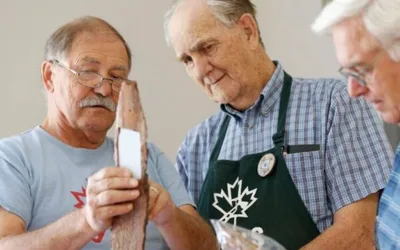
On a Thursday morning this September, a handful of men will fold into the Pat Porter Active Living Centre in Steinbach, not for a fitness class or a committee meeting, but for something far simpler and rarer: a place to just be among men, coffee in hand, tools and cards on a table, no agenda beyond connection. This is the Steinbach chapter of Manitoba Men's Sheds, a free, drop-in gathering that meets every Thursday from 9 a.m. to noon, and it may look unremarkable from the outside — but its roots run deep, all the way to a small town in South Australia where a coordinator for an activities centre for the elderly watched her own father sink into loneliness after retirement.
The man behind Steinbach's chapter is Abe Sawatzky, a local organizer whose journey started with a scroll through Facebook. "I saw an ad on Facebook about Men's Shed, and I said, 'Oh, that might be something interesting to start a chapter in Steinbach,'" Sawatzky told SteinbachOnline. That single spark has grown into a regular gathering, one that Manitoba Men's Sheds hopes will become a permanent anchor for men in the southeast who are navigating life changes — retirement, loss of routine, the slow drift of old friendships — and looking for a place to land.
Men's Sheds is, at its heart, a global movement born from a simple observation: men don't talk face to face; they talk shoulder to shoulder. That phrase, shortened to the movement's slogan "Shoulder to Shoulder," was adopted after the 2008 Australian Men's Shed Association conference, and it captures something profound about how men connect. Put a man in a room with a coffee and a woodworking project, and the conversation flows sideways — over the grain of a board, between hands of cards, in the comfortable silence of shared work. The shed, whether literal or metaphorical, becomes a space where men can open up without the pressure of eye contact and forced intimacy.
The movement's origin story is, appropriately, a story about one woman's empathy. In the early 1990s, Maxine Chaseling was coordinating an activities centre for the elderly in Goolwa, South Australia, a small town along the Murray River. Her father, a retired man, had fallen into depression after his working life ended, his identity and purpose stripped away. Chaseling recognized that pattern in other retired men she served — skilled, capable men with decades of knowledge who had no place to go and no one to tinker alongside. So she started a shed, a space where older men could gather, work with their hands, and talk in their own way. That first shed, established in 1993, became the seed of a worldwide phenomenon. Today, Men's Sheds number in the thousands across Australia, New Zealand, the UK, Ireland, Finland, Estonia, Greece, and Canada.
In Canada, the movement found a champion in Doug Mackie, a Winnipegger who founded a Men's Shed in his city and became associated with the Canadian Men's Shed Association. Mackie's Winnipeg shed became a proof point for the movement in Manitoba, demonstrating that the Australian model could transplant to the Prairies. Manitoba Men's Sheds has since grown to serve communities across the province, and its website carries a welcoming ethos: "We don't care who you were; we care who you are today."
Steinbach, a city in Manitoba's Eastman region, is a fitting home for a Men's Shed. Founded in 1874 by Plautdietsch-speaking Mennonite settlers from Ukraine, the city has deep roots in mutual aid, community self-reliance, and craftsmanship — values that echo the Men's Shed ethos. Over generations, Steinbach has grown from a farming settlement into a thriving city, with a strong evangelical and Mennonite heritage that prizes neighbourliness and practical skill. For men retiring from farms, trades, and businesses in this region, the transition can be stark: a lifetime of purpose, suddenly unmoored. The Men's Shed offers a gentle counterweight.
The Steinbach chapter, as Sawatzky describes it, is intentionally unstructured. "The group has not yet established a formal structure, but it is already meeting regularly," he said. Activities vary from shed to shed, with each group deciding what fits its members. In Steinbach, those possibilities include wood carving, playing cards or other games, and simply gathering over coffee and conversation. The emphasis, Sawatzky stressed, is not on productivity but on relationship: "Men getting to know each other, maybe share some skills or activities that we have a common interest in." The shed is a place where a retired electrician can teach a younger man to whittle, where a widower can find a table of cards on a quiet Thursday, where a man who has felt invisible can be seen again.
The Pat Porter Active Living Centre, located at 10 Chrysler Gate, is the venue for this gathering — a modern facility designed for active living, with space for everything from pickleball to community programs. Its bright, open rooms offer a comfortable, welcoming environment for the men's meetup, low-barrier and accessible to all. The drop-in format means no membership fees, no paperwork, no commitment — just show up and see. That low barrier is precisely the point. For men who have spent decades in workplaces where they were expected to be self-sufficient, the act of walking into a room of strangers can feel monumental. The shed takes away the friction.
The Steinbach chapter's launch is part of a broader wave of growth for Men's Sheds in Canada. When Mackie founded that first Winnipeg shed, the movement was barely known on this side of the ocean. Today there are dozens of sheds across the country, each adapting the Australian model to its own community. The movement's appeal lies in its simplicity: a space, a time, a group of men, and permission to just be together. No therapists, no curricula, no performance metrics. Just wood, cards, coffee, and conversation — though its advocates argue the health benefits are real and measurable, a kind of "health by stealth."
On September 16, 2026, the Steinbach Men's Shed will hold its Thursday morning meetup, and the door will be open to all men. There is no grand fanfare planned, no ribbon-cutting. There will simply be a room at the Pat Porter Active Living Centre where men can gather, perhaps to carve a piece of wood, perhaps to lose a hand of cards, perhaps to sit quietly with a coffee and let the conversation find them. For Abe Sawatzky, the project is about something deeply human: giving men in the southeast a place to connect, share skills, and build friendships that might just carry them through the next chapter of their lives. It is, in the truest sense, a shed — four walls, a roof, and a world of meaning inside them.