


The date on the calendar is a little off, and that is worth noticing. World Spine Day is officially observed every October 16, a global awareness campaign. But the Manitoba Chiropractors Association is throwing its celebration at The Forks on Sunday, October 4, 2026, from 10 a.m. to 3 p.m. — twelve days ahead of the rest of the world. The reason is practical rather than symbolic: a free, family-friendly outdoor festival in Winnipeg in mid-October is a gamble against the weather, and an early-autumn Sunday at the city's most-visited historic site is a far safer bet.
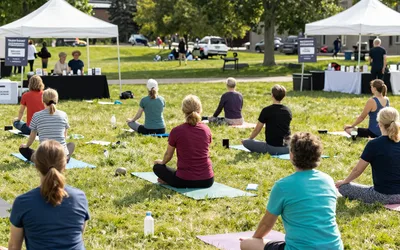
What the association has planned is less a lecture than a fairground for the back. There will be interactive movement demonstrations, activities pitched at every age, community partner booths, and sessions of yoga, tai chi and general fitness. The pitch is deliberately low-barrier: no registration, no fee, no commitment. Stop by for one activity or spend the whole day. The framing, according to the association's own materials, is that spinal health is a lifelong project rather than a response to a crisis — something to tend to at every stage of life, from infants to older adults.
The event lands at a site with a much longer history of gathering people than any health campaign could claim. The Forks takes its name from the point where the Assiniboine River empties into the Red, and archaeological digs carried out between 1989 and 1994 turned up a 6,000-year-old hearth along with catfish bones, stone tool flakes and the remains of numerous later campsites. Aboriginal bison hunters used the spot long before Europeans arrived by canoe in 1738, when La Vérendrye built Fort Rouge nearby. Nakoda, Cree, Anishinaabe and Dakota peoples passed through the junction, which became the hub of the fur trade until the 1880s. Then came the railways — the Northern Pacific and Manitoba Railway, the Canadian Northern, the Grand Trunk Pacific — and the site spent much of the twentieth century as a rail yard before being reborn as the interpretive park, market and public square that Winnipeggers know today. It was designated a National Historic Site in 1974.
That history is a fitting backdrop for a day about spines, because the modern case for spinal health is largely a story about what people stopped doing. World Spine Day organizers estimate that roughly one billion people worldwide live with spinal pain, and that it is the single biggest cause of disability on the planet. The campaign's earliest theme was "Straighten Up and Move," a slogan aimed squarely at posture and daily activity. The 2026 theme is broader: "Spine Health for Life," with a call to build a global culture that values spinal wellbeing at every age.
The Manitoba association has been pushing a similar message locally, arguing that chiropractic care is not just for adults with chronic back pain. In its public communications it points to infants and toddlers dealing with biomechanical stress from birth, school-aged children lugging heavy backpacks and hunching over screens, athletes looking to correct imbalances and prevent injury, and older adults managing joint stiffness and balance. It also cites a striking statistic about modern screen habits: using a phone with a hunched-forward posture can put as much as thirty pounds of extra strain on the spine, and Canadians average more than six and a half hours online each day. The association says more than 300,000 Manitobans seek chiropractic care each year.
It is worth being clear about what this event is and is not. It is a public health awareness festival hosted by a professional association with an obvious interest in promoting its members' services. It is not a clinical trial, and the claims made on the day will be the association's own. But the format — free, outdoors, no registration, mixing yoga and tai chi with booths from community health and wellness organizations — is an unusual one for a medical awareness campaign, which more often takes the form of a screening clinic or a sponsored walk. The choice to stage it at The Forks, a site that functions as Winnipeg's default public square, suggests the organizers are aiming at the casually curious rather than the already converted.
For anyone who shows up, the practical offering is simple: a few hours of guided movement, some information about posture and activity, and the chance to try tai chi or yoga without signing up for a class. The deeper argument, repeated across the World Spine Day campaign and echoed by the Manitoba association, is that back pain is not an inevitable feature of aging or desk work — that posture, activity and ergonomics are things people can actually change. Whether a Sunday at The Forks changes anyone's spine is unprovable. But as a way to spend an early-October afternoon at a place where people have been gathering for six millennia, it is a reasonable proposition.