


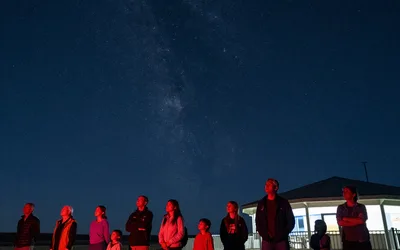
On the first Friday of October, as the light drains out of the Kiche Manitou day-use area and the sand hills go quiet, a park interpreter will stand up in the Spruce Woods Visitor Centre and ask a room full of people to think about darkness. Not as an absence, but as a resource — one that is quietly disappearing from most of the places we live.
The program is called Dark Skies for Wild and Eye, and it runs from 7 to 8 p.m. on October 2, 2026, opening a weekend the park is billing as Park After Dark. It is free, as all Manitoba Parks interpretive programming is, and open to anyone who shows up. The subject is the Spruce Woods Dark-sky Preserve designation — how the park got it, what it actually protects, and why a sky with fewer lights in it matters to more than just astronomers.
That designation is younger than most people assume. Spruce Woods was declared a Dark-Sky Preserve on September 4, 2022, in a partnership between Manitoba Environment, Climate and Parks, the Winnipeg Centre of the Royal Astronomical Society of Canada, and the Friends of Spruce Woods, the non-profit that supports the park and runs its gift shop. It was the first RASC-designated dark-sky site in Manitoba. When the news broke, Environment, Climate and Parks Minister Jeff Wharton framed it as a commitment to preserving nighttime ecosystems and teaching visitors about light pollution. Spruce Woods joined a roster of dark-sky preserves across Canada that then numbered in the low thirties, including thirteen national parks.
The park did not have to reach far to qualify. It was already known for having some of the highest-quality night skies in southern Manitoba, drawing amateur stargazers and professional astronomers alike. But a designation is not just a compliment. It comes with guidelines, and the park had to meet them: capping artificial light, and committing to interpretive programming — night hikes, night-ecology talks, exactly the kind of thing happening on October 2. In the parts of Spruce Woods that genuinely need light for safety, security or navigation, the park installed dark-sky-compliant fixtures that use low wattage, fitted with amber-coloured lamps and shields that throw their light downward instead of scattering it into the sky.
That last detail is the whole point, and it is where the program's title earns its double meaning. Light pollution is not only a problem for people who want to see stars. Many plants, wildlife and insects depend on darkness to forage, breed and navigate. Artificial light at night disrupts those behaviours in ways that are easy to ignore and hard to undo. Protecting a dark sky, then, is not a hobbyist's indulgence; it is habitat protection that happens to be invisible during the day.
The story of how Spruce Woods got here is partly a story about a small group of people who would not let the idea go. The Friends of Spruce Woods were central to the effort, and the Winnipeg RASC Centre supplied the astronomical muscle and the volunteer hours. The centre's biggest members-only event of the year, the Spruce Woods Star Party, is a weekend of stargazing held inside the preserve — a gathering that has become a fixture for Manitoba astronomers, complete with a solar-scope tour and what regulars describe as the most popular feature of the whole weekend, a binocular tour led by amateur astronomer Gerry Smerchanski.
Smerchanski is worth knowing about, because he is the thread connecting Spruce Woods to the broader campaign. He appears in Dark Skies, a 44-minute documentary directed by Winnipeg filmmaker Tyler Funk for CBC's Absolutely Canadian series, which makes the case for a second dark-sky preserve in Manitoba — a roughly 190-square-kilometre area north of Highway 201, between Stuartburn and Vita, about 100 kilometres southeast of Winnipeg. Funk has described the film as "a love letter to the sky, to the dark sky." During filming, he learned that Spruce Woods had become a preserve in 2022.
Smerchanski's argument, as he put it to CBC, is that light pollution is unusual among environmental problems because it is so easily solved. "This is the one form of pollution we can just do something about by just not doing anything," he said — "by just refusing to participate in something that's detrimental." It is, in other words, a problem that yields to turning off a switch.
That is a hopeful message to carry into a fall evening in the sand hills, and it is the message the October 2 program is built around. The Spruce Woods Visitor Centre is the province's premier interpretive centre, built jointly by the Province of Manitoba and the Friends of Spruce Woods. Its exhibit building walks visitors through the landscape's deep history — its formation as a delta in glacial Lake Agassiz, the arrival of Indigenous peoples, fur traders and settlers — and its displays cover the park's uncommon natural communities: Spirit Sands, the oxbow lakes, the mixed-grass prairie. Live specimens on site include the endangered western hognose snake and the northern prairie skink, Manitoba's only lizard. The centre sits in the Kiche Manitou day-use area, near the main campground and the trailhead to Spirit Sands, which makes it an easy stop before an evening program.
It is also worth saying plainly what this evening is and is not. It is a talk, not an observing session — an hour indoors exploring the story of the designation, the effects of light pollution on people and wild places, and the value of preserving the night sky. Anyone hoping to look through a telescope should check the park's wider Park After Dark schedule. And anyone planning to attend should confirm the details before driving out: the event appears on the Discover Westman community events listing, which points to the park's interpretive programming page and gives the park's interpretation line, 204-827-8850, and email, [email protected], for more information. The province's own interpretive events page notes that interpretive events are always free of charge and that everyone is welcome, but it highlights only selected programs, so the specific listing may not appear there. A phone call is the surest way to confirm.
What is not in doubt is the ground the talk stands on. Spruce Woods encompasses 269 square kilometres of the Assiniboine Delta Natural Region, land shaped by a retreating glacier and now holding spruce parkland, upland deciduous forest, mixed-grass prairie, river-bottom forest and open sand dunes. The Assiniboine River runs through it, along with eleven oxbow lakes, the Devils Punch Bowl — a depression in the hills carved by underground streams — and Spirit Sands, the desert-like dune field named in recognition of its religious significance to Indigenous inhabitants. Elk move through it. The northern prairie skink skitters through it. Cacti grow in it. It is, by any measure, an unlikely place to find a dark-sky preserve, and an obvious one once you stand in it after sundown.
The area's human history runs just as deep. The Clovis and Woodlands peoples lived here roughly 11,000 and 2,000 years ago respectively, followed by the Assiniboine, Cree and Anishinabe (Ojibwe) peoples. The land was also once home to Fort des Epinettes, a Northwest Company trading post. The park sits on Treaty No. 1 Territory and the Homeland of the Red River Métis. A program about preserving darkness, in other words, is also a program about a very long human relationship with this particular patch of prairie and sand — one in which the night sky was never an afterthought.
That is the thread the interpreter will pull on October 2. For an hour, in a building full of exhibits about glaciers and snakes and fur traders, the subject will be something you cannot put in a display case: the dark itself, and the fact that in one corner of Manitoba it is still possible to look up and see what everyone used to see. The Park After Dark weekend begins there. So, in a small way, does the argument that the rest of the province could follow.