


The lava that once poured down the Callaghan Valley near Whistler is gone from living memory. It erupted during the Late Pleistocene, long before anyone was around to watch, and it left behind a sprawling field of dark basalt that geologists have been picking apart ever since. On Tuesday, October 6, a researcher who has spent years studying those rocks will come to Brandon University to explain what they reveal about how volcanoes behave when mountains, ice, and water get in the way.
Dr. Annie Borch of the University of British Columbia will speak at 1 p.m. in Room 4-47 of the John R. Brodie Science Centre as part of the university's Science Seminar Series. Her talk, "Volcanic Eruptions in Complex Mountain Drainages," is free and open to the public, and will also be available online for those who cannot attend in person. Those wanting details can email [email protected].
The subject is less esoteric than it might sound. Borch is a volcanologist whose work focuses on the Garibaldi Volcanic Belt, a northwest-to-southeast chain of volcanoes running through the Pacific Ranges of the Coast Mountains in southwestern British Columbia. It is the same belt that includes Mount Garibaldi, known to the Squamish Nation as Nch'kay, which has been assigned the highest threat ranking of any volcano in Canada. The belt has erupted episodically for roughly two million years, and its recent geological record includes several Pleistocene-to-Holocene eruptions that sent lava flowing down valleys rather than simply piling up around a summit.
That valley-filling behavior is the heart of Borch's research. In a 2023 paper published in the Canadian Journal of Earth Sciences, she and her co-authors described the Cheakamus basalts, a set of valley-filling lavas that erupted from a vent near present-day Conflict Lake in the alpine Callaghan Valley. The flows were voluminous -- about 1.65 cubic kilometres of rock -- and the study concluded they represented a rapid, continuous eruption within a mountainous drainage system. In plain terms, the lava did not trickle out over centuries. It moved through a landscape of steep valleys and confining ridges in a way that shaped where it went and how far it reached.
Borch's broader interest is the two-way relationship between volcanoes and the environments they erupt into. As she describes it, she studies how paleoenvironments affect volcanic eruptions and, in turn, how volcanic activity reshapes landscapes over time. Her approach is deliberately multidisciplinary: field mapping, paleomagnetic studies, remote sensing, and spatial analysis all feed into the work. She completed a master's degree at UBC and is now a PhD candidate there, supervised by Dr. Kelly Russell, one of the foremost researchers on glaciovolcanism and a longtime student of the Garibaldi belt. Her doctoral thesis defense, scheduled for August 2026, carried the same title as Tuesday's talk.
Her path to volcanology ran through industry before it ran through academia. Borch worked in mineral exploration for several years before returning to graduate school, a detour she has described as formative but constraining. What she wanted, she has said, was time to observe, to sketch, and to walk another five minutes to see the other side of a rock outcrop just for curiosity's sake. Graduate research gave her that. She has also credited her undergraduate years at Quest University in Squamish, British Columbia, with making the Garibaldi belt feel like home ground -- a place of steep glaciated fjords, looming volcanoes, and lava flows perched in hanging valleys.
The phrase "forensic volcanology" captures what she does. Because no one witnessed the Cheakamus eruptions, the evidence has to be reconstructed from the deposits themselves: the chemistry and mineralogy of the rock, the magnetic signatures locked in as lava cooled, the shape of the terrain it flowed across. Read carefully, those clues can establish not just when a volcano erupted but how fast, how long, and along which routes the lava travelled. That kind of reconstruction matters for hazard assessment, because the past behavior of a volcanic system is often the best available guide to what it might do next.
Brandon University's Science Seminar Series has been running for well over a decade, bringing outside researchers to campus for talks that range across chemistry, biology, mathematics, and the earth sciences. Sessions have historically been held in the Brodie building, and recordings have been posted to a departmental YouTube channel, extending their reach beyond the room. The series is a quiet institution on a campus where the sciences have deep roots.
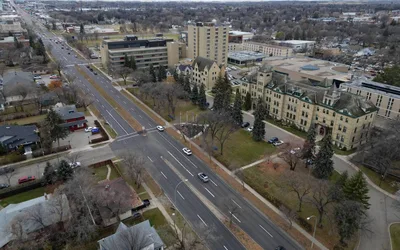
The Brodie Science Centre itself dates to a period of unusual ambition at the university. Construction began with a sod-turning ceremony on May 26, 1970, and Queen Elizabeth II visited the site that July, leaving a commemorative stone behind. The building opened to students and staff on May 8, 1972, and at 137,000 square feet across roughly five and a half floors, it remains the physical centre of science at Brandon University. It is named for John Robert Brodie, a Quebec-born businessman who arrived in Brandon in 1902, ran a grain brokerage, bought a silver mine in Cobalt, Ontario, and founded The Great West Coal Company in Winnipeg. He was, by one account, an avid hockey player who may have skated on Montreal teams that won the Stanley Cup and world championship in 1901 and 1902.
More than half a century after the Brodie building opened, the university has been weighing a major renewal of the facility, which no longer meets the needs of the Faculty of Science. But on Tuesday afternoon, the building will do what it has done for decades: host a researcher with something to explain and an audience free to walk in and listen.
For anyone curious about how a volcano's ancient footprints can inform the hazards of the future, the talk begins at 1 p.m. in Room 4-47. It is free, and no background in geology is required.