


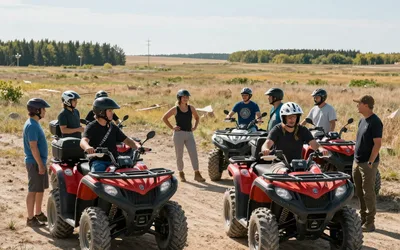
The land south of the Trans-Canada Highway, about ten kilometres west of Carberry, is quiet now — rolling prairie grass, a few low ridges, and the faint, orderly depressions of a landscape that was once churned by tens of thousands of boots. On Saturday, October 17, 2026, that quiet will give way to the growl of engines when the Westman ATV Association holds its third annual Poker Derby at Camp Hughes.
Registration runs from 9 a.m. to 12 p.m., and there is no ticketing platform, no reserved seating, no advance online checkout — riders simply show up, sign in, and head out. The format is the old prairie club tradition of the poker derby: riders follow a marked route, stop at checkpoints scattered along the way, and draw a playing card at each one. At the end, whoever holds the best five-card poker hand takes the top prize. It is a ride that rewards luck as much as throttle control, and it turns a long trail day into a rolling game of chance.
The association's second annual derby, held October 18, 2025, gives a good sense of what the day looks like. Entry was twenty dollars, the route ran approximately seventy kilometres, and the purse was paid out in percentages — twenty-five percent to first place, fifteen to second, ten to third. There was a 50/50 draw and a silent auction, and food was sold on site: cheeseburgers, hamburgers, hot dogs, pop and water. The club describes the gathering simply as its annual Club Poker Derby, and the 2024 edition was captured on video by riders who posted their run through the Camp Hughes trails online.
The Westman ATV Association is the Brandon-based club that covers southwestern Manitoba, affiliated with the ATV Association of Manitoba, the provincial body for powersports users. Its best-known route is the Strathcona Centennial Trail, roughly thirty-five kilometres of former rail bed running from Ninette to Baldur. The club's own website is currently being rebuilt — a landing page promises "new trails, new stories, same community," and lists three trail systems totalling more than fifty-three kilometres, built, in the club's phrase, "by riders, for riders." The derby is one of the ways that community gathers in person rather than online.
What makes the venue unusual is that it is not really a trail system at all. Camp Hughes is a National Historic Site of Canada, designated in 2011, and it preserves what Parks Canada calls the most intact First World War battlefield terrain created for training purposes in Canada. The ground the riders will cross still holds trenches, a rifle range, grenade training grounds, gun positions and observation posts, spread across a 420-hectare parcel.
The camp's story begins in 1909, when the Canadian Militia proposed land between Sewell Station and Carberry — chosen partly for its direct access to the Canadian Pacific Railway — as the site of the main summer training camp for District 10, a district that took in Manitoba, Saskatchewan, and the Keewatin, Kenora, Rainy River and Thunder Bay areas. The first summer camp followed in June 1910, with 154 officers and 1,315 men. It was originally called Camp Sewell, after a nearby station, and in 1915 the CPR renamed Sewell Station to Hughes Station while the Militia renamed the camp itself in honour of the Minister of Militia and Defence, Lieutenant-General Sir Sam Hughes.
Through the First World War the camp grew into something closer to a city than a training ground. In 1915, 414 officers and 10,580 men trained there. In 1916 the numbers jumped to 880 officers and 25,067 men, plus about 1,600 staff — making Camp Hughes the second-largest training camp in Canada that summer, behind only Camp Borden, and, for a season, the second-largest community in Manitoba. The Royal Canadian Artillery Museum puts total training at upwards of thirty-eight thousand recruits across 1915 and 1916. Veterans returned from France to dig and teach in a full-scale replica trench system completed in 1916, and soldiers wrote home about the scale of the place — one corporal with the 222nd Battalion noted in June 1916 that there were "about 20,000 men here already." The camp also boasted what was described as the largest outdoor heated swimming pool in Western Canada, and battalions organized swimming parades as relief from the prairie heat. Many of the men who trained in those trenches went on to fight at Vimy Ridge.
Army training continued at Camp Hughes until 1934, and the site served as a communications station from the early 1960s until 1991. Today it is both a provincial and a national historic site, with a plaque on Provincial Road 351 recalling Canada's determination to train soldiers for the specific tactics and conditions of the Western Front.
That is the odd and appealing thing about a poker derby here. The route is not a groomed recreational trail but a historic landscape, and riders pass over ground that was engineered a century ago to imitate the battlefields of France. The club's derby is a modest, homegrown affair — cash prizes, a silent auction, burgers off a grill — but it happens on one of the few surviving First World War training terrains anywhere, ten kilometres west of a town of a few thousand people on the Trans-Canada.
For anyone planning to go, the practical details are straightforward. The event is Saturday, October 17, 2026, at Camp Hughes, south of the Trans-Canada Highway west of Carberry. Registration is from 9 a.m. to 12 p.m. on site, and the ride is roughly seventy kilometres. There is no online ticket to buy in advance — you register when you arrive. Riders should expect a full day out, food available for purchase, and a route that runs through a piece of Canadian history that most Manitobans have never seen up close.