


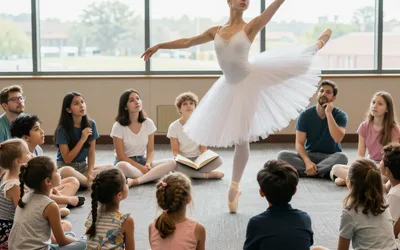
On the last Friday morning in October, a room that usually holds picture books and storytime rugs will hold something else: dancers. Ballet Theatre of Maryland will visit the Eastport-Annapolis Neck Library in Annapolis on October 30, 2026, from 11 to 11:45 a.m. for a program the library calls Ballet Storytime and Preview. The premise is simple and a little disarming — that ballet and movement can tell a story and take us on adventures, just like a book.
It is a free, drop-in program at 269 Hillsmere Drive, open to the public with no ticketing and no listed capacity limit. The library notes that American Sign Language interpreters are available for library-sponsored programs with advance notice, requested at least a week before the event through the library's online form. For a family looking for something to do on a Friday morning, the barrier to entry is essentially zero.
What makes the half-hour worth noting is who is doing the telling. Ballet Theatre of Maryland is the state's professional ballet company, and it has been a fixture in Annapolis for decades. It was founded in 1978 as a private nonprofit corporation under a different name — Ballet Theatre of Annapolis — and only later grew into a company with statewide reach. Edward Stewart, who served as artistic director from 1980 until his death in 2002, is credited by the company with forging the path its future would follow. Dianna Cuatto then led the company for seventeen seasons beginning in 2003, arriving after four years as ballet mistress at Richmond Ballet and a performing career that began in 1963 with Ballet West and carried her through Sacramento Ballet, Oklahoma Ballet, Berkeley Ballet Theatre, the San Francisco Chamber Ballet, and the Sangre de Cristo Ballet Theatre, plus Hollywood work for the American Music Awards, Broadway musicals, and a PBS broadcast for which she choreographed "Wonderful World of the Waltz." She retired in 2020, and Nicole Kelsch — who joined the company as an apprentice in 2006, rose to principal dancer, and became school principal and then ballet mistress — took over as artistic director that July, leading the company through a full 2020-2021 season at the height of the pandemic.
Today the company describes itself as presenting more than twenty full-length performances each season in classical and contemporary styles, and it runs a Conservatory of Dance for students of all ages. Its stated mission includes educating the community and making ballet accessible to the under-served, and it says plainly that it partners with local organizations to do so. The library storytime is that mission in its most literal form.
The format is not improvised. Ballet Theatre of Maryland has made a habit of this kind of event. In October 2025, it partnered with Historic Annapolis for a Nutcracker Storytime at the William Paca House and Garden, where costumed dancers read the holiday classic aloud, offered a sneak peek at an Annapolis-themed production, and invited children into an interactive move-along, followed by a meet-and-greet, crafts, face painting, and refreshments. That event charged admission — $10 for children ages 3 to 17 and $5 for adults, with discounts for Historic Annapolis members and military families and free entry for children under three — and it filled a tented brick terrace in a colonial garden.
The Eastport program strips away the ticket price and the historic setting and keeps the core idea: dancers in front of children, demonstrating that the body can narrate. The library's own calendar is built around exactly this audience. Eastport-Annapolis Neck runs Preschool Storytime on Tuesdays at 10 a.m. for ages three to five, Babies in Bloom on Wednesdays at 10 a.m. for children from birth to 18 months, and Toddler Time on Thursdays at 10 a.m. for ages 18 to 36 months — a weekly rhythm of songs, rhymes, and movement activities designed to build early literacy skills. Friday at 11 is normally open. On October 30 it will be filled by a professional company that spends most of its year on the stage at Maryland Hall for the Creative Arts.
The venue itself sits at an ordinary Anne Arundel crossroads with an outsized convenience: off Forest Drive, next to the Bay Ridge Shopping Center and across the street from Quiet Waters Park, reachable on foot from the shopping center via a path. The branch is open Mondays through Thursdays from 10 a.m. to 8 p.m. and Fridays and Saturdays from 10 a.m. to 5 p.m., so the ballet program falls squarely inside normal hours. The library also maintains a memorial tree at the branch, the Esther D. Robinson Memorial Tree, for those who want to honor a loved one.
There is a particular resonance in putting a ballet preview in a public library rather than a theater lobby. Ballet has spent centuries building a reputation as formal, expensive, and remote — an art of velvet seats and printed programs. A storytime in a branch library, free, on a Friday morning, with children sitting on the floor, is a deliberate argument against that reputation. The company's own language leans into it: the program promises that movement can take us on adventures, just like a book. It is a comparison a four-year-old can understand immediately, and one that happens to be true — ballet's history is full of narratives told without a single spoken word.
What the October 30 program will actually contain is not spelled out beyond that premise. The library listing describes a session in which dancers share how ballet and movement tell stories; whether it includes a read-aloud, a demonstration, audience participation, or a preview of a specific upcoming production is not stated. The word "Preview" in the title suggests the company may be offering a glimpse of something on its 2026-2027 season, which opens with subscriptions at Maryland Hall in mid-October, but the listing does not say so, and it would be a mistake to promise more than the library does.
What is certain is modest and appealing: forty-five minutes, no admission, no ticket, no reservation, in a neighborhood branch across from a park, with a professional ballet company sending dancers to show a room full of children that a story does not need pages. For families in Annapolis who have never taken a child to the ballet — or who have assumed they couldn't afford to — this is the cheapest possible introduction, and it happens to be the one the company itself considers part of the job.