


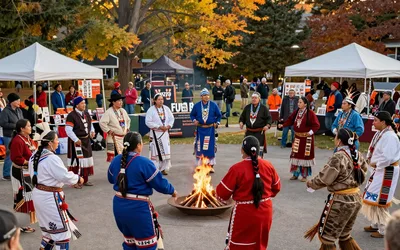
The drum is the first thing you hear. It is a low, steady pulse that carries across the lawn before you ever see the dancers, and for the Stockbridge-Munsee Mohican people who will gather at Shakespeare & Company in Lenox on October 3 and 4, that pulse means something specific. It is a heartbeat.
"There is a heartbeat," said Kaakska'kweenow, who will serve as master of ceremonies for the Second Annual Homelands PowWow. "The heartbeat is the heartbeat of the Mother Earth, and that's what the men sing on. When the men sing around that grandfather, that drum, that is the heartbeat of the Mother Earth that the men can control, because men cannot give life like a woman can give life, so a woman feels that heartbeat like the mother of earth that grows things."
His sons and grandsons will serve as the host drum for the two-day gathering, whose theme this year is "Tending the Fire." It is open to the public, and that openness is the point.
What is happening in Lenox this weekend is not simply a festival. It is a homecoming, and by the reckoning of the organizers themselves, it is the largest gathering of Stockbridge-Munsee people on their ancestral lands since 1786, when their ancestors began the long trek west.
The Mohican people, who called themselves the Muh-he-con-ne-ok, or "People of the Waters That Are Never Still," lived for millennia in the river valleys of what are now western Massachusetts and New York. In the 1730s, a Christian missionary named John Sergeant established a mission on the Housatonic in a place that came to be called Stockbridge, and over the following decades the Mohicans there adopted many of the ways of their colonizers, including Christianity, even as their language and customs began to fade.
Then came the removals. Driven west by expanding European settlement in the early nineteenth century, the Stockbridge people moved first to north-central New York, settling near the Oneida between 1783 and 1786, then to Indiana, where they joined with the Munsee, and finally to Wisconsin, where the Stockbridge-Munsee Community remains today. Their reservation lies in Shawano County in the northeastern part of the state. The community's own history calls the Mohicans a people who were forced to move many times after they first encountered Europeans, beginning in 1609, when the Dutch trader Henry Hudson sailed up the Mahicannituck, the river that flows both ways, into Mohican land.
That is the distance, geographic and emotional, that this weekend's powwow is meant to close. More than 160 tribal members and descendants are traveling from Wisconsin to the Berkshires for the gathering, up from the roughly 50 who made the trip for the inaugural event in 2025. That first powwow, held at the Darrow School in New Lebanon, New York, drew about 2,000 visitors and was described by organizers as the first powwow on those ancestral homelands in hundreds of years.
Ginger Stevens, a Stockbridge-Munsee Mohican and an organizer, has spoken about how the idea began as something modest and grew into something much larger. "What began as a desire to bring a few more members of the Stockbridge-Munsee community to the homelands of our people became a dream realized, with more than 50 tribal members and descendants returning in our first year," she said. "This year, 160 people will be coming from Wisconsin. This will be the largest gathering of Stockbridge-Munsee people in the homelands of our people since 1786, when we began our trek to the West."
Stevens has described the emotional force of that first return in plain terms. "We are making a HUGE impact on these people and their lives," she said. "When we walked these lands, we felt the connection to the land, to the ancestors. We wanted others to be able to feel that. We can bring people here, but we never know if they will feel the same connection and fulfillment that we did. Then we spoke with people who came last year and heard that they felt it in their heart and in their blood. 'We are HOME!' That's why we do this!"
Wanonah Kosbab, a board member, described the work in similar terms ahead of the first gathering, framing the return as a way of replacing what was left behind. "When we left them homelands, there was a lot of negative energy that was left behind," she told WAMC. "And so that negative energy just kind of sits there and stews, and it's a stale energy. And so when we reconnect in a good way, we replace that negative energy with all of this good energy that we're bringing by coming back together in community, in love this time."
Kathryn Footit, a Stockbridge-Munsee Mohican crafter and board member who attended the first powwow and is returning to help with logistics this year, put it as a matter of walking where her ancestors walked. "I am so happy to be returning to the breathtaking heart of the Berkshires as a Mohican crafter for the second Homelands PowWow," she said. "Last year, we had such an enjoyable adventure, sharing our lives and our history with the local people at the event and on our special outings. This year, I am so honored to be participating as a board member and helping find ways to allow my fellow Mohicans to 'come home' and experience what it is like to walk on the same earth our ancestors lived on, fought on and where some gave their lives for America's freedom. See you at PowWow! Oneewe, my friends!"
Shawn Stevens, president of the Homelands PowWow board, framed the annual event as an obligation as much as a celebration. "We have rekindled the fire that connects us to our ancestors and to these ancestral lands," he said. "Now our responsibility is to tend that fire, to nurture it, keep it burning and pass its warmth on to the generations that follow so they do not have to know life without it."
The fire metaphor runs through everything about this year's gathering, from its theme to the way organizers talk about continuity. Mysti Hammer, a tribal member, extended an invitation to the region's residents to come and see it for themselves. "Last year, there was something powerful about standing together in our ancestral Homelands, dancing, singing, reconnecting and feeling that undeniable sense of being home," she said. "This October, we invite you to experience it with us as we return to Lenox, Mass., for the Second Annual Homelands PowWow. Come gather with us, celebrate culture and community and be part of another unforgettable journey home."
The weekend's public programming includes intertribal dancing, traditional drum groups, artisan vendors, Indigenous food, storytelling, and cultural demonstrations.
Behind the dancing is a practical machinery of fundraising. The Homelands PowWow is organized by a Massachusetts-registered nonprofit and recognized 501(c)(3) charity, founded by enrolled Stockbridge-Munsee tribal members together with local allies. Its mission is to reconnect the Mohican people with their ancestral lands by raising money to cover travel and lodging for tribal members making the trip east. The organization is careful to note that it operates independently and does not speak on behalf of, or officially represent, the Stockbridge-Munsee Tribal Council.
The choice of venue carries its own resonance. Shakespeare & Company sits on Kemble Street in Lenox. This weekend its grounds will host something other than theater, on land that was Mohican long before it was anything else.
For those who have never attended a powwow, Kaakska'kweenow offered a way in. Asked what dancing is about, he answered with a question of his own, and then with a memory. "It's like asking me why the Indian children were smiling when the government was rounding them up and placing them in the dirt, and they laughed and played in the dirt," he said. "It's a part of who we are, and that Mother Earth. We're dancing to show who we are, that we are still here. That's why we dance."
That is the thread that runs from 1786 to a lawn in Lenox. The people who left are coming back, more of them than at any time in more than two centuries, and they are bringing a drum.