


The room where it happened is still standing, and it still has something to say.
On October 15, visitors to the Old South Meeting House at 310 Washington Street can step into "Ruckus!," a 25-minute immersive show that turns one of Boston's most consequential colonial interiors into a wraparound theater. The show runs from 10 a.m. to 5 p.m. and is included with general admission. It is not a film about the American Revolution so much as a film inside the American Revolution — projected directly onto the walls, balconies, and windows of the building where the argument actually happened.
That distinction is the whole point. Old South Meeting House, built in 1729 as a Puritan meeting house, was the largest gathering space in colonial Boston. When Faneuil Hall could not hold a crowd, the town came here. In November and December 1773 it was the staging ground for mass protests against the tea tax, and, most famously, on December 16, 1773, 5,000 colonists gathered here to protest the tax. From these pews, Samuel Adams gave the signal that sent the "Mohawks" to the harbor. John Hancock cried, "Let every man do what is right in his own eyes!" Josiah Quincy warned that the protests might stir up a hornet's nest.
"Ruckus!" was created by Revolutionary Spaces, the organization that stewards both Old South and the Old State House, and it was three years in the making. Matthew Wilding, the group's director of interpretation, has described the building itself as the star of the show. "We've utilized an 18th-century historic building and its architecture to tell a permanent story about itself," he told the Boston Globe. "If you want to see what Boston contributed to the 250th, this is it."
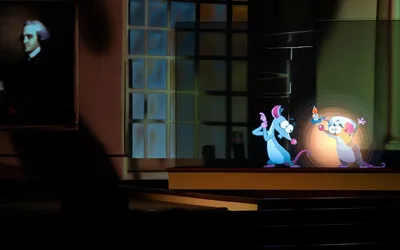
The production is a genuine technical undertaking. Wilding told WBZ NewsRadio that the show deploys six projectors, eight gobos, and a series of transparent OLED screens to paint the meeting house's tall white walls with sound, light, and animation. The effect, one early visitor told the station, was "like moving and almost seemed 3-D." The narrative is framed in part by two animated rodents whose imagined relationship with the building — past and present — links its nearly three-century history to the story of the Revolution. One reviewer called the talking rodents a highlight; the show's own promotional materials describe "fiery revolutionaries, determined citizens, and some unlikely troublemakers whose courage shook these walls."
The choice of venue is what separates this from a standard museum film. Nat Sheidley, president and CEO of Revolutionary Spaces, made the case simply: "You can imagine that the sounds that you heard are just like the echoes of those voices that were in this hall 250 years ago." The show is designed less as a destination than as a springboard — Wilding has said he hopes it gives visitors "the basic framework to then explore our exhibits and the exhibits of a lot of other sites throughout the freedom trail and beyond."
The building's own survival is part of the story the show tells. By the 1870s, Old South's congregation had moved on and the structure was slated for demolition. In 1876 it was saved from the wrecking ball by a group remembered as "twenty women of Boston," and it has operated as a public museum since 1877 — one of the country's earliest historic conservation efforts and one of its earliest museums of American history. It is now a National Historic Landmark, designated in 1960, and a stop on the Freedom Trail. Its colonial congregation once included Phillis Wheatley, the enslaved poet who published a book in 1773; patriots Samuel Adams and William Otis; William Dawes, who rode with Paul Revere; and a young Benjamin Franklin.
"Ruckus!" opened to the public on July 2, timed to America's 250th anniversary and supported by a roster of funders including The Lynch Foundation, the Massachusetts Office of Travel & Tourism, Massachusetts 250, and Meet Boston. It runs as a permanent fixture at the meeting house, which means the October 15 date is less a one-off engagement than an invitation to catch a show that has quietly become part of the building's long afterlife.
For anyone who has walked the Freedom Trail and wondered what it actually sounded like when Boston decided to rebel, the answer is now being projected onto the walls of the room where the decision was made. The show is short — 25 minutes — but it is staged in a space that has been making its case for 297 years. Late entry is not permitted once the show begins, so arriving a few minutes early is worth it. The room, after all, has been waiting a long time for an audience.