


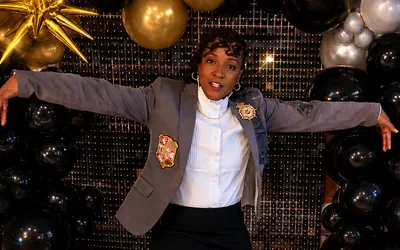
Kalamazoo has held a Pride celebration every year for nearly two decades, and the arc of its growth tells a story of what a community can build when it insists on being seen. What began in 2007 as a modest three-hour gathering inside a metalworking shop called SmartShop now spreads across two days and draws crowds upward of twenty thousand to the Arcadia Festival Site downtown. On Saturday, Aug. 29, 2026, the people who helped nurture that growth are planting another seed, this time in Bates Alley, where the city's first Black Pride will unfold from 2 to 8 p.m. under the banner "Celebrating Queer Black Joy."
The event is a collaboration between OutFront Kalamazoo and the Institute of Public Scholarship, and its energy comes from a partnership between two people who understand both the local landscape and the long, complicated history of Black queer celebration in America. Michael Cleggs-Arnott, the deputy director of OutFront Kalamazoo, and Dr. Michelle S. Johnson, executive director of the Institute of Public Scholarship, have organized the event, and they see it not as a rebuke of the broader Pride movement but as a complement to it, a space designed to center voices that mainstream celebrations have often pushed to the margins.
The impulse behind the event grew out of OutFront's Black Queer Trans Alliance, a peer-led group for Black LGBTQ+ adults that meets monthly at the organization's offices. "Our volunteers were like, 'We would love to have an event purely geared towards us, mainly to just uplift our community,'" Cleggs-Arnott recalled. "When we go to other Pride festivals around the country – or even our own locally – you don't really get a sense sometimes of inclusivity for everyone. A lot of times it's focused on one specific community: the white community, sometimes."
That sense of exclusion doesn't stop at Pride events. Cleggs-Arnott said that even at gatherings meant for Black people, like Kalamazoo's Juneteenth celebration, LGBTQ people often don't feel safe being fully themselves. "You don't really see LGBTQ folks being uplifted or being comfortable being themselves there because they know that there might be a specific backlash that comes towards us," he said. "So we really just want to provide a space for us to be ourselves, that also has that safety and that joy."
Johnson has been contemplating a Black Pride for at least five years, a vision that crystallized during the COVID-19 shutdowns of 2020. The isolation and quarantine of those months made her realize, she said, that "people being out in nature was something that was essential, especially for Black and brown people." Her early vision was to have it "not necessarily in an urban environment." Like many realized ambitions, the event has evolved from a rural idea into a block party in the heart of downtown, threading into the texture of Bates Alley.
The movement Johnson is joining has deep roots. The Black Gay Pride movement began in 1991 with DC Black Pride, a way to provide Black LGBTQ+ people with an alternative to the largely white mainstream LGBTQ+ movement and to unite the community in response to the HIV/AIDS crisis that was affecting Black and brown people.
The festival includes a lineup of Michigan-based performers, including rapper Sarge Tha Dame. The festival will take the form of a block party collaborating with Bates Alley businesses, several of which will offer signature cocktails and mocktails as part of the event. Tickets are $8, with proceeds supporting both OutFront Kalamazoo and the Institute of Public Scholarship, and there's an equity price structure that includes a "pay what you can" option and a "pay it forward" option. "We're not going to turn folks away," Johnson said. "We do want people to understand the importance of how to be in a space that is intended to create safety and community for Black and brown people, especially Black people, and understand the importance of this for us."
Organizers stress that everyone is welcome, and they're especially hoping allies will volunteer to help staff the event, which may need up to fifty volunteers for set-up, entry, and more. "I love seeing allies volunteer at these events," Cleggs-Arnott said. "The more allies who volunteer, the more our community can just show up and have fun instead of having to work."
It's not a coincidence that the organizers of this moment grew up with the festival itself. When the main Kalamazoo Pride started in 2007, it was nothing more than an afternoon in a metalworking shop; now it draws more than twenty thousand to Arcadia. They would love to see the same path for Black Pride, an event that in its first year already makes a statement: a community can build its own space, hold its own history, and celebrate its own joy in the heart of the city that calls it home.