


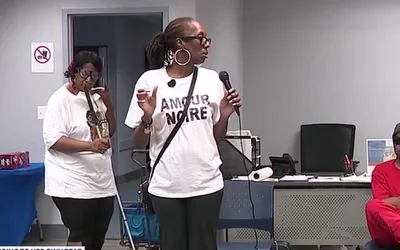
On any given Monday evening in Detroit, a small group of people gathers in the lower level of a building on West Outer Drive. Some arrive with canes, some with guide dogs, some with just a hand on a friend's shoulder. They come for a reason that might seem impossible to outsiders: to dance.
There is no mirror in the room. No one is watching to correct a posture or perfect a step. The instructor, a woman who calls herself Lady J, cannot see the dancers, and many of them cannot see her. What they share is the music. It fills the space, and they move to it. By listening.
Lady J is a dancer first and foremost. "I am a dancer, I came to dance," she tells the crowd that gathers at the Disability Network Wayne County Detroit, a center at 7800 West Outer Drive that connects people with disabilities to resources, peer support, and community. The dance class, which runs every Monday from 5:30 to 7 p.m., was built for people who are blind or have low vision. But its real purpose goes far beyond movement.
"It was hard being blind and dancing," Lady J said. "And now, they're out listening to music, being able to relate to the music, coming together, socializing, being happy again."
The story of how this class came to be starts with Lady J's own loss. About six years ago, she suffered a retinal detachment in her left eye. It was a sudden, devastating turn. "It deteriorated my vision, and it never came back fully," she said. A woman who had spent her life dancing, who had learned the hustle and other moves by watching and copying, suddenly found herself in a world where that method no longer worked. She could not see the steps anymore.
So she made up her own.
"I began to make up my own hustles because I didn't have enough sight to learn the hustles everybody else was doing," she said. The name she gave herself, "the blind hustler," came with time.
"Lady J is out there hustling again," she says, and the words are both a declaration and a promise to anyone who has ever felt left behind.
Now she brings that promise to others. Each week, Lady J invites those who are blind or have low vision to join her at the Disability Network. The classes are free and open to anyone who wants to come. Some walk in tentatively, unsure of what to expect. Others have become regulars, greeting each other by name.
The reaction says everything about what makes this class unusual. In most dance studios, mirrors line the walls. Dancers are taught to watch their own reflections, to adjust their alignment, to see what the audience will see. For blind and visually impaired dancers, that entire visual feedback loop is absent. But Lady J's class proves that rhythm is not a visual experience. It is an auditory one, a physical one, felt in the bones and the chest and the pulse. The body knows the beat before the eyes ever see it.
The Disability Network Wayne County Detroit, where the class is held, was founded in 2002 with five employees at Wayne State University. It later moved to the Samaritan Center in 2004. Its mission is to empower, educate, and advocate for individuals with disabilities, promoting independent living, inclusion, and accessible pathways. In that mission, programs like Lady J's dance class are not incidental; they are essential. Because dancing is not just about the steps. It is about showing up in the world, taking up space, and refusing to disappear.
For the people in Lady J's class, that refusal is a daily act of courage. Many have limited access to transportation or affordable activities. They face obstacles that sighted people rarely consider. Yet every Monday, they find their way to the lower level on West Outer Drive. They come to move, to listen, to laugh. "I lost my vision about six years ago," Lady J said, and she knows the journey each of her students is on because she is on it herself.
That message of possibility is the heart of the class. It is not about perfection. There are no sharp lines to hit, no complicated choreography to memorize. There is only the music and the people moving to it, each in their own way. Some sway gently. Some spin. Some let their bodies take over completely, lost in the sound. The joy is palpable, and it radiates outward.
Lady J is not finished yet. She is now looking for funding to open her own dance studio for people who are blind or have low vision. She has launched a GoFundMe campaign to support the effort. The studio she envisions would give her growing community a permanent home, a place where the lessons of the Monday night class could reach even more people. It is a dream borne of necessity, the same necessity that led her to invent her own dances when she could no longer see the ones others were doing.
In a city like Detroit, a place built on rhythm and resilience, Lady J's story makes a particular kind of sense. Detroit is where Motown taught the world to find the beat. And it is where, every Monday, a blind woman and her students prove that the beat belongs to everyone. The music does not discriminate. It does not require sight. It asks only that you listen.
"I'm telling y'all, it does not stop here," Lady J says, and her voice carries the certainty of someone who has lived it. The class may be held in a modest lower level on a Detroit side street. There may be no mirrors, no bright lights, no audience. But something real is happening there. Something that began in the dark, built from loss and refusal and rhythm, is teaching people to move again. And for the blind and visually impaired dancers of Detroit, that is everything.
Anyone who wants to join the class can simply show up at the Disability Network Wayne County Detroit, 7800 West Outer Drive, on a Monday evening. The doors open at 5:30 p.m., and the music plays until 7. No registration. No experience needed. Just bring yourself, and the willingness to listen.