


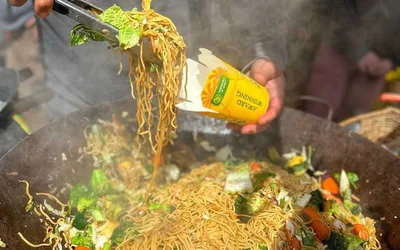
At 11 a.m. on a Thursday in mid-September, the smoke from grills and the smell of sizzling onions drift across Cadillac Square like a summoning bell. The food trucks have lined up along Woodward Avenue, their doors slid open, their menus chalked and ready. By noon, the plaza in the heart of downtown Detroit will be thick with office workers, tourists, and curious wanderers, all drawn by the same magnetic pull: Michigan's largest weekly food truck rally, Downtown Street Eats, celebrating its 14th season.
The Sept. 17 lineup reads like a culinary greatest-hits card, a rotating cast that has become a ritual for thousands. Little Caesars rolls in with its signature hot-and-ready pies, Andiamo brings an Italian kitchen on wheels, Big Bo's Grill slings hearty plates, Cousins Maine Lobster offers a taste of New England, Los Dos Amigo's Taco Truck delivers street-style tacos, and Little Bite Big Taste serves up small plates with big flavor. It's a lineup that spans continents and traditions, all within a few dozen feet of one another, all free to wander into, no ticket required.
But the story of Downtown Street Eats isn't just about the food. It's about the strange and layered history of the very ground those trucks park on. Cadillac Square, which sits just east of Campus Martius Park, was once part of Michigan Grand Avenue, a broad boulevard laid out by Augustus Woodward, Detroit's first chief justice, who rebuilt the city after the Great Fire of 1805 using a plan inspired by Washington, D.C. At what became the junction of Woodward and Michigan Avenues, surveyors marked the "Point of Origin," the zero mile marker from which Detroit's mile roads stretch northward to 8 Mile and beyond. Today, a monument marks that spot, a quiet reminder that every road in the city begins here.
In 1835, a section of that grand avenue was chosen as the site for Detroit's first City Hall, which doubled as the Central Market. It was a multipurpose building in the truest sense: meat vendors worked the lower floor while city officials, theatrical performances, and religious services shared the second. When a newer City Hall was dedicated in 1871 across Campus Martius, the old building was briefly considered for conversion into a library, but it was deemed more cost-effective to build anew, and the structure was torn down in 1872. A replacement Central Market Building rose in 1879, housing the Board of Health, the Poor Commission, and the Park Commission alongside its vendors, but it stood for only a decade before the growth of Eastern and Western Markets rendered it obsolete. The market was deemed unnecessary and came down in 1889.
So when modern Detroiters grab a lobster roll or a taco on that exact spot, they are participating in a tradition that traces back nearly two centuries: feeding the public on the site of the city's original central market. The square has always been a place of commerce and congregation, and Downtown Street Eats simply continues that lineage in a far more mobile form.
Adding to the square's character is the Bagley Memorial Fountain, a pink granite monument more than 18 feet tall that has called Cadillac Square home in its relocated form. The fountain was created in 1887 with money from the estate of John Judson Bagley, a New York-born tobacconist who helped organize both the Michigan Mutual Life Insurance Co. and the Republican Party, and who served as Michigan's governor from 1873 to 1876. When Bagley died in 1881, his will called for a drinking fountain that would provide the people of Detroit with "water cold and pure as the coldest mountain stream." The design came from H.H. Richardson, one of America's most important architects, and the monument is the only known surviving work of his in Michigan. Richardson modeled it after a ciborium in St. Mark's Basilica in Venice, and four lion heads originally dispensed chilled and regular water, the cold kept cool by ice packed around the pipes. It is, by all accounts, one of the most important architectural structures in Detroit, and it now watches over the food trucks with a kind of stone-benevolent gaze.
The event itself, created, programmed, and managed by the Downtown Detroit Partnership, launched in its current form in 2013, and for 14 seasons it has grown into a genuine civic institution. More than 80 local food trucks and restaurants rotate through the square each season, offering everything from Asian and Greek to Mexican cuisine, and the rally attracts more than 2,500 people each day. The season runs weekdays from 11 a.m. to 3 p.m. through early October, with additional appearances at special events like the Detroit Grand Prix, the Detroit Tree Lighting, and tailgates. It is free, it is uncapped in a public square, and it is open to anyone who happens to be downtown, whether they work there or are just visiting for the day.
There is a rhythm to the season, a sense of anticipation that builds each spring. "Downtown Detroit Street Eats has really become a signature part of spring and summer in Downtown Detroit," said Laura Dean, director of parks and public spaces for the Downtown Detroit Partnership. "It gives people a reason to step outside, connect with the city and enjoy some of the best food Detroit has to offer." For the vendors, the rally is more than a business opportunity; it's a community. Greg Arnoldy, founder of CIA Cheesesteak Institute of America, a returning favorite, put it simply: "We love being part of Downtown Street Eats. It feels like family. The customers are great, and the Downtown Detroit Partnership team that runs the program is incredibly supportive. They really work to help vendors succeed."
The Sept. 17 lineup is a snapshot of that family, a mix of old friends and new faces. Cousins Maine Lobster, which started with two cousins from Maine and grew into a national phenomenon, brings its lobster rolls to the square; Little Caesars, born in Detroit in 1959, needs no introduction; Los Dos Amigo's Taco Truck serves up the kind of tacos that make you close your eyes and savor; and Little Bite Big Taste, Big Bo's Grill, and Andiamo round out a spread that could feed a small army. Each truck has its own personality, its own regulars, its own story.
But perhaps the deepest story is the square itself. It is a place where Michigan's original road plan begins, where the city's first meat market stood, where a governor's fountain still offers cold water to strangers, and where, every weekday for fourteen seasons, a rotating fleet of food trucks gathers to feed the people of Detroit. It is a living tradition, a history that is not preserved under glass but served fresh, one lunch break at a time. On a warm September afternoon, with the fountain in the background and the smell of tacos in the air, it's easy to feel that you're standing in the middle of something timeless—the oldest and newest version of Detroit at once.