


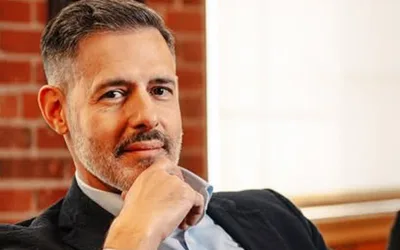
John Corvino has spent three decades arguing in public — about same-sex marriage, religious liberty, and the moral status of homosexuality — and he has spent much of that time doing it with people who thought he was wrong. On October 21, 2026, the Wayne State University philosopher will launch a book that tries to explain how that is possible, and why he thinks it still matters. The Other Side: A Moderate's Manifesto on How to Disagree is part of the Philosophy in Action series, and the launch runs from 5:30 to 7:30 p.m. at the Community Arts Auditorium, 42 W. Warren Ave., on the university's Detroit campus.
The format is unusual, and not only because of the book. Corvino will open with a brief summary of the book's arguments. Two colleagues — Prof. Ashley Woodson and Prof. Kevin Deegan-Krause — will then offer comments. Corvino gets the last word, a rejoinder. But because he has a neurodegenerative disorder that affects his speech, that rejoinder will be delivered using AI voice-cloning technology designed by a Wayne State student. A book sale and signing follows the program.
That detail is the sort of thing a university announces in a single sentence and an audience remembers for years. Voice cloning is usually discussed in the context of fraud, deepfakes, and the erosion of evidentiary trust. Here it is doing something closer to the opposite: restoring a scholar's ability to speak in his own voice, in his own room, to his own colleagues, at the one event where the sound of the author's voice is the whole point. The student who built the system is not named in the university's announcement, but the arrangement — a student's technical work carrying a professor's argument — is itself a small demonstration of the book's thesis about disagreement and cooperation across difference.
The book draws directly on Corvino's biography. As the publisher's description puts it, he was "an active participant in the debates over same-sex marriage for three decades," and in that time he "built strong relationships, and even friendships, with many on the other side." The Other Side is his attempt to extract a method from that experience: when to engage with views you believe to be false, what civility is actually for and where its limits lie, how to attend to what people are hearing rather than only to what you are saying. It takes up cancel culture and free speech, and it identifies what Corvino calls "conversation stoppers" — moves that foreclose dialogue rather than advance it. He is candid about the difficulty of the task in an environment where a remark can go viral and be ripped from context before its speaker has finished the sentence.
Corvino, born in 1969, earned his BA at St. John's University and his PhD at the University of Texas at Austin, where he wrote a dissertation on Hume's moral realism under A. P. Martinich. He joined Wayne State and became a professor of philosophy and dean of the Irvin D. Reid Honors College; he is now dean emeritus. His earlier books include What's Wrong with Homosexuality?, Debating Same-Sex Marriage (with Maggie Gallagher), and Debating Religious Liberty and Discrimination (with Ryan T. Anderson and Sherif Girgis). That last pairing is worth pausing on. Corvino has repeatedly built books out of actual exchanges with opponents — not summaries of their positions, but their own arguments, printed alongside his. The new book's title is not a metaphor for him so much as a description of his working method.
The venue suits the subject. The Irvin D. Reid Honors College, which Corvino led, is named for Wayne State's former president, and the Community Arts Auditorium sits at the center of a campus in the middle of a city that has had plenty of practice at arguing across difference. The event is free and open, and attendees can park on the street or pay at WSU Parking Structure #1, at Cass and Palmer.
There is a particular poignancy in the evening's structure that the announcement does not belabor. A book about how to keep talking to people who disagree with you is being launched by a man who is losing the physical capacity to talk, and who has arranged — with a student's help — to keep talking anyway. The rejoinder is the part of the program where an author answers his critics. Corvino will answer his in a voice that is his and is not quite his, produced by a machine trained on him, in a room full of people who came to hear what he has to say. Whatever one thinks about voice cloning in general, it is hard to imagine a better argument for the technology's humane uses than a philosopher using it to finish an argument he started thirty years ago.
Copies of The Other Side will be available for purchase and signing after the program.