


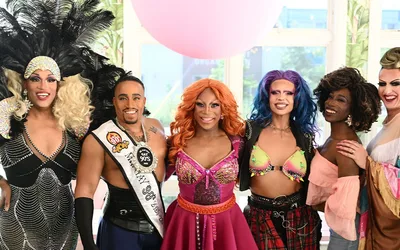
For more than a century, the Minnesota State Fair has promised something for everyone, a sprawling summer ritual where the roar of the midway and the proud shuffle of livestock define the scene. Its organizers like to call it the Great Minnesota Get-Together, a cross-section of the state's people, its food, its crafts, and its culture. But there has always been a glaring absence hidden in all that abundance. Of all the art forms represented across the fairgrounds, one has never graced the schedule: the jaw-dropping, sequined, high-heeled art of drag. Until now.
On Thursday, August 27, and Friday, August 28, the fair will close out its Arts A'Fair program each day with Power: Drag Revue, marking the first time a drag production company has ever been selected to perform at the Minnesota State Fair. Four free shows will pop up each afternoon at 3:30, 4:30, 5:30, and 6:30 p.m. at West End Market, filling the space with a rotating cast of the Twin Cities' most dazzling entertainers delivering a blend of comedy, dance, music, and full-throttle glamour. For the organizers behind it, the invitation is nothing less than a landmark moment of inclusion for an institution that has represented Minnesota to itself for generations.
The company making history is the brainchild of Kevin Billups, the performer better known as the drag queen Lala Luzious. Billups, who directs Power and serves as its host, describes the invitation as an incredible honor, and the fact that it arrives in 2026 carries particular weight, because his entire career was built in the spaces where that kind of recognition did not exist. In a 2022 interview with Mpls.St.Paul Magazine, he recalled how his journey into drag began in a college town that offered almost no room for it. At Wabash College, a small all-men's school in Crawfordsville, Indiana, he had no drag community at all. The pathway that pulled him in was almost accidental: the school wanted to put on a drag show, and if the school had to pay for it, a student had to perform it. The Gay Straight Alliance consisted of two gay guys and a crowd of supportive straight guys, and none of them was about to do drag. So Billups volunteered. He fell in love with the art form and eventually transformed into Lala Delaire, performing professionally in Indiana and, later, the Twin Cities. But from the beginning, he faced the same barrier that would come to define his career. He started in 2006, before RuPaul's Drag Race had saturated the culture with tutorials and resources, and the lessons he could find online were almost always performed by white queens. In Minnesota, he spent his first several years of his career often as one of the only entertainers of color in the shows he worked. "I always felt that there wasn't enough representation in drag communities," he said. "For such, such, such a long time, we were invisible."
That invisibility became the mission. In June of 2021, Billups formed Power, a BIPOC-focused drag group to expand opportunities for queer performers and artists who had historically been pushed to the margins. The founding moment came during one of the most turbulent chapters in recent Twin Cities history. The Black Hart, an LGBTQ soccer bar in St. Paul, had been forced to close when the pandemic struck, and its regular drag shows had not returned. At the same time, the uprisings in the wake of George Floyd's murder pushed the bar's owner, Wes Burdine, to re-examine who held the power on his stage. Billups walked into that open moment. Power's inaugural performance happened on the Black Hart's first weekend back open, and the evening carried a weight that Burdine has never forgotten. From that first weekend, Power has become an important fixture, extending its reach across the Twin Cities with events at Blondette at the Rand Tower Hotel, Sociable Cider Werks, and Queermunity.
What audiences get at a Power show is not a fixed script but a rotating cast that represents the full breadth of the Twin Cities drag scene, delivering music, dance, comedy, and glamour. The emphasis on BIPOC performers is central, and Billups has been outspoken about the barriers that persist for entertainers of color even after drag went mainstream. Power's arrival at the fair, coming off a summer circuit of Pride and Juneteenth celebrations in the Twin Cities and Indianapolis, is the latest and most visible extension of that mission. The shows are part of the Arts A'Fair program, which has for years popped up unexpected performances across the fairgrounds, mixing cultures, ages, and genres. The addition of drag to that long and varied lineup is a milestone, a recognition that the great Minnesota get-together can finally celebrate every Minnesota artist's full, glittering range. The performers of Power see something meaningful in the particular stage they have been given. "We hope these performances help showcase the diversity and talent that exists throughout Minnesota's drag scene," Billups said. It is a sentiment that can be seen as the completion of a long journey. When he was starting out, Billups had to learn from videos that rarely reflected his own experience, in venues where he was often the only person of color on the stage. He built Power, in part, to be the outlet he wished he had when he was beginning. Now, on the most public stage in the state, at the fair that claims to bring everyone together, that outlet has become a headline act. For four hours on each of the first two days of the fair, the Great Minnesota Get-Together will take on a new color, proof that the state's most beloved institution still has room for a little more joy, a little more light, and a great deal more power.