


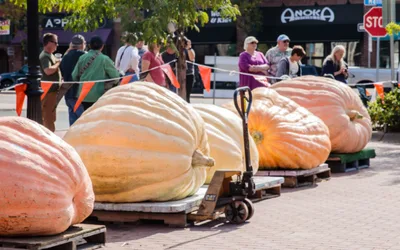
The pumpkins that arrive at Anoka City Hall Plaza on the first Sunday of October do not roll in on wagons so much as they are escorted, cradled in slings and set down on industrial scales with the care of something fragile and enormously expensive. That is roughly the truth. A competitive giant pumpkin is the product of months of obsessive horticulture, and when it is finally hoisted onto the scale at the Great Pumpkin Expo, the number that comes up is the payoff for a whole season of worry.
The Expo runs from 11 a.m. to 2 p.m. on October 4, 2026, at 2015 First Avenue, in the heart of a downtown that has spent more than a hundred years treating October as its own personal holiday. Admission is free. There is no gate, no ticket, no capacity limit — just a public plaza, a sanctioned weigh-off, and whatever the growers of Minnesota and the surrounding states managed to coax out of the ground this year.
The weigh-off is the centerpiece, and it is not a casual affair. It is sanctioned by the Great Pumpkin Commonwealth, the international body that keeps the official records for giant pumpkins, tomatoes, and other outsized produce, and that maintains the rules growers compete under. A GPC-sanctioned weigh-off means certified scales, verified entries, and results that count toward the record books. For the growers, that matters. A pumpkin is only a world-class pumpkin if someone official writes down what it weighed.
Around the scale, the Expo stacks a full afternoon of small-town spectacle: a scarecrow contest, an adult pumpkin carving and decorating contest, a car show, and rows of craft and business vendors. The event is one entry in a much larger October calendar that Anoka Halloween Inc. has been running for generations, a month stuffed with parades, a medallion hunt, a bonfire, a gift shop, and contests for every age group.
To understand why a Minneapolis suburb of fewer than 20,000 people takes pumpkins this seriously, you have to go back to 1920, when Anoka's Halloween tradition began not as a celebration but as a containment strategy.
As the town's own history tells it, Anokans woke one morning to find their cows roaming Main Street, windows soaped, and outhouses tipped over. Halloween in early-twentieth-century America was less a holiday than a night of tolerated vandalism, and Anoka was getting the worst of it. A clip the Anoka County Historical Society uncovered from the November 4, 1914, Anoka County Union captures the tone of the era: "Halloween was exceptionally quiet this year, and little real damage was done. Windows were soaped, fences torn down." That was a good year.
So in 1920, civic leader George Green and other Anoka figures proposed something bigger: a giant celebration to give the town's young people somewhere to put their energy. The idea was adopted by the Anoka Commercial Club and the Anoka Kiwanis Club, and by September a Halloween committee had formed, drawing in businessmen, teachers from the public and parochial schools, parents, and students. More than a thousand schoolchildren spent weeks making costumes. The parade that followed included local and neighboring bands, drum corps, the police and fire departments, the Kiwanis and Commercial Clubs, and the Anoka National Guard. Hundreds of bags of popcorn, candy, and peanuts were handed out to the children who marched, and everyone was invited to a bonfire at Bridge Square.
It worked. Anoka has held a Halloween celebration every year since, pausing only in 1942 and 1943, when the country was at war. The town now claims the trademarked title Halloween Capital of the World, and it is a claim with a real basis: Anoka is believed to be the first city in the United States to put on a Halloween celebration, and it did so specifically to divert its youngsters from pranks. A giant, blinking pumpkin sits atop city hall each October. The whole downtown leans in.
That history is why the Expo's contests feel less like a fall festival and more like a civic inheritance. The scarecrow contest and the carving contest are the direct descendants of those 1920 costume-making sessions — the same instinct, a century on, to hand people a creative project instead of a night of mischief.
The giant pumpkin weigh-off is the newer wrinkle, and it belongs to a subculture with its own gravity. Competitive pumpkin growing is a year-round discipline: seeds started indoors under lights, seedlings tented in the patch against late frost, female flowers hand-pollinated and then covered with foam cups so honeybees cannot muddy the pedigree. Growers check their patches multiple times a day. The results are absurd in the best way. A world-record strawberry or tomato weighs roughly ten times the average for its kind; a giant pumpkin can weigh a hundred times the average. The long-standing goal in the community has been the one-ton squash, a mark that has crept from fantasy to near-miss.
Minnesota is not a bystander in that pursuit. In 2023, Travis Gienger of Anoka set a world record for the heaviest pumpkin at the Safeway World Championship Pumpkin Weigh-Off in Half Moon Bay, California, with a gourd that tipped the scales at 2,749 pounds. A pumpkin from Anoka — the town that invented the American Halloween — became, for a time, the heaviest ever recorded anywhere. It is the kind of fact that makes a local weigh-off feel like a stop on a national circuit rather than a small-town curiosity.
Which is the particular pleasure of the Expo. You do not need to know any of this history to enjoy it. You can simply walk into the plaza, look at a pumpkin the size of a compact car, and understand immediately that something unusual has happened. But the context is what makes it worth the trip. This is a free, open, unhurried afternoon on a public square in a town that decided, more than a century ago, that the best way to handle October was to throw a party big enough to absorb everyone.
The Expo also lands inside Anoka's social district, the designated downtown zone where visitors can buy a drink and walk the streets with it — a pilot the city launched to encourage exactly the kind of casual, stroll-and-linger evening that a fall festival rewards. The district runs through several blocks of downtown, bounded by the Rum River to the west, 2nd Avenue to the east, Harrison Street to the north, and East Main Street to the south. It is a small detail, but it says something about how Anoka treats its downtown: as a place to be, not just to pass through.
So on October 4, the plaza will fill with vendors and cars and scarecrows, and at some point a grower will guide an enormous orange thing onto a certified scale while a small crowd leans in to read the number. Nobody will know until the moment it happens how big the biggest pumpkin is this year. That uncertainty is the whole point. A hundred and six years after Anoka decided to give its kids something better to do than tip over outhouses, the town is still finding new ways to make October strange and generous and worth showing up for.