


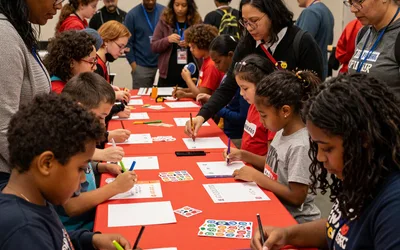
Walk into the University of Minnesota Bookstore on the ground level of Coffman Memorial Union during the first full week of October, and you'll find a modest table set up near the books: free stickers, free bookmarks, and a button-making station where anyone can press a small metal pin and walk away wearing it. There is no ticket, no registration, no lecture to sit through. The event runs during the store's regular hours, from Monday, October 5 through Friday, October 9, 2026, and it costs nothing to stop by. It is, on its face, a very small thing — some paper goods and a hand-cranked press.
But the occasion behind it is one of the more consequential annual observances in American letters, and its origin story is stranger and more theatrical than most people realize.
Banned Books Week was launched in 1982, and it began not with a library committee or a government proclamation but with a piece of stagecraft at a booksellers' convention. That year, the American Booksellers Association set up an exhibit at its BookExpo America trade show in Anaheim, California. At the entrance to the convention center, attendees were met with large, padlocked metal cages. Inside were some 500 books that had been challenged or banned somewhere in the United States, stacked behind the bars. Overhead hung a sign warning, in effect, that some people considered these books dangerous. The point was made without a single speech: here is what censorship looks like when you build it full size.
The exhibit landed in a moment of genuine alarm. The early 1980s saw a sharp rise in challenges to books in libraries, bookstores, and schools, along with organized protests over what belonged on shelves. That same year, the Supreme Court decided Island Trees School District v. Pico, a case that arose after a New York school board removed several titles it deemed objectionable from its junior and senior high school libraries. The Court ruled that school officials cannot remove books from library shelves simply because they disagree with the ideas inside them. It was a narrow but symbolically enormous decision, and it gave the growing unease among librarians and booksellers a legal shape.
Riding the momentum of the Anaheim cages, the American Booksellers Association invited Judith Krug to help build something bigger. Krug was the director of the American Library Association's Office for Intellectual Freedom, a Chicago-based operation founded in 1967 to defend the freedom to read. She had arrived at the ALA as a 27-year-old reference librarian from Evanston, Illinois, and over the following decades she would become the public face of intellectual freedom in American libraries. In 1982 she became a founder of Banned Books Week, joining the booksellers and the National Association of College Stores in a new coalition.
By the account the ALA's own staff later gave, the three organizations scrambled to pull something together in time for the September show date. What they managed was modest: a news release and a publicity kit, distributed to a combined membership of roughly 50,000 people. That was the entire first Banned Books Week. It was less a festival than a memo — a request that booksellers, librarians, and teachers start a conversation.
The conversation took. Institutions and stores picked up the idea, and the observance settled into a rhythm that has held for more than four decades: the last week of September or the first week of October, every year. Its stated purpose has stayed remarkably consistent. Banned Books Week highlights the value of free and open access to information and draws together what the ALA calls the entire book community — librarians, educators, authors, publishers, booksellers, and readers of every kind — in shared support of the freedom to seek and to express ideas. The campaign stresses that unorthodox and unpopular viewpoints need to remain available to anyone who wants to encounter them, so that people can reach their own conclusions rather than have those conclusions chosen for them.
Over the years the week has grown its own traditions. There is a Virtual Read-Out, in which people record themselves reading from challenged books. There is a First Amendment Film Festival. Since 2011, the American Association of School Librarians has designated the Wednesday of Banned Books Week as Banned Websites Awareness Day, extending the conversation from books to the internet. Amnesty International has partnered on the campaign, drawing attention to writers and readers persecuted around the world for what they produce, circulate, or read. And the list-keeping itself has become a kind of institution: the ALA's Office for Intellectual Freedom has documented challenges for decades, and for its 150th anniversary in 2026 the association released a list of the 150 most challenged books from 1990 through 2025.
The University of Minnesota's contribution to all this is deliberately unpretentious. The Bookstore at Coffman — the region's largest independent bookstore and one of the largest public college bookstores in the country, by its own description — marks the week with the table of stickers, bookmarks, and buttons. The button-making station is the centerpiece, and it is a small piece of genius as outreach goes: it turns a passerby into a participant, and it sends them back out into campus wearing a message. A button is a tiny, portable argument.
There is something fitting about the setting. Coffman Memorial Union has anchored the East Bank campus at 300 Washington Avenue SE since it opened in 1940, named for Lotus Coffman, the university's president, and built in a Stripped Classical style with a Streamline Moderne interior. It has been renovated twice, in the mid-1970s and again around 2003, and it remains the crossroads of campus life — a building people pass through on the way to somewhere else. That is exactly the traffic a Banned Books Week table wants. Nobody has to seek it out. They just have to slow down.
And the stakes behind the stickers are not hypothetical. The ALA's own framing of the week's history notes that it was born in the 1980s, "a time of increased challenges, organized protests" — language that could be lifted almost verbatim from coverage of the present day. The 1982 cages in Anaheim were a response to a surge in book challenges. The observance has never really stopped being a response to one.
So the table at Coffman is a direct descendant of that padlocked cage. The cage was designed to be impossible to ignore; the button station is designed to be impossible to refuse. Both are trying to do the same thing — put the question of who gets to decide what you read in front of people who weren't necessarily looking for it. Five days, free stickers, a hand press, and a stack of bookmarks. The whole history of the thing fits in a pocket.