


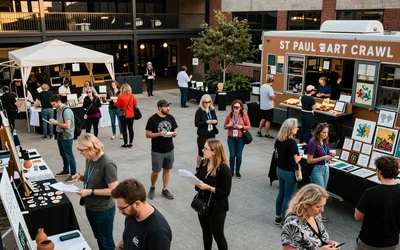
The building at 900 West 7th Street in Saint Paul looks less like an apartment complex than a castle — a hulking, Gothic-towered pile of brick and stone that has loomed over the West 7th neighborhood for well over a century. On Saturday, October 17, its doors swing open to the public for the fall edition of the St. Paul Art Crawl, when more than 80 artists fill the historic Schmidt Brewhouse with pottery, painting, fiber work, jewelry, metal and wood craft, and more.
The event runs from noon to 7 p.m. on Saturday, part of a full weekend of crawl hours — Friday from 6 to 9 p.m. and Sunday from noon to 5 p.m. Admission is free, and visitors enter at Door 1 of the Brewhouse, near the tall smokestack on the north side of the building. Food trucks park on the plaza, and a lobby cafe serves those who'd rather stay indoors. Free parking is available on nearby streets.
What makes the Schmidt crawl distinctive is the building itself. Artists exhibit from the Tunnel Gallery up to the rooftop, where the event's "Open Palette" invites visitors to bring their own art materials and a project and spend 45 minutes making their mark against the backdrop of the downtown Saint Paul skyline. For the fall 2026 crawl, the rooftop art demonstrations are being run in partnership with Art Battle. There's also a Kids' Table and a balloon-crafting clown, and each day the first 25 shoppers who spend more than $100 on art receive a free Schmidt-designed tote bag.
The crawl is not a one-off vendor fair but a piece of a much older civic tradition. The St. Paul Art Crawl traces its origins to 1977, when a group of artists living in Lowertown — then a district of empty parking lots and deteriorating warehouses — founded the St. Paul Art Collective with a mission to educate the public about Minnesota artists and promote new work. Their first group exhibition was held at Union Depot. Over the following decade and a half, the artists staged loosely organized group events in and around downtown, and from 1981 to 1985 the Collective ran a critically acclaimed fine art gallery in Lowertown called the Wall Street Gallery.
As tax laws made it feasible to rehabilitate the rundown warehouses, artists learned their studios would be eliminated. The Collective formed a housing committee to establish an artist-owned cooperative studio and living space in Lowertown; the first attempt collapsed when the bank that had agreed to participate backed out, citing doubts about the artists' ability to repay the debt. The committee regrouped and kept pushing. The crawl itself grew through the mid-2000s, expanding out of Lowertown into neighborhoods across the city. Today Visit Saint Paul describes it as the longest-running art crawl in the United States, drawing roughly 300 artists across 10 districts.
The Schmidt site's own story is even older. Beer was brewed on this ground beginning in 1855, when Christopher Stahlmann established what was originally known as the Christopher Stahlmann Cave Brewery. Saint Paul's sandstone was easy to carve, and Stahlmann excavated extensive lagering caves — an undertaking said to have cost him $50,000 — creating the most extensive brewery cave in the state. The caves mattered because German-style lager needs months of cool storage before it's ready to drink, and Minnesota's cool natural sandstone was ideal for the purpose. At least 14 breweries used Saint Paul's sandstone caves.
The brewery passed through a succession of names and owners — St. Paul Brewing Company, then Jacob Schmidt Brewing Company from 1900, followed by Pfeiffer, Associated Brewing, G. Heileman, and finally Minnesota Brewing Company. For nearly a century the site turned out suds and provided jobs, with the last kegs of Grain Belt and Pig's Eye rolling out in 2002. A brief and unpopular stint as an ethanol plant followed, and then the property sat vacant for a decade, landing on a list of Minnesota's "10 most endangered historic places."
Redevelopment was a heavy lift. The affordable housing developer Dominium took it on, rehabilitating the Brewhouse and Bottling House into 247 affordable, loft-style live/work units, with 13 townhomes added for a total of 260. The studio, one-, two-, and three-bedroom homes are reserved for residents earning no more than 50 to 60 percent of the area median income. The project preserved the building's natural light, high ceilings, and idiosyncratic character — as project developer Owen Metz put it, "The building was about as far from a housing design as you can imagine for a starting point." Financing for the roughly $122 million project drew on low-income housing tax credits, historic tax credits, tax-exempt bonds, and grants covering environmental cleanup. The Schmidt Artists organization dates the renovation to 2013.
Crucially, the development was designed with artists in mind, including studios for painting, ceramics, dance, and music, plus galleries and common space. Schmidt ARTS, the resident group that organizes the crawl and other public events, was founded in 2017 by residents seeking a protocol for managing events and funding. It is not incorporated or a nonprofit on its own, but operates under a fiscal sponsorship with the Community Reporter that gives it 501(c)(3) status for grants and donations. Members are dedicated residents who volunteer their time without payment, and a portion of donations and proceeds from large public events like the Art Crawl goes toward buying equipment for the community.
That is the through-line of the Schmidt crawl: a 19th-century brewery built by German immigrants, saved from demolition by an affordable-housing conversion, and now animated twice a year by the artists who live in it. Visitors on October 17 can wander five floors of studios, watch painters work on the roof, buy directly from makers, and take in a view of the city that the brewers of 1855 would have recognized — from a building locals have long called the castle on West 7th.