


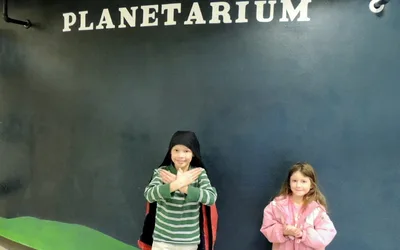
Every October, the same question gets asked across kitchen tables and classroom carpets: why do we dress up and go door to door on the last night of the month? At the Como Planetarium in St. Paul, the answer starts with the sky. On Saturday, October 24, from 10:30 to 11:30 a.m., the planetarium inside Como Elementary School at 780 W. Wheelock Parkway hosts "Halloween: Celestial Origins," a program for all ages that traces the holiday back to the turning of the seasons and then points out what will actually be overhead on the evening of October 31.
The premise is simple and, once you hear it, hard to unhear: Halloween sits almost exactly halfway between the autumn equinox and the winter solstice. Astronomers and folklorists call dates like this cross-quarter days, the hinges of the year that fall between the four great solar markers. In the Celtic calendar, that hinge was Samhain, the start of the dark half of the year, when the harvest was in and the cold was coming. The planetarium's own description of the program puts it plainly: Halloween has deeper ties to the night sky than most people think, and the show explores the history of the holiday through its connection to the changing seasons as a cross-quarter day.
That framing is the heart of the hour. Rather than treating Halloween as a purely commercial affair or a purely spooky one, the program treats it as an astronomical event with a long cultural tail, one that predates pumpkins and candy corn by a considerable margin. The holiday's date is not arbitrary. It is a marker on the same solar calendar that gives us equinoxes and solstices, and the planetarium makes that connection visible.
Then the show turns from history to the here and now. After the seasonal explanation, visitors tour the night sky and learn which planets, constellations, and stars to look for on our own Halloween evening, the one coming up at the end of October 2026. That is the part that makes this program unusual. Plenty of planetariums run seasonal sky tours; plenty of museums run Halloween programming. Few put the two together so literally, teaching the holiday's origins and then handing the audience a viewing guide for the actual night they will be out in costume.
The setting matters too. The Como Planetarium is a 55-seat dome tucked inside Como Elementary School, and it has been in operation since 1975, which makes it one of the older planetariums in Minnesota and, by any measure, one of the more unusual public resources in the Twin Cities. It is not part of the Bell Museum, and despite the name it is not inside Como Park, though it sits close by in the surrounding neighborhood. It is a Saint Paul Public Schools facility, and it operates both a classic star ball, the electromechanical projector that generations of schoolchildren watched wheeling overhead, and an updated digital system. The dome is 30 feet across. In April 2025 the planetarium marked its 50th anniversary with a free public star party that included telescopes, a classic planetarium film, and a display of the original equipment used over five decades of science education in the city.
That history is part of the appeal. A school district planetarium that has survived half a century of budget cycles is a rare thing, and the public programs are how it stays connected to the wider community. The fall 2026 slate includes the Halloween show in several versions. The October 24 morning session is the family-friendly "Celestial Origins" program, open to all ages, with pre-registration required. Costumes are optional, which is worth noting: this is a show you can attend in a witch hat or in a fleece, and either will be fine.
There are other chances to catch the material. The planetarium has scheduled the same program for Tuesday, October 27, at 6 and 7 p.m., and Friday, October 30, at 1 p.m. A separate, longer collaboration with the Celtic Junction Arts Center, titled "Halloween: Celestial and Celtic Origins," digs deeper into the holiday's Irish roots and runs October 30 from 12:30 to 2 p.m. for $20; that session is taught by Sarah Weaver, the planetarium's educator, and is co-presented with Saint Paul Community Education. It falls on a school release day for the district. The October 24 show is the straightforward, all-ages version, and it is one of the cheaper ways to spend a Saturday morning indoors as the leaves come down.
Because seating is capped at 55, the planetarium strongly recommends buying tickets in advance through the district's registration system rather than showing up at the door. Children three and under are typically admitted free at Como's public shows, though families should confirm details when they register.
What the audience gets for that hour is a shift in perspective. The holiday that arrives every year in a blur of costumes and candy turns out to be a calendar marker, one of the four hinges between the solstices and equinoxes that older agricultural societies watched closely because their lives depended on knowing where the sun stood. The dark half of the year began around this date, and the traditions that grew up around that threshold, from bonfires to masks to the notion that the boundary between worlds grew thin, were layered on top of an astronomical fact. The Como Planetarium's contribution is to put that fact back in front of people, literally, on a dome, and then to send them outside on Halloween night knowing what to look for.
For a family looking for something to do on an October Saturday that is not a corn maze, that is a fairly specific offer: an hour under a 30-foot dome in a St. Paul elementary school, learning why the holiday exists and what the sky will look like when it arrives. The show starts at 10:30 a.m. on October 24. Registration is required, and the seats go fast.