


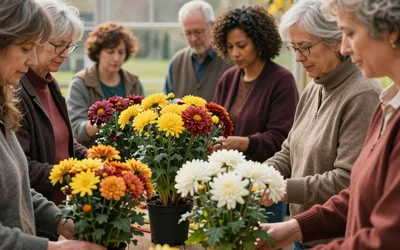
On a Tuesday afternoon in mid-October, a small group will gather at the main entrance of Bellefontaine Cemetery and Arboretum in north St. Louis, then walk into a landscape of rolling hills and some ten thousand trees and shrubs to learn a language almost no one speaks anymore. The occasion is a horticulture class called Floriography, the Language of Flowers, taught by the cemetery's own floriculturist, Payton Stutte. Over two hours, from 1 to 3 p.m. on October 13, 2026, attendees will sit through a slide presentation on the origins of floriography and the meanings Victorians attached to autumn blooms, then build their own cut-flower arrangements, each one carrying a coded message they can take home. All materials and supplies are provided. The class is free to attend with a suggested donation of $15 per person, but space is limited and registration is required.
The pairing of subject and setting is not accidental. Floriography -- the practice of assigning meanings to individual flowers and combining them to send messages -- reached its peak in the 19th century, the same decades in which Bellefontaine was carved out of a farm overlooking the Mississippi River. The cemetery was founded in 1849, the year a cholera epidemic swept through St. Louis and the city's existing burial grounds began to overflow. A group led by former mayor William McPherson bought the 138-acre Hempstead farm north of the city, along the road to Fort Bellefontaine, and hired Almerin Hotchkiss away from Green-Wood Cemetery in Brooklyn to lay out the grounds. Hotchkiss stayed for 46 years, designing fourteen miles of curving drives that followed the terrain's natural contours and opened views toward the river. The result was the first rural cemetery west of the Mississippi, a style of burial ground that doubled as a public park -- a place families visited on Sundays, strolled through, and treated as a garden.
That garden has grown. Bellefontaine now covers 314 acres and holds more than 87,000 graves, including those of William Clark of the Lewis and Clark expedition, Anheuser-Busch founder Adolphus Busch, Senator Thomas Hart Benton, and the writers William S. Burroughs and Rush Limbaugh. Its monuments include the Wainwright Tomb, one of only three mausolea designed by the architect Louis Sullivan and listed on the National Register of Historic Places. In 2012 the grounds were accredited as an arboretum, and today Bellefontaine is Missouri's first Level III Arboretum, a designation reserved for collections with significant educational and conservation programs. The cemetery has been shifting toward conservation landscape practices since the early 2010s, and Stutte, who joined the horticulture team after studying biology and environmental studies at Truman State University, cares for the gardens and trees across the grounds, with particular responsibility for Wildwood Valley Gardens.
Floriography itself is older than the Victorians. The idea that flowers carry fixed meanings runs through mythology, religion, and regional folklore, and it varies widely from one culture to the next. The tradition that reached England and America took shape partly through the Ottoman Empire: in the early 18th century, Lady Mary Wortley Montagu, the wife of the British ambassador to Constantinople, wrote letters home describing a Turkish custom of sending coded messages through flowers. Her account, published decades later, helped seed a European fascination with the idea. By the 19th century, the language of flowers had become a mainstream parlor pursuit in France, Britain, and North America, and publishers rushed to meet demand with floral dictionaries -- most famously Kate Greenaway's illustrated Language of Flowers in 1884.
Those dictionaries were never standardized, which is part of what makes the subject fun to teach. Different books assigned different, sometimes opposite, meanings to the same bloom; lavender could signal distrust in one volume and devotion in another. What the Victorians shared was the impulse behind the code. In a society governed by strict etiquette, where open declarations of affection, desire, or disdain were discouraged, a bouquet could say what a person could not. A single flower sent alone carried one message; a carefully composed arrangement carried a sentence, or a paragraph.
That is the practical heart of the October class. After the slide presentation, attendees will assemble their own arrangements, choosing blooms for their connotations and building a message in stems and petals rather than words. The autumn timing matters, since the class focuses on the meanings attached to fall flowers specifically. Stutte's own description of her work -- a blend of art and science, where ornamental landscapes are at once expressive and ecologically alive -- fits the exercise neatly. Floriography is a reminder that a garden is never only a garden; it is also a text, and Bellefontaine, with its 175 years of monuments, mausoleums, and plantings, has been accumulating footnotes for a very long time.
Anyone planning to attend should wear appropriate walking attire and arrive at the main entrance 15 to 20 minutes before the 1 p.m. start, as the group departs promptly. Registration is handled through the cemetery's events page, and because space is limited, signing up in advance is the only way in. The suggested $15 donation supports the horticulture program that keeps the grounds -- and classes like this one -- going.