


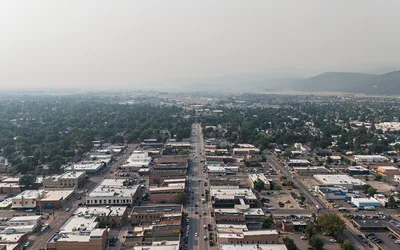
In late August 2026, as a familiar brown haze settled over the Flathead Valley, three public buildings in three small Montana towns quietly opened their doors for a different kind of gathering. There would be no music, no vendors, no parade. Just volunteers, box fans, HEPA filters, and a stack of flyers explaining something many residents were only beginning to understand: that going inside during a smoke event does not automatically mean breathing clean air.
The events were the debut of a new community resource. Climate Smart Glacier Country, the Whitefish-based nonprofit known for its volunteer-driven approach to climate resilience, hosted a series of pop-up open houses at three newly designated Clean Air Centers in Kalispell, Columbia Falls and Whitefish. Held from 2 to 6 p.m. on three separate days—August 24 at the Columbia Falls Community Center, August 25 at the Gateway Community Center in Kalispell, and August 27 at the Whitefish Community Library—the gatherings offered refreshments, kid-friendly activities, and a drawing for a free household HEPA air filter. But the real point was education: how smoke gets inside, how it can sicken the young and the old even when the nearest fire is hundreds of miles away, and how a box fan and a simple filter can make a bedroom markedly safer on the worst days.
The timing was not accidental. Wildfire smoke was again blanketing the Flathead Valley, and the new clean air centers gave residents a concrete answer to a familiar problem: a place to go where the air could be trusted, and the knowledge to make their own homes safer. Against that backdrop, the centers had never felt more necessary.
The concept behind them stretches back several years. In 2020, CSG launched what it called its Wildfire and Health project, an effort to put HEPA filters into the homes of people whose health conditions made them especially vulnerable to wildfire smoke.
From the start, the program's answer to the region's smoke problem was practical rather than rhetorical. It raised money to buy HEPA filters and, in partnership with Logan Health and the Community Action Partnership of Northwest Montana, put them into the hands of low-income seniors, pregnant women, infants and people with respiratory or heart conditions. With funding from Flathead Electric Cooperative's "Roundup for Safety" program and grants from the Whitefish Community Foundation, it distributed scores of units year after year, reaching more than 200 households since 2020. It also built a network of outreach, posting tutorials on its website that walk residents through building a DIY box-fan filter, upgrading a home HVAC system to catch smoke particles, and evaluating standalone HEPA units.
But filters for individual homes only go so far. In 2025, the Montana Department of Public Health and Human Services (DPHHS) piloted the idea of clean air centers in Missoula and Ravalli counties. In 2026, the program expanded across western Montana. In the Flathead, CSG coordinated with DPHHS to upgrade the HVAC and filtration systems in three public facilities: the Columbia Falls Community Center, the Whitefish Community Library, and the Gateway Community Center in Kalispell, the latter in collaboration with Northwest Montana United Way.
The choice of venues mattered. Each is a place where people already gather for reasons unrelated to air: a library, a community center, and a community hub in Kalispell. Each is now outfitted with a PurpleAir sensor, a small device that measures particulate matter (PM2.5)—the invisible particles small enough to slip deep into the lungs—and posts the readings in real time on map.purpleair.com, alongside the outdoor conditions of the same neighborhood. A visitor on a smoky afternoon can compare the number indoors with the columns rising outside, and see, often for the first time, how much difference a filter actually makes.
The pop-up events were designed to make that lesson feel welcome. Volunteers handed out refreshments and guided parents through how smoke affects developing lungs; kids were kept busy while adults learned how a simple filter could make their home a safer place. Attendees could enter a drawing for a free household HEPA unit—a prize that, given that CSG has been distributing filters to at-risk households since 2020, may have been less a surprise than an introduction. Everyone could go home with the knowledge that a homemade box-fan filter can be assembled for a few dollars and that the real enemy indoors is not the visible smoke but the tiny particles that slip through cracks and doors the moment someone steps outside.
"Wildfire smoke can affect your health even when the fire is hundreds of miles away," said Kate McMahon, a volunteer who coordinates CSG's Wildfire and Health initiative. "Staying indoors doesn't necessarily mean you're breathing clean air. During periods of heavy smoke, indoor air can become nearly as polluted as outdoor air if your home or building does not have adequate filtration." That message, she said, is the heart of the project: the instinct to retreat indoors during a smoke event is sound, but the refuge only works if the room you retreat to has been filtered.
Behind the scenes, CSG has also pushed the work beyond households. With a 2025 Smoke-Ready Communities grant, it expanded clean-air improvements to childcare facilities serving low-income families, purchasing air monitors and classroom-sized filters for Head Start programs through the Early Childhood Coalition of the Flathead Valley, and piloting a model that could be replicated for the infants and toddlers who are the most vulnerable of all. That work continues through the 2026 season, alongside a case study that organizers say they'll publish after the smoke season.
For a volunteer-driven organization with no large staff and no steady government funding, the opening of those three centers signals how far a small group of committed locals can carry an idea. "Climate Smart Glacier Country serves as a community catalyst to tackle emerging challenges that otherwise haven't received much attention," said Steve Thompson. "As a volunteer-driven organization, we work with diverse community partners to make a difference." From a small group of volunteers talking about climate change, to a county-wide network of filtered rooms, public sensors, and community pop-up events, the arc of the project has been incremental and cumulative—a box fan in one bedroom, a sensor in one library, a weekend gathering in one small town, and a cleaner, cooler refuge waiting when the smoke rolls back in.