


Warren McGee's bronze likeness now occupies a bench in Underpass Park in downtown Livingston, Montana, at the corner of Park and Main Streets — a fitting and entirely appropriate setting. The statue depicts the lifelong railroader at the twilight of his life, seated and gazing down the tracks as if waiting for a train, while a smaller figure of McGee as a young boy peeks over his shoulder, sharing the view. The seat beside him remains empty, an open invitation to anyone who wants to sit and watch the trains go by.
The dedication ceremony on September 2, 2026, could hardly have chosen a more telling moment. Halfway through the noon unveiling, a passing train — the very soundtrack of McGee's life — rolled by and momentarily drowned out the speakers. The crowd simply chuckled and fondly imagined that the trains were McGee's way of communicating from the Great Beyond. It was, everyone agreed, entirely in character for a man who fell in love with trains when he was just four years old and never looked back.
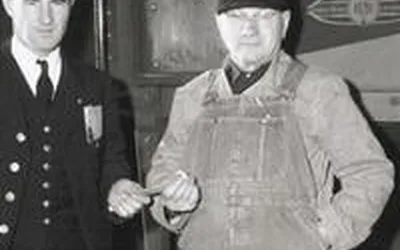
McGee was born September 7, 1914, in Livingston, at 222 South D Street. He came from railroad stock — a third-generation railroader — and in 1936, having survived the rough work of the Great Depression (washing dishes for 250 construction workers on the Red Lodge-Cooke City highway, working seasonally in Yellowstone Park, laboring on Fort Peck Dam), he saw his application for brakeman accepted by the Northern Pacific Railway. His first pay trip came July 11, 1936. For the next four decades, until his retirement in October 1975, he worked both passenger and freight service, running east to Laurel and west to Helena. World War II interrupted the career: drafted into the Army Air Force in 1942, he served in photo reconnaissance squadrons through the Solomon and Marianas campaigns, landing back in Seattle as a tech sergeant in September 1945 and returning to train service at Livingston.
But it was behind a camera, not at a throttle, that McGee made his most enduring mark. He began photographing railroad history in the 1930s, and over the years amassed a collection of more than 40,000 images that captured the Northern Pacific and its workers in everyday, unglamorous detail. Roughly 32,000 of his negatives are preserved at the Montana Historical Society in Helena, with more housed at Livingston's Yellowstone Gateway Museum. His work found its way into Trains magazine, where he knew editor David Morgan personally, as well as trade publications like Railway Age, the Northern Pacific Historical Association's The Mainstreeter, and numerous books — including the photographs in Richard Green's volumes and the five-volume history of the Northern Pacific written by Dr. Lorenz P. Schrenk and Dr. Robert Frey. He was known to railroad presidents, in demand for slide shows from St. Paul to Portland and Tacoma, and in California, and a pilgrimage destination for rail fans who flocked to Livingston, where Bernice, his wife, would feed and lodge the visitors.
McGee was more than a photographer and conductor. He served as chairman of the Livingston Anti-Merger Committee from 1960 through 1970, fighting the proposed union of the Northern Pacific, Great Northern, and Chicago, Burlington & Quincy railroads, a battle that ultimately carried him to testify in the U.S. Supreme Court. He ran for the Montana Legislature in 1965. After retirement, he was arguably busier than ever, telling his train stories to varied groups, tracing the old Bozeman Trail across the state as a historian of the 1864-1868 route, and helping convert the old North Side School into what became the Yellowstone Gateway Museum. In January 1980, he and Bernice were named Livingston's Citizens of the Year. In 2008 he received the South Central Montana Heritage Pioneer Railroad Award Hall of Fame honor. Late in life, the city gave him his own tribute: McGee Drive, in Sacajawea Park.
That park was perhaps his proudest civic achievement. Serving on the Park Board, McGee helped restore Sacajawea Park, planting and watering more than 196 trees, revitalizing the lagoon and stream area, and nurturing the duck and goose populations that still make the park a showplace. The depot center's statement also credits him with helping save the Livingston Depot and with helping stop the proposed dam that would have flooded Paradise Valley. In other words, as community foundation executive director Gavin Clark put it at the dedication, McGee embodied the idea of planting trees whose shade one will never enjoy. "Warren literally did that 196 times," Clark said. "Not being able to enjoy that shade, but he knew that the work that he was doing would provide that for the future." He added: "Warren's legacy is what is embodied in this sculpture today. He showed us that generosity is not a single act, but a lifetime."
The statue itself was a labor of love begun years before McGee's death in 2017 at age 102. His friend Patricia Grabow — who attended McGee's 100th birthday celebration in 2015, camera in hand — campaigned for years to commemorate his contributions. She petitioned sculptor Mary Michael, who works in cast bronze, to take on the project. Michael, who created Livingston's beloved sculpture of Sacagawea and her son Pomp near the Civic Center, recalled that Grabow "had wanted something done for Warren for years." Michael already had an idea for a sculpture of McGee sitting on a bench, so she took many photos of McGee in exactly that pose. The bronze work was cast by Boyer Bronze of Livingston.
The figure, as unveiled, is slightly larger than life-size — partly a quirk of the bronze process, in which shrinkage occurs between the wax and the final casting. And the sculpture was itself not quite complete at the ceremony. An additional piece, depicting young Warren as a boy peering over the shoulder of his older self, both watching the rails, was still to come. When the statue first arrived in the park, city workers were still finishing the concrete pad on which it would sit, and the sculpture of McGee was resting on a pickup truck tailgate. "He looked exactly like he was overseeing the work," Michael laughed.
That collaborative, unfinished spirit was intentional. The dedication was cast not as a closing chapter but as an opening one in a larger revitalization of Underpass Park and the pedestrian corridor that connects Livingston's downtown to the depot. "Warren McGee had a gift for bringing people together to accomplish extraordinary things, and this statue is just the beginning," said Laura McCarthy of the Livingston Depot Center. "It represents new partnerships, a revitalized underpass park and pedestrian corridor, a more beautiful downtown, and a stronger community."
The project was made possible by a generous gift from the Washington Foundation — the Dennis and Phyllis Washington Foundation was named among the major donors at the ceremony — and by a partnership among the Livingston Depot Foundation, the Park County Community Foundation, the City of Livingston, and the Livingston Downtown Building Owners & Business Association. Representatives from each spoke at the ceremony, alongside members of McGee's family.
For those gathered around the veiled bronze in Underpass Park that afternoon, the moment carried a deep resonance. As Grabow herself noted, all of McGee's contributions stemmed from that four-year-old's discovery of his lifelong passion. "And doesn't love just about accomplish anything you really want to have happen in life," she asked. The train that interrupted the ceremony seemed to confirm it — a reminder from McGee, as his friends imagined, that he would always be present where the rails run through Livingston. The man who documented the railroad era has now, in bronze, become part of the town's permanent landscape, still watching the tracks, an empty seat beside him for the next generation to join the wait.