


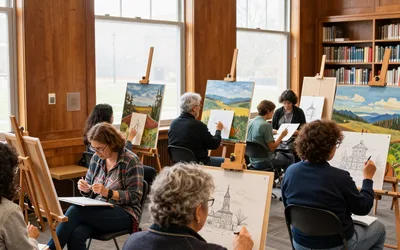
On a Saturday afternoon in mid-October, a handful of Billings artists will set up easels under the oculus of the Billings Public Library and do something that has been a fixture of art training for centuries: they will copy. The occasion is the library's latest installment of the Copyist Program, a series of art events staged at museums, galleries, and libraries across the city, and this time the source material includes George Catlin's "Indian Snow Shoe Dance" alongside selected Western paintings, all made available through the generosity of D. Hummel, a noted Billings collector.
The event runs from noon to 3 p.m. on October 17, 2026, at 510 North Broadway. The artists for this session have already been selected, but the public is invited to drop in, watch over their shoulders, and talk with them as they work. That open-door quality is the point of a copyist program: the copying happens in full view, turning a solitary studio exercise into something closer to a performance.
Copying as a way of learning is not a modern invention. The Metropolitan Museum of Art in New York has run its own Copyist Program since 1872, only two years after the museum first opened its doors, making it the longest-running program in the institution's history. Generations of artists have stood in those galleries and worked from the old masters, and the practice has always carried a range of intentions. A copy can be literal or interpretive, a study or a reimagining. What it is never, in the hands of a serious artist, is mere duplication.
The Billings program follows that tradition but with a distinctly Western flavor. Earlier sessions in the series have sent local artists to the Western Heritage Center and the Yellowstone County Museum, with additional sessions at the Yellowstone Art Museum and the library itself. A December 2024 session at the library invited eight artists to study and reinterpret Joseph Henry Sharp's "Near Fort Washakie," working under the building's oculus. The stated goal then, as now, was to give artists a rare chance to study an original work closely and attempt to recreate it -- and to let onlookers observe and interact with the process.
This year's centerpiece, the Catlin, comes with a story of its own. George Catlin was born in Wilkes-Barre, Pennsylvania, in 1796, trained as a lawyer, and then abandoned the law for painting. Traveling to the American West five times during the 1830s, he painted and wrote about the lives of Plains Indian peoples. His "North American Indian Portfolio" gathered those images into hand-colored lithographs that remain among the most significant visual records of Indigenous cultures and the frontier at a moment of profound change.
The "Snow Shoe Dance" depicts a ceremony Catlin described among the Ojibbeway: a dance performed by hunters, with songs of thanks to the Great Spirit, when the first snow of winter falls. Catlin's own caption for the scene framed it as a dance of gratitude meant to improve the hunting. It is a picture about the turning of the seasons and the dependence of a people on the land -- a subject that lands differently in Montana, where the first snow is still an event worth marking.
The other works on the easels come from the collection of D. Hummel, described by the library as a noted Billings collector. That a private collector would lend original Western paintings for a free public copying session is unusual, and it is what makes the afternoon possible. Copyist programs at major galleries exist precisely because access to originals is rare; most artists spend their careers working from reproductions. For three hours on a Saturday, that barrier comes down in a public library on North Broadway.
There is also something quietly democratic about where this is happening. The Met's copyists work in marble galleries with uniformed guards; Billings' copyists work under an oculus in a public library, where anyone walking in to return a book can stop and watch a painting come together. The artists have been chosen, but the audience has not. That is the invitation: come in, stand close, ask questions, and see what happens when a nineteenth-century image of the first snowfall passes through a twenty-first-century hand.
The Copyist Program runs October 17, 2026, from 12 to 3 p.m. at the Billings Public Library, 510 North Broadway. It is free and open to everyone.