


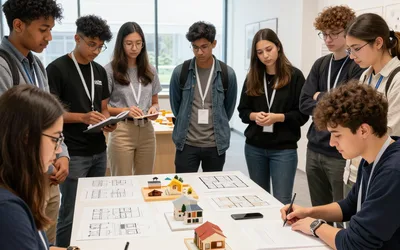
On the evening of October 6, a suite on the ground floor of the Lincoln Mall will look less like an architecture office and more like a design school's end-of-term review. Hand sketches will be taped to the walls, floor plans spread across tables, and small physical models set out for close inspection. The people presenting them, though, are not licensed architects. They are high school students, and the buildings they have spent six weeks designing are tiny houses.
The Lincoln Lighthouse Student Gallery Walk, presented by NOMA Nebraska, runs from 5:30 to 6:30 p.m. at DLR Group Lincoln, 1128 Lincoln Mall, Suite 103. It is an informal affair — guests drift from project to project, students explain their thinking, and light refreshments are served. There is no formal presentation, no podium, no jury. The point is simply to let the students stand beside their own work and talk about it.
Behind that casual evening is a program that did not exist a year ago. The Architecture & Design Club is the first of its kind for NOMA Nebraska, the state chapter of the National Organization of Minority Architects. It launched as a six-week pilot in September 2026, organized in partnership with Lincoln Lighthouse, and enrolled 13 high school students. The curriculum is deliberately hands-on: guided drawing and sketching exercises, model-making and material exploration, an introduction to design thinking and spatial concepts, and direct contact with practicing architects. The students received their own architecture supply kits at the first session, learned industry vocabulary through a game called "Archi-Talk-Ture" Bingo, and were handed their design challenge — a tiny house — to carry through the full six weeks.
The club was led by Britt Coudriet, an architectural designer in Lincoln and a NOMA member, who has been candid about why the chapter built the program. In a post this year, she cited a stark figure: in 2024, Nebraska had only four Black male licensed architects and zero Black femme licensed architects. "This absence is felt in the walls of our schools, the streets of our neighborhoods, and the futures imagined for our communities," she wrote. NOMA Nebraska's stated mission is to foster justice, equity, diversity, inclusion, and collaboration in the state's architecture and design community, and the design club is its most direct attempt to widen the front door. As the chapter put it when announcing the club, the work is about expanding access to the profession and "creating meaningful pathways" into it.
That mission has deep roots. The National Organization of Minority Architects was founded in 1971 by twelve African American architects in Detroit, at a moment when the profession was overwhelmingly white and the pathways into it were narrow. More than fifty years later, the national picture has shifted only slowly — NOMA and outside observers still note that a small fraction of the country's licensed architects are Black. The Nebraska chapter's approach is to start early, before students have decided what they can and cannot become. As the chapter's own program page notes, for many students, especially those from underrepresented backgrounds, architecture "is simply not visible as a possible future." The design club is an attempt to make it visible.
The partner organization on the other side of the program has its own long history in Lincoln. Lincoln Lighthouse was founded in 1990 by Peter and Maureen Allman and Jim Perry, after Pete Allman visited Covenant House in New York City in the late 1980s and came home to hear from Lincoln community members that local teenagers needed a safe place of their own. Initial funding from the Woods Charitable Fund paid for a needs assessment, and the organization opened in the Atwood House at 17th and G before moving a year later to a spot across from its current site at 26th and N. The present Lighthouse building went up in 2008 after a capital campaign. From the beginning, the focus has been education and high school graduation, paired with recreation and social connection.
Today Lighthouse is an accredited after-school program serving middle and high school students Monday through Friday, twelve months a year, with academic support, evening meals, counseling, mentoring, and enrichment activities. Its own framing is that teenagers need "a safe harbor during the high risk, after-school hours." The organization estimates that roughly $1,100 a year covers everything one teenager receives through its services — academic help, a healthy evening meal, counseling, mentoring, and structured activities — and it points out that the same year in the youth detention center costs $6,240. The comparison is the argument: prevention is cheaper, and better.
The tiny-house project sits at the intersection of those two missions. It is enrichment programming for Lighthouse students and pipeline-building for NOMA Nebraska at the same time. The chapter has been explicit that the program needs outside support to keep going; its sponsorship ask is a $500 one-time donation, which it says covers three students for the six weeks, going toward drawing and modeling supplies and dinner. The professional partners listed for the pilot include Alley Poyner Macchietto Architecture, BVH Architecture, DLR Group, HDR, Pella Corporation, and Schemmer — several of Lincoln and Omaha's established firms, lending staff time and, in DLR Group's case, the room where the gallery walk will be held.
That venue is itself a small statement. DLR Group is an integrated design firm offering architecture, engineering, planning, and interiors, and its Lincoln office sits in the heart of downtown, a short walk from the restaurants and garages of the Lincoln Mall corridor. Hosting teenagers' hand-drawn floor plans in a working architecture office is the kind of thing that makes a profession feel less remote to a fifteen-year-old.
What visitors will actually see on October 6 is the raw material of design: sketches made before the ideas were fully formed, diagrams working out how a small space might function, floor plans drawn and redrawn, and physical models built by hand. Tiny houses are a useful teaching constraint precisely because they are unforgiving — every square foot has to justify itself, and there is nowhere to hide a bad decision. For students who have never met an architect, the exercise is also a first encounter with the idea that the built world is designed by people, and that those people could include them.
The gallery walk is free and open, an hour long, and deliberately unstructured. The students will be there to explain their work themselves — which, for a program built around the premise that these teenagers should "see themselves as designers, creators, and problem-solvers," is arguably the whole point.