


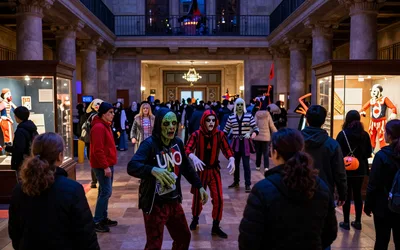
For one evening each October, the grand waiting room of Omaha's old Union Station fills with small ghosts, goblins and superheroes instead of travelers. The Great HALL-oween Haunt, the Durham Museum's family Halloween night, returns on Tuesday, October 20, from 5 to 8 p.m. The museum closes at 4 p.m. and reopens at 5 for the event, and advance tickets are encouraged because the night has become one of the museum's most popular of the year, though walk-up tickets are sold the day of the event if space allows.
The premise is simple and specific to this building: trick-or-treating through a history museum. Children in costume collect candy from costumed historical characters stationed throughout the exhibits, which means the people handing out sweets are as likely to be figures from Omaha's past as they are to be witches. Games and crafts take over the Swanson "Ghoulery," and visitors can walk through the museum's historic train cars, decorated for the season with cobwebs, skeletons and spiders. The Durham is careful to describe the haunted train as spooky but not too scary, a distinction that matters when the audience skews young.
The train cars are not a Halloween prop. They are part of the museum's permanent collection, and the holiday is one of the few times of year when families are encouraged to climb aboard. The haunted fleet is open daily from October 13 through November 1, except Mondays, so the Haunt falls in the middle of a broader Halloween season at the museum rather than standing alone.
The night's signature spectacle is the dancing zombies from UNO's The Moving Company, a crowd favorite that the museum brings back year after year. At the Haunt they perform in the Suzanne and Walter Scott Great Hall, the soaring Art Deco space that was originally Union Station's main waiting room. The museum lists a 6:45 p.m. start for the zombie performance on October 20; the troupe also returns during Hallo-weekend on October 24 and 25. Omaha Circus Arts performs as well, and community organizations set up booths around the building, among them Fontenelle Forest, The Rose Theater and the Omaha Children's Museum.
That setting is the reason the event works. Union Station opened in 1931, designed by architect Gilbert Stanley Underwood in Art Deco style and described as one of the finest examples of that architecture in the Midwest. It was listed on the National Register of Historic Places in 1971, designated an Omaha Landmark in 1978, and named a National Historic Landmark in 2016. The building's ornate ceilings, including those in the Great Hall, have been the subject of a multi-phase restoration, with conservators returning to repair and refinish the Art Deco designs in recent years. Trick-or-treating under that ceiling is a different experience from trick-or-treating down a suburban sidewalk.
The museum itself has a layered history. It opened in 1975 as the Western Heritage Museum, originally housed elsewhere in Omaha, and later moved into the former station. It closed in 1995 and 1996 for a roughly $22 million renovation largely funded by Charles and Margre Durham, whose name the institution now carries. Today it operates as a Smithsonian affiliate, with partnerships with the Library of Congress, National Archives and Field Museum, and it holds collections including the Byron Reed coin and document collection. The old-fashioned soda fountain stays open during the Haunt for food and Halloween sweets available for purchase.
The Haunt is one piece of a fuller Halloween calendar at the museum. A 21-and-over Durham After Dark night is scheduled for Thursday, October 22, from 6 to 10 p.m., with a tasting from Kinkaider Brewing, tarot readings, vintage vendors, Nebraska legends performed by Nebraska Story Arts and rarely seen objects pulled from the museum's collections. Hallo-weekend follows on October 24 and 25, when children 12 and under get in free and costumes are encouraged. The Great HALL-oween Haunt itself is included with museum admission and free to members.
For a city with plenty of pumpkin patches and trunk-or-treats, the appeal here is the collision of the holiday with a real piece of Omaha history. The candy is ordinary. The room it is handed out in is not.