


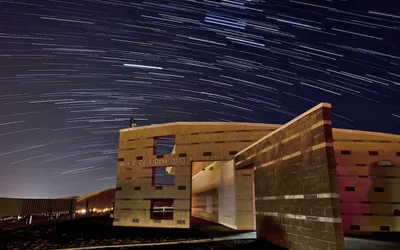
As the sun sinks behind the Sierra Nevada, a different kind of light show begins above Carson City. On Saturday, September 5, Western Nevada College throws open the doors of its Jack C. Davis Observatory for a free Star Party, inviting anyone with a sense of wonder to spend the evening tracing the paths of planets, peering into ancient star clusters, and reaching across 2.5 million light-years to touch our nearest galactic neighbor.
The evening unfolds in stages, each hour offering a new celestial reward. Early visitors will train their eyes on the west-southwest horizon, where Venus blazes brilliantly about an hour after sunset, with the bright star Spica hovering just a few degrees away. Binoculars help reveal Spica as twilight fades. Later, attention shifts eastward as Saturn rises, its rings coming into crisp focus through the observatory's telescopes beginning around 9:30 or 10 p.m.
"We'll be able to catch Venus just as the Sun gets behind the mountains, and it will set pretty quickly after it gets dark," said Dr. Thomas Herring, director of the observatory and professor of physics at WNC. "Saturn won't be up until a bit later, maybe 9:30 or 10 p.m. for good views."
But the evening's true depth lies beyond the planets. "This time of the year is great for globular clusters, collections of tens to hundreds of thousands of ancient stars in our galaxy," Herring said. "Also, a couple of nice galaxies including Andromeda, our nearest neighbor, at 2.5 million light years."
These Saturday night Star Parties, held roughly twice a month, have become a beloved Carson City tradition. They are hosted by the Western Nevada Astronomical Society, a volunteer group affiliated with the college, and are completely free, requiring no tickets or reservations. Visitors wander among the observatory's collection of telescopes, guided by knowledgeable volunteers and astronomy enthusiasts, while a lecture series—now named in honor of Mike Thomas—offers deeper dives into topics ranging from the Trojan War to killer asteroids.
The observatory itself is a testament to what a community can build when it dares to dream big. It began with Robert Collier, who envisioned the creation of an observatory at WNC. What followed was a community-wide effort that brought the facility to life. Astronaut Buzz Aldrin, the second man to walk on the Moon, lent his star power to the effort, appearing at the observatory's First Light ceremony on May 15, 2003, alongside hundreds of well-wishers.
The facility was named for Jack C. Davis, the founding president of Western Nevada College. Today, the observatory houses three main telescopes: two 0.4-meter (16-inch) reflecting telescopes and one 0.25-meter (9.8-inch) reflector, one of which is equipped with a spectrograph. Outside, a small 0.12-meter refractor sits under a robotic dome, dedicated to studying sunspots. All of the telescopes are fitted with cameras and connected to the internet, allowing large groups to view images from remote locations.
A research-grade weather station, powered by solar panels, collects data outside the observatory and transmits it to the Desert Research Institute in Reno for analysis. And connecting the main campus to the observatory is the Planetary Walkway, a path lined with massive sandstone monuments carved by artistic inmates from the Nevada State Prison at the prison's old quarry. Each stone features a carved image of a planet, along with information about it and a dedication to the donors who helped make the observatory possible.
Over the years, the observatory has earned recognition far beyond Carson City. AAA named it among the nine best Western destinations for stargazing and astronomy. It has hosted school visits, special events, and presentations. In 2023, the community gathered to celebrate its 20th anniversary.
"The observatory provides a pretty unique environment for astronomy and astrophysics education," Herring said at the anniversary celebration. "The opportunity to actually point a telescope at something is often lacking in astronomy classrooms. Just being surrounded by the workings of an observatory really aids in teaching and learning about the universe."
For students like Cody Johnson, who took Astronomy 110 and Astrobiology 120 at the observatory, the facility has been transformative. "The observatory itself is an amazing asset to the college, and the students that take classes there are more likely to become interested in STEM fields as a career," Johnson said. "Dr. Tom is an amazing teacher and has been like a mentor to me."
The Star Parties also carry a deeply personal legacy. The lecture series is now dedicated to Mike Thomas, whose memory lives on in every Saturday night gathering where curious minds come together under the stars.
Whether you are a lifelong astronomy enthusiast or simply someone who has never looked through a telescope, the Star Party at Jack C. Davis Observatory offers a rare chance to experience the universe firsthand, guided by experts who are eager to share their passion. The observatory sits at 2269 Vanpatten Avenue on the northern end of WNC's Carson City campus. Doors open at 6:30 p.m., and the evening runs until 11 p.m.
Come early to catch brilliant Venus and Spica, stay into the evening for Saturn, and let the globular clusters and distant galaxies remind you just how vast and beautiful the cosmos truly is. The forecast is the only thing left to cooperate.