


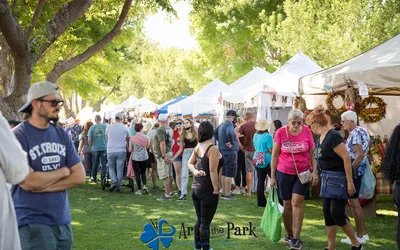
Every October, the parks around Boulder City Hall fill with white tents, the smell of kettle corn, and the work of hundreds of artists from across the West. It is easy to mistake Art in the Park for a simple craft fair — a pleasant autumn weekend of pottery, jewelry, and tie-dye. But the festival's real story begins more than six decades ago, in a living room, with a hospital the community was determined to keep.
Boulder City was built by the federal government to house workers constructing Hoover Dam, and for its first decades it was a company town in the truest sense. The Boulder City Hospital was founded in 1931. When the Bureau of Reclamation announced in 1954 that it would no longer subsidize the hospital, residents walked door to door to raise enough money to keep it running as a community-operated institution. That spirit of self-reliance — a town of a few thousand people deciding it would not lose its hospital — is the soil from which Art in the Park grew.
The festival's founder was Sara Denton, a Kentucky-born transplant who arrived in Boulder City with her husband Ralph, a prominent local attorney. Born Sara Pittard in Paducah, she grew up on a farm with fruit orchards, learned to crochet, quilt, and paint at her mother's knee, and carried that flair for homemaking and decoration into her adopted desert town. By the early 1960s she was deeply involved with the Boulder City Hospital Auxiliary, the volunteer group that raised money for the hospital's needs.
Accounts differ slightly on the exact year. A Boulder City Review feature on Denton's 100th birthday describes the event as one she co-founded "over 50 years ago to save the old Boulder City Hospital," while a Boulder City Hospital Foundation profile of Denton states plainly that Art in the Park began in her home in 1963. A Boulder City Review news story on the festival calls it "a Boulder City staple since 25 women started it in 1962." The discrepancy is a matter of a single year and the difference between the idea and the first sale; what every source agrees on is that a small group of women, led by Denton, launched a homegrown art sale as a fundraiser, and that it worked.
What began as a modest local effort has become something far larger. The Boulder City Hospital Foundation now bills Art in the Park as one of the largest outdoor art festivals in the Southwest and the largest juried outdoor art festival in the region. Boulder City's population sits just over 16,000, yet the festival draws more than 100,000 visitors each year, along with hundreds of artists and crafters. The math is startling: a town of sixteen thousand hosts a crowd six times its size, and does it without charging a dime at the gate.
That free admission is central to how the event works. The foundation's primary revenue comes not from tickets but from renting booth space to vendors, which means the festival's success depends on filling the parks with artists and the parks with shoppers. In one recent year, Art in the Park raised $160,000 for the hospital, according to the Boulder City Review. The foundation has used that money over the years to purchase emergency room ultrasound machines, patient lifts, lab equipment, and even blanket warmers — the unglamorous, essential hardware of a working hospital.
The stakes are higher in Boulder City than in most towns. The Boulder City Hospital is the only hospital in Nevada that does not receive funding from a taxing district, a corporate health system, or mining dollars. It relies instead on the fundraising efforts of the Hospital Foundation and on individual gifts. The foundation itself was formed in 1995 as a nonprofit dedicated solely to supporting the hospital, but its most important engine predates it by three decades. As foundation director Leslie Woodbury has put it, Art in the Park is a "pure fundraiser," with every dollar raised going directly toward hospital needs.
The festival has also become part of the town's identity in a way that transcends its balance sheet. Boulder City is one of the few places in Nevada where gambling was long prohibited by law, a planned community with art deco bones and a walkable core, sitting about 45 minutes from the Las Vegas Strip and a short drive from Hoover Dam, Lake Mead, and the Valley of Fire. Art in the Park fits that character: a small-town street fair with big-city artistic ambition, held in the open air rather than a convention hall.
This year's edition, the 62nd annual, runs Saturday, October 3, from 9 a.m. to 5 p.m., and Sunday, October 4, from 9 a.m. to 4 p.m. It spreads across the four parks adjacent to City Hall at 401 California Avenue: Wilbur Square, Bicentennial Park, and the North and South Escalante Parks. The layout matters — the festival is not contained behind fences or turnstiles. Visitors wander between parks along Arizona and Colorado Streets, drifting in and out as they please. There is no ticketing, no capacity cap, and no admission charge.
The event's programming reflects its dual identity as art show and community fair. First- through third-place ribbons are awarded across multiple categories, including Fine Art, Fine Craft, and Traditional Craft, along with an overall Best in Show. There are live art demonstrations, live music, food and beverage vendors, raffle prize giveaways, and activities for families. The 2026 featured artist is Chuck Watkins of Henderson, whose piece "Larry's Bathhouse" depicts a desert tortoise luxuriating in a clawfoot tub — a fitting mascot for a festival that has always blended craft with a certain desert whimsy.
What makes Art in the Park unusual is not just its size but its endurance. Festivals come and go; this one has run for six decades, through the hospital's expansions and contractions, through the town's transformation from a federal reservation to an incorporated city to a tourist destination. It has survived because it was built on a simple, durable premise: the community would take care of its hospital, and the hospital would take care of the community.
Sara Denton, who was honored by the Hospital Foundation at its Heart of the Community Gala, lived to see her living-room fundraiser become a regional institution. She was described in the Boulder City Review as one of the town's oldest and most cheerful residents, a woman who loved to laugh and lived with gusto. Her legacy is measured now not in a single year's proceeds but in the machines that keep a small desert hospital running, and in the thousands of people who will walk through Wilbur Square this October, most of them unaware that the whole thing started with a handful of women and a hospital they refused to let close.