


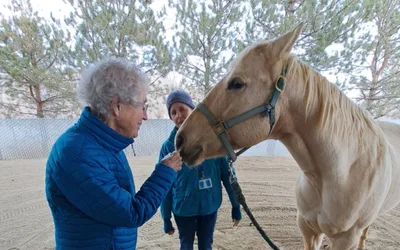
On the first three Saturday mornings of October, a small group of people will gather at a ranch in Minden and stand quietly beside horses. No one will ride. No one needs to know anything about horses. They will come in pairs — one person living with memory loss or early-stage dementia, and the care partner who walks that road with them — and they will spend two and a half hours learning what the animals seem to teach simply by being present.
The program is called Connected Horse, and the sessions at Kids & Horses in Minden are among a growing network of workshops offered at barns. The fall series begins Saturday, Oct. 3, and continues Oct. 10 and Oct. 17, from 9 to 11:30 a.m. each week. Registration requires committing to all three consecutive sessions, and space is limited. There is no cost, though donations are accepted. Prior horse experience is not necessary; participants work with the horses from the ground, and everyone must be able to walk unassisted and take part as a pair.
What makes the workshops unusual is not just that they happen at all — a dementia program built around horses is not something you find on a typical community calendar — but that they rest on formal research rather than intuition. Connected Horse was launched in 2015 by two lifelong equestrians who also happened to be experts in aging and elder care. Nancy Schier Anzelmo, a gerontologist, and Paula Hertel, a social worker, had each spent years watching what a dementia diagnosis does to a family. They saw the isolation, the depression, the way a couple's relationship can get flattened into patient and caregiver. And they believed that horses offered something no pharmaceutical or structured support group could replicate.
That first year, they took the idea to Stanford University's Alzheimer's Disease Research Center and the Red Barn Leadership program. In 2016, the work continued with a three-year study alongside the UC Davis Alzheimer's Disease Research Center and the university's Center for Equine Health, looking closely at how equine-assisted services affected the bond between people living with dementia and their care partners. The pilot study measured the workshops' effect on stress and quality of life, and the results, as the organizers describe them, were striking: significant improvement in mood, a more positive perception of social support, and a greater awareness and appreciation of the relationship between the person with memory loss and the person caring for them. The research has since grown into peer-reviewed publication, international conference presentations, and a current collaboration with Kaiser Permanente studying how "social prescribing" — connecting patients to community programs rather than only to clinics — affects health and wellbeing.
The mechanics of the workshop are deliberately simple. Trained facilitators guide ground-based interactions between participants and horses, along with meditation, sensory walks, and group support. The thinking behind it is that horses, as prey animals, are exquisitely tuned to nonverbal cues and emotion; they respond to and mirror what a person is feeling. For someone whose verbal abilities may be slipping, that can be a relief. The barn becomes a place where communication doesn't depend on finding the right words. Participants report gaining clarity, releasing fear and grief, and learning to be fully present in the moment. The program's own framing puts it plainly: the workshops help people feel whole again.
The dyad model is central. Rather than separating the person with dementia from their care partner, Connected Horse keeps them together throughout every session, which is part of why the research found the relationship itself improving. The program's founders describe the goal as cultivating unconditional acceptance and calming the nervous system through psychosocial and lifestyle activities — a mouthful of clinical language for something that, at the barn, looks a lot like two people standing beside a horse and breathing.
Kids & Horses, the host site, has its own long history of pairing horses with people who need them. The Minden nonprofit was founded in 1999 by Sam and Lorri Waldman, who turned their own Double W Ranch into a center serving children and adults with autism, cerebral palsy, Down syndrome, and other physical and intellectual disabilities. Sam Waldman was an unlikely equine pioneer — born and raised in Brooklyn, a graduate of NYU's school of finance who spent thirty years at Airco Industrial Gases and a decade working in Japan and the Pacific Rim before settling in Incline Village, where he owned Bowl Incline and several car washes and served as a chamber of commerce president and an Improvement District trustee. He was an early adopter of using horses to help people with disabilities. After he died, Lorri and a devoted board, staff, and volunteer corps resolved to carry the mission forward.
The Memory Loss Workshops are one arm of that mission. Another is the Memory Café, held on the fourth Monday of every month from 10 to 11:30 a.m. Now in its second year, the café draws both new faces and regulars, offering activities, social connection, and links to community resources — plus, as the organizers note with evident pride, time with the therapy horses, which is what sets it apart from other memory cafés. Reservations are required and capped at ten individuals plus their care providers, so spaces do occasionally open up.
For the October workshops, registration runs through Catherine O'Brien, the program director, at 775-267-1775. The sessions are free, but the commitment is real: three Saturdays, in sequence, as a pair. That requirement is not arbitrary. The research suggests the benefits build over the arc of the program — the mood lift, the shift in how partners see each other, the slow settling of stress — and a single session wouldn't capture it. What the workshops ask for, in the end, is the same thing the horses seem to ask for: showing up, together, and staying in the moment.