


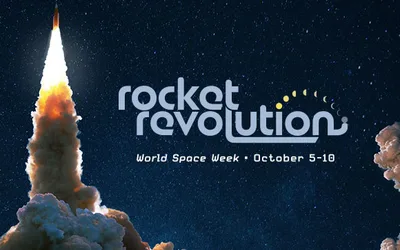
Every October, something quietly enormous happens in the world of science education. For seven days, space agencies, schools, museums, and rocket clubs around the world coordinate their calendars around a single shared theme. The World Space Week Association calls it the largest space event on Earth.
This year the theme is "Rocket Revolution," and in Reno it lands at The Discovery, the Terry Lee Wells Nevada Discovery Museum at 490 S. Center Street. From October 5 through October 10, 2026, the museum is running a week of space programming under the banner World Space Week: Rocket Revolution. It is an official World Space Week event, which means it is part of a global network of celebrations.
The name of the theme is not decorative. "This year's theme is the Rocket Revolution," said Dennis Stone, president of the World Space Week Association, in the organization's September 2026 announcement. "It recognizes how increased space access and falling launch prices have stimulated the space ecosystem and exciting new space applications." The association also intends the rocketry theme as a hook for student interest in STEM fields.
World Space Week itself has a specific and deliberate history. On December 6, 1999, the United Nations General Assembly declared October 4 through 10 as the official dates for the annual celebration. The window was not chosen at random. October 4, 1957, is the day the Soviet Union launched Sputnik 1, the first human-made satellite to orbit the Earth, an event that opened the space age and set off the geopolitical scramble that followed. October 10, 1967, marks the date the Outer Space Treaty entered into force, the foundational international agreement governing how nations may use space. World Space Week brackets those two moments: the beginning of spaceflight and the beginning of the law that governs it.
At The Discovery, the week's programming is built around hands-on participation rather than lectures. The centerpiece is the museum's current featured exhibition, Above and Beyond: The Ultimate Interactive Flight Exhibition, a 5,000-square-foot aerospace installation produced by Evergreen Exhibitions in association with Boeing, in collaboration with NASA and the Smithsonian's National Air and Space Museum. Access to it is included with general admission, and it remains on exhibit at The Discovery through January 17, 2027.
Inside Above and Beyond, visitors can design and test-fly their own supersonic jet, pilot a drone into the eye of a hurricane, experience flight as a bird or a futuristic wing-flapping aircraft, or take an elevator ride to the edge of space. During World Space Week, the exhibition also hosts a compressed-air rocket build at 1:00 p.m., where visitors construct a rocket from a provided template and then launch it on the museum's compressed-air launcher to test its flight capabilities. The exhibition is presented in both English and Spanish.
Outside, in the museum parking lot, the programming turns toward the actual sky. From 11:00 a.m. to 3:00 p.m., the museum is hosting "Staring at the Sun," a solar observing session using telescopes fitted with special light filters. Thomas Herring of the Carson Observatory will be on site to guide visitors through the viewing, and Zach Hamer of Reno Astro will be available to answer questions and assist. It is a rare chance to look directly at the sun safely, and a reminder that the museum's space week is not confined to screens and simulators.
The flight simulators run the full day, 10:00 a.m. to 5:00 p.m., alongside the rest of the museum's 67,000 square feet of permanent and featured exhibitions. The event is general admission, meaning visitors can wander in without a separate ticket for the space programming.
The Discovery opened to the public in 2011 as a private nonprofit and has become northern Nevada's home for hands-on science, sitting between Reno's downtown core and the Midtown District. It serves visitors of all ages, and its mission statement is deliberately plain: "Inspire by being the place to experience science." The museum reported 182,230 visitors in 2019, and its programming spans everything from Camp Discovery to an adults-only Social Science series.
That local institution joining a UN-declared global event is the point of World Space Week. The association's stated mission is to strengthen the link between space and society through public education, participation, and dialogue on the future of space activity. In practice, that means a child in Reno launching a compressed-air rocket in a museum gallery on the same week that a student elsewhere launches a model rocket, and both of them doing it under the same theme.
The timing of the Reno event is convenient for local families. The Discovery is also open 10:00 a.m. to 5:00 p.m. on Monday, October 5 and Monday, October 12, 2026, for the Washoe County School District's fall break, so the space week programming overlaps with a stretch when school is out. The museum advises checking its calendar of events for what is happening across the full week of fall break.
For anyone who has ever wanted to build a rocket and watch it fly, or to look at the sun through a filtered telescope and see it as something other than a bright disc, the week offers both. The revolution, in this case, is small, hands-on, and open to anyone who walks through the door.