


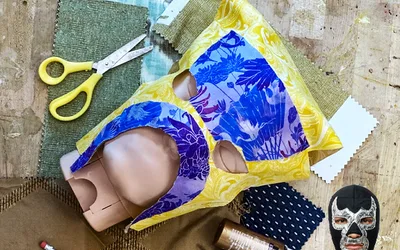
On a Sunday in mid-October, the workshop at The Discovery will smell of glue and fabric scraps, and the tables will fill with masks — some painted in the red, white, and green of the Mexican flag, others in whatever colors a seven-year-old grabs first. The museum's hands-on maker space, called The Shop, will host a drop-in session from 10:30 a.m. to 4:30 p.m. on October 11, 2026, inviting visitors to cut, glue, and decorate their own lucha libre masks. What you make, you keep.
It is a simple craft project on its face. But the museum's own description reaches further back than the scissors and felt: "Lucha Libre has played an important role in Mexican culture since the late 1950s," the event listing reads. "The mask gave ordinary people the chance to be fearless protagonists in the ring. The mask represented hopes, traditions, fears, and accomplishments." The invitation to visitors is pointed: "create their own Lucha masks and use their masks to declare who they are or who they want to be."
That last line is the heart of the thing. In lucha libre, the mask is not a costume. It is an identity.
Lucha libre — Spanish for "freestyle wrestling" — arrived in Mexico in the early 20th century. The mask itself is older still: professional wrestlers were wearing them as far back as 1915, and one of the earliest documented masked grapplers, a Frenchman named Thiebaud Bauer, debuted his disguise at the 1865 World's Fair in Paris before touring the United States in the early 1870s. But it was in Mexico that the mask became something closer to sacred.
The turning point is usually dated to the 1940s and 1950s, when a wrestler named Rodolfo Guzmán Huerta began fighting as El Santo — "The Saint." Born in Tulancingo in 1917, Guzmán debuted in 1934 and spent nearly five decades in the ring, becoming the most famous luchador in history. He wore a silver mask, and he almost never took it off. He appeared in more than fifty films, usually as a masked crime-fighter battling vampires, mummies, and mad scientists, and he starred in comic books that cast him as a champion of the poor. When he finally unmasked on television in 1982, a year before his death, it was a national event. El Santo had become a folk hero — proof that a man of ordinary origins could put on a mask and become a symbol of justice.
That is the tradition the workshop is drawing on. In lucha libre, a mask is a persona, a promise, and a secret all at once. When a luchador loses a mask-versus-mask match — the "lucha de apuestas," or bet match — he must unmask permanently, surrendering his identity in public. It is considered one of the highest stakes in the sport, a wager with real weight attached. The mask carries the wrestler's history, his family lineage, sometimes his whole career. Many luchadores come from extended wrestling families who pass down names and masks across generations.
So a mask-making table is, quietly, a lesson in identity. Children who sit down to decorate one are being handed the same raw material the legends worked with: a blank face and the freedom to decide who is behind it. The museum's framing — "declare who they are or who they want to be" — is a fair translation of what the mask has always meant in Mexican culture. It is a way for an ordinary person to become, for a while, fearless.
The setting matters too. The Discovery, formally the Terry Lee Wells Nevada Discovery Museum, opened in 2011 in the 67,000-square-foot former Reno City Hall building downtown, at 490 South Center Street. It was the brainchild of a local entrepreneur named Chris Riche. The museum now welcomes well over 100,000 visitors a year — 182,230 in 2019 alone.
The Shop, where the mask-making happens, is the museum's tinkering heart. Its philosophy is deliberately messy: visitors are encouraged to "tinker, repurpose, upcycle, take apart, put back together," using real tools and materials. The museum does add a caution — the space offers access to tools that can be dangerous if misused, and parents and caregivers are asked to help younger makers work safely. It is a maker space, not a coloring station.
The workshop falls on a Sunday. The mask session runs the bulk of the day, so there is no need to arrive at the stroke of 10:30 — it is built for drop-ins.
What visitors walk away with is a piece of fabric and cardboard, but also a small inheritance. The mask has outlasted nearly every other prop in professional wrestling because it does something no championship belt can: it lets the person underneath disappear and something larger take their place. El Santo understood that. So did the generations of luchadores who followed, and so, in their own way, will the kids at the table in Reno — deciding, for an afternoon, exactly who they want to be.