


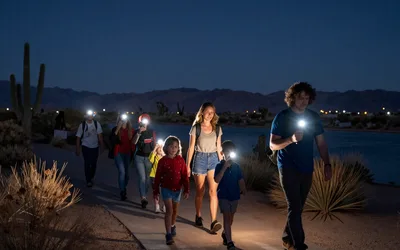
On the night of October 12, 2026, the upper parking lot of Valley of Fire State Park will fill with telescopes pointed at the sky. The occasion is an Astronomy in the Park night hosted by the park and the Las Vegas Astronomical Society, and it begins indoors, in the park's new visitor center, with a presentation by Gabriella Motta, a planetary science PhD candidate whose research centers on Mars geology and meteorites.
That pairing -- a scientist who studies the rocks of another world, followed by a night spent looking up at it -- is the shape of the evening. From 6 to 7 p.m., Motta gives an indoor talk. Then, from 7 to 10:30 p.m., volunteers from the society set up their telescopes in the upper parking lot and invite the public to move between them, each instrument aimed at something different: galaxies, planets, stars. Some members also bring screens to display astrophotography. Guests are welcome to bring their own telescopes, along with a chair or blanket, water, weather-appropriate clothing, and a flashlight with a red, blue, or green setting -- white light is discouraged because it wrecks the dark adaptation that takes the human eye roughly twenty minutes to build and a single stray beam to destroy.
The event is deliberately open. There is no registration and no capacity cap; it is drop-ins only, and the cost is the standard per-vehicle park entry, ten dollars for Nevada vehicles and fifteen for out-of-state ones. Minors under eighteen must be accompanied by an adult. Pets are welcome in most areas on a leash no longer than six feet, but must be kept away from telescope equipment and out of the visitor center. The telescope area, outdoor amphitheater, and restrooms are wheelchair accessible. Because the rest of the park closes at sunset, attendees must remain in the area designated for the event once the sun goes down. The whole program is weather dependent and can be cancelled without notice, so the park advises checking its website before heading out.
Valley of Fire is a fitting place for this. It is Nevada's oldest state park, designated in 1935, and it protects roughly 40,000 acres of bright red Aztec sandstone outcrops set against gray and tan limestone, along with petrified trees and petroglyphs carved into the rock more than 2,000 years ago. The park sits in the Mojave Desert about an hour northeast of Las Vegas, which is precisely the point for an astronomy night: the glow of a metropolitan area of more than two million people is left behind at the park boundary, and the desert sky opens up.
The evening's indoor portion takes place in the park's new visitor center, a roughly 17,000-square-foot facility that Nevada State Parks broke ground on in April 2024. The project was funded in part by a seven-million-dollar grant from The Leona M. and Harry B. Helmsley Charitable Trust, and at the groundbreaking Bob Mergell, administrator for the Nevada Division of State Parks, called it a gateway to the park that would give visitors "enhanced opportunities to connect with the natural beauty and rich history of this unique landscape." The building was slated to open in the fall of 2025, and its exhibits cover the geology, ecology, prehistory, and history of the park and the surrounding region -- a reasonable place to hear about Martian geology before walking outside to look at Mars itself, if it happens to be up.
The Las Vegas Astronomical Society is a 501(c)(3) nonprofit made up of amateur astronomers, formed to promote amateur astronomy in Southern Nevada. Its stated purpose is simply to promote the love and enjoyment of astronomy, and it holds regular monthly meetings and observation sessions where members trade information on current astronomical events, observation techniques, astrophotography, and astronomy software. The club runs an active education outreach program supporting school science and astronomy nights, Scout troops, and service organizations, and it works to keep its events open to the public. Membership is open to anyone.
Its president, Mig Ponce, has described an astronomy habit that started early. "I've been into astronomy since I was about 8 years old," he told KSNV. "My grandmother got me a subscription to a kids astronomy magazine and I was bitten by the bug and here I am, all these years later." Of the view through a telescope, he said, "You are looking at something through millions of miles, billions of miles and it's a pure ethereal feeling." Ponce has also emphasized that expertise is not a prerequisite for the club's public nights. "Some people like to see things through a telescope just because they've never seen that before," he said. "Others like to really ponder what it means about their place in the universe. For me, it's combined excitement of the treasure hunt of seeing something awe inspiring, sharing that with people. It really is just an unforgettable sight for everyone."
That spirit is what the Valley of Fire night is built around. The park describes it as a friendly, informal gathering of people interested in the night sky, with no reserved seating and no ticket to buy beyond the entry fee. Volunteers stand at their scopes and answer questions; visitors wander from one to the next. Some of the instruments will be aimed at planets, others at star clusters or distant galaxies, and the screens set up by members offer a second way to see what the cameras have captured.
For anyone planning to attend, the practical notes matter. Bring a chair or a pad if you want to sit, dress for desert night temperatures that can drop sharply after sunset, and carry water. Red, blue, or green flashlights preserve night vision; white ones do not. Keep pets leashed and clear of the equipment. And check the park's website before leaving, because a cloudy sky or high wind can cancel the program outright.
The event runs from 6 p.m. to 10:30 p.m. on October 12, 2026, at Valley of Fire State Park. Admission is the regular park fee -- ten dollars per Nevada vehicle, fifteen per out-of-state vehicle -- with no registration required.