


On a Tuesday in early October, the Allison D. McCain Commons inside Head Hall at the University of New Brunswick will fill with research posters, information booths, and people who want to talk about how a small city gets around. Mobility Day, hosted by UNB's Community Transportation Research Lab, runs from 11 a.m. to 3:30 p.m. on Oct. 6, 2026, and it is free and open to anyone who walks in.
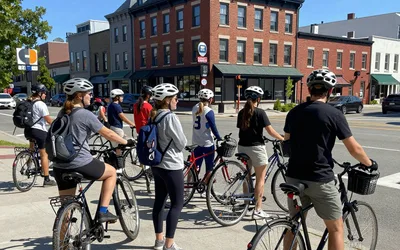
The day begins at 11 a.m. with a research poster display and booths, followed at 11:30 by welcoming remarks from Trevor Hanson, the civil engineering professor who founded and coordinates the lab. From noon to 1 p.m., attendees can drop in on an exercise called "Design your own transit system of the future" — a participatory session that asks ordinary people, not just planners, to imagine how buses and routes might work. At 1 p.m., a roundtable takes up a question that resonates far beyond campus: "Can Regional Transportation solve our parking woes?" The day closes with a group bike ride from 2:30 to 3:30 p.m., meeting at the Windsor and Albert Street sidewalk before walking to the trail. The ride is weather dependent.
Mobility Day is not a one-off. It is the public face of the Community Transportation Research Lab, known as CTRL, which Hanson launched in 2024. The lab exists because of a gap Hanson and his colleagues kept running into: most Canadian transportation research focuses on big cities, while smaller urban areas, regional corridors, and rural communities are left with high car dependence and few of the sophisticated planning tools and data that larger centres take for granted. CTRL's stated aim is to bring an engineering lens to partnerships with communities, helping them improve their transportation planning practices and develop effective alternatives that reduce reliance on cars while preserving personal mobility. Its focus is deliberately on places with fewer than 200,000 people.
The scale of the challenge is visible in the numbers. According to UNB, more than 16,000 cars enter and exit College Hill in Fredericton every day, and more than 4,000 vehicles enter and exit the UNB Saint John campus daily. Both campuses are served by transit, but the vast majority of people still arrive by car. In a province as car-dependent as New Brunswick, changing that is not simple.
The first UNB Mobility Day was held in October 2024, with events on both campuses — Oct. 15 in Fredericton and Oct. 18 in Saint John. It was organized by CTRL in partnership with the UNB Sustainability Office and the UNB Urban and Community Studies Institute, and it coincided with the launch of Hanson's new lab. The program that year included transportation-focused presentations, information booths, panels, and micromobility demonstrations, all aimed at improving student transportation access. The Saint John edition featured e-bikes from the NB Lung Association and an electric Flex Bus from Saint John Transit, which proved popular with attendees. The Fredericton event had to pivot online because of a power outage, but the Saint John gathering proceeded as planned.
The idea for Mobility Day came from abroad. It was inspired by a similar event in Stuttgart, Germany, led by Prof. Lutz Gaspers of HFT Stuttgart, who attended both the UNB Fredericton and Saint John gatherings. The Canadian and German connection runs deeper than a single event: in April 2024, UNB civil engineering students traveled to Stuttgart for a summer school on mobility, working alongside HFT master's students in transport infrastructure management on an international comparison of how Canada and Germany administer mobility and transport policy. Their visit included a tour of the Stuttgart 21 railway project, the largest railway construction site in Europe, where the city's main station is being converted from a terminus into a through station. Gaspers also led the group through Esslingen, offering insights into the development of public transport in and around that medieval city.
Hanson himself has spent two decades in and around transportation policy. He is a professor in the department of civil engineering and a familiar figure at transportation conferences and municipal gatherings across the province.
His lab's work is grounded in data. A CTRL report on quantifying travel demand notes that UNB has a student population of roughly 10,000 and about 4,000 employees spread across its Fredericton and Saint John campuses — a substantial daily commuting load for a small city. The lab's research areas include developing models and analysis to support "what-if" scenarios, collecting data in places where it is limited, and studying datasets that have not yet been fully analyzed for transportation planning. Student trainees form the core of the lab, with projects scaled from undergraduate work up through master's and PhD research.
That emphasis on students is not incidental. The roundtable at this year's Fredericton event is expected to draw on student leaders from multiple institutions, continuing a collaboration that in past years brought together UNB, St. Thomas University, and the New Brunswick Community College. Hanson has described Mobility Day as an anchor for discussing transportation issues and an opportunity to promote change within communities, addressing core concerns such as inadequate parking and high transportation costs.
The broader context is shifting, too. Fredericton Transit introduced a new Route 300 Campus Connect in June 2026, a service designed to link key destinations across the city — including the UNB Student Union Building, the Dr. Everett Chalmers Regional Hospital, Regent Mall, and surrounding neighbourhoods — as part of a phased transit expansion. The city's transit system carries more than a million passengers a year and operates seven days a week, with an all-accessible bus fleet.
Against that backdrop, the questions on the table at Mobility Day are practical ones. Where should buses run? Who gets left out when a city is built around cars? Can a regional approach ease the daily scramble for parking on a hill that sees 16,000 vehicles a day? The event's format — posters, booths, a drop-in design exercise, a roundtable, and a bike ride — suggests the organizers want answers to come from the people who live with the problem, not only from the experts who study it.
Mobility Day runs Oct. 6, 2026, from 11 a.m. to 3:30 p.m. at the Allison D. McCain Commons in Head Hall, 15 Dineen Drive, Fredericton. A second session is scheduled for Oct. 7 at the Hans Klohn Learning Commons. The event is free and drop-in; questions can be directed to Trevor Hanson at UNB.