


Every oak on the Squam watershed ridge began its life as a gamble made by a squirrel. That is the premise behind "Nuts About Nature: The Secret Life of Squirrels," a free family program running from 10 a.m. to noon on Saturday, October 10 at the Squam Lakes Association in Holderness. The two-hour session is built around a deceptively simple idea: the bushy-tailed animals raiding backyard feeders all autumn are, in fact, among the most productive foresters in the Northeast — and they do it entirely by accident.
The mechanics are called scatter-hoarding. Rather than stashing every nut in one big larder, a gray squirrel digs hundreds of small, separate caches across a territory, each one typically holding a single acorn or a few seeds, each one buried shallowly and marked in memory by nearby landmarks — a stump, a rock, the fork of a root. Come winter, the squirrel returns to dig them up. It does not find them all. Estimates of how many caches go unrecovered vary, but the survivors are enough to matter: an acorn buried an inch or two deep, in loose soil, away from the parent tree, is exactly the head start an oak seedling needs. The squirrel forgets; the forest remembers.
That relationship runs deeper than a happy accident. Oaks and squirrels have been shaping each other for millions of years, and the arrangement cuts both ways. Acorns are a squirrel's staple food, and oak masting — the irregular years of overwhelming abundance — is thought to be a tree strategy for satiating seed predators while still leaving enough behind to germinate. Squirrels also move fungal spores along with the seeds, and the mycorrhizal fungi they spread help the very trees that feed them take up water and nutrients.
Central New Hampshire is good territory for the story. The region's forests are home to the eastern gray squirrel, the smaller and more vocal American red squirrel, and the nocturnal flying squirrel, along with chipmunks — all members of the family Sciuridae, which spans roughly 200 to 300 species worldwide. Fall is when the caching behavior becomes impossible to miss, as squirrels shuttle between trees and bare ground with cheeks packed and tails flicking, sometimes stopping to pat down the soil over a fresh cache with their noses and paws.
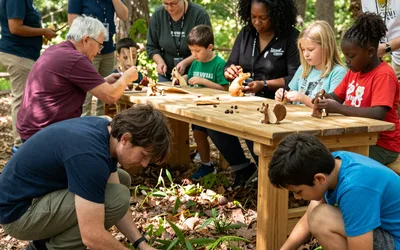
The October 10 program turns that biology into a game. Guests will hunt for hidden "acorns" in a two-part challenge, then test their aim by tossing the finds into a "drey" — the leafy stick nest squirrels build high in tree branches, and the source of the event's second vocabulary lesson. The morning wraps up with a craft session in which participants make their own squirrel art from everyday supplies. The association is inviting whole families and describes the event as autumn-themed fun; it is free and open to the public.
The host organization has been at this kind of work for a long time. At the turn of the twentieth century, Squam looked very different from the postcard lake of today. The surrounding mountains had been stripped by logging, sawdust lay several feet thick in some coves, driftwood made navigation hazardous, and refuse — tires, mattresses, even dead animals — had been dumped into the water. In 1904 a group of concerned landowners formed the Squam Lakes Improvement Association; the following year it was legally incorporated as a nonprofit conservation organization and renamed the Squam Lakes Association. Its early battles were about pollution, water levels, boat safety and navigation. More than a century later, the mission has broadened to conserving the natural beauty, peaceful character and resources of the entire watershed — Big and Little Squam plus Barville, Jackson, Kesumpe, White Oak and Sky ponds, Owl Brook and the Squam River, across the towns of Holderness, Ashland, Center Harbor, Sandwich, Moultonborough, Campton, Meredith and New Hampton.
Big Squam itself is six miles long, nearly 6,800 acres, four miles wide, 98 feet deep at its deepest, and dotted with dozens of islands; it is the second-largest lake in New Hampshire after Winnipesaukee. The association manages more than 60 miles of trails around the watershed, including the Chamberlain-Reynolds Memorial Forest on College Road in Center Harbor, and runs boat rentals and island campsites alongside its education programming.
That education programming is where a squirrel event fits. The association's public offerings lean toward the hands-on and the local — water-quality excursions with Lakes Region Conservation Corps members, guided hikes, paddling trips — and the squirrel session follows the same template: take something ordinary enough to be overlooked, explain the mechanism underneath it, and send people outside to look again.
There is a certain symmetry in the timing. October in the Lakes Region is peak caching season, the weeks when the acorn crop is coming down and the squirrels are at their most industrious. A family that spends a Saturday morning hunting for hidden acorns on the association grounds will, in all likelihood, walk past the real thing on the way back to the car — a gray squirrel digging, burying, patting the soil flat, and moving on. Most of those caches will be found again. Some will not. The ones that are not may be the beginning of a tree that outlives everyone who watched it happen.
Details and registration information are available through the Squam Lakes Association, which asks interested visitors to check its website for program specifics. The event runs 10 a.m. to noon on Saturday, October 10, at the association's Holderness campus.