


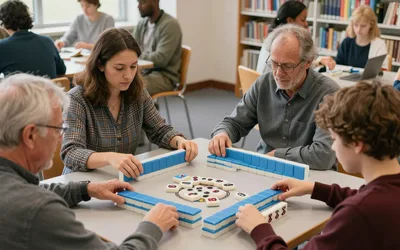
On a Saturday morning at the Portsmouth Public Library, the quiet of the reading rooms gives way to a sound that has traveled a long way to get here: the dry clatter of tiles being washed across a table. From 10:30 a.m. to 12:30 p.m. on November 7, 2026, the library at 175 Parrott Avenue opens its doors for Mah Jongg, the tile game that has been played in one form or another for more than a century and a half. It is free, it requires no registration, and it is open to all ages, with one caveat: children under ten must be accompanied and supervised by an adult.
The session is part of a weekly Saturday gathering at the library, and it comes with a built-in on-ramp for newcomers. Beginners are taught the Taiwanese version of the game starting at 10 a.m., a half hour before open play begins. That detail matters more than it might seem. Mah Jongg is not one game but a family of games, and the version most Americans picture when they hear the name is not the one being taught here.
The game itself is younger than its reputation suggests. Popular lore has long attributed Mah Jongg to Confucius or to ancient dynasties, but scholarly consensus places its development in the mid-nineteenth century, in the coastal regions around Ningbo, Shanghai, and Nanjing during the waning years of the Qing Dynasty. It grew out of earlier Chinese card games, particularly Madiao, a trick-taking game popular in the Ming Dynasty, and possibly the leaf cards known as Yezi Pai, which carried money symbols. The shift from cards to tiles may have been a practical matter of durability, but it also gave the game its signature quality: heavy pieces, a wall you build and then demolish, and the audible rattle that players have associated with the game ever since.
That rattle is embedded in the name. The Chinese word for the game, 麻雀 (máquè), means "sparrow," a reference, most likely, to the chattering and clacking of shuffled tiles. Originally Mah Jongg was primarily a gambling game played by men, and it spread through China's treaty ports, carried by merchants and travelers returning to their home provinces. The tile format may itself have been a kind of survival strategy: Chinese authorities repeatedly banned card games they associated with gambling, and cards were easy to seize and easy to outlaw. Tiles sitting on a teahouse table looked like a puzzle or a pastime.
By the 1890s the game was a fixture of Shanghai's teahouses. Its journey westward is usually dated to the 1920s, when Joseph Park Babcock, a Standard Oil representative who had arrived in China in 1913, helped introduce the game to the United States and touched off one of the most intense game fads in American history. What Americans did with it, though, was their own thing. In 1937 a group of Jewish women formed the National Mah Jongg League and standardized a distinctly American set of rules, built around an annual card of official hands that players buy each year. That version, usually spelled "Mah Jongg" and often called simply "mahj," became the game of suburban living rooms, synagogue social halls, and long-running neighborhood tables.
The Taiwanese version taught at the Portsmouth library is a different animal. It is one of the three major Mahjong traditions widely played in the United States, alongside Hong Kong Mahjong and American Mahjong, and it traces its roots to the style developed and popularized in Taiwan, where the game is a deeply embedded part of social and family life. Its most visible distinction is the hand size: Taiwanese Mahjong uses a sixteen-tile hand rather than the thirteen tiles of Hong Kong style, and it does not require the annual league card that governs American play. Players hold more information, hands can grow in more directions, and the table tends to feel fuller and more kinetic. Scoring is tai-based, and the culture of the table is expressive and social. For beginners, that larger hand can be an advantage rather than a hurdle, since there is more to work with while learning.
Hosting all of this is a library with a history of its own. The Portsmouth Public Library spent much of its existence as a nomad, moving between several locations in the city before settling in 1896 into a renovated building at the corner of Islington and Middle Streets, originally constructed in 1809 as the Portsmouth Academy, a private college preparatory school. The library stayed there for 110 years. In December 2006 it moved to the current building on Parrott Avenue, which was designed in a U shape to keep readers connected to nature on all sides and became the first municipal building in New Hampshire to earn LEED certification, taking silver with strong marks for reuse and recycling, energy conservation, and daylighting. The old building now houses the Portsmouth Historical Society's Discover Portsmouth center and is listed on the National Register of Historic Places.
The new building carries its own talismans. In the main stairwell hangs the Liberty Pole Eagle, a gold-leafed wooden carving about 43 inches high with a 31-inch wingspan, made around 1824 to cap the Liberty Pole that succeeded the one erected in 1766 at the time of the Stamp Act. The eagle perched 110 feet up on Marcy Street as a wind indicator, spinning on a wooden dowel, until it was judged too fragile for the weather in 1977; it was conserved and moved indoors the following year. It is attributed to Laban Beecher, a Boston wood carver who would have been about 19 when he made it, and conservation revealed it had been gilded at least twelve times.
It is a fitting setting for a game that has been reinvented repeatedly and carried across oceans. Mah Jongg has survived bans, crossed the Pacific, been standardized by a league, and split into competing traditions, and it keeps showing up in new places, including a public library on a Saturday morning in New Hampshire. The library's own listing makes the pitch plainly: the game is fun for all ages, free, fast, and easy to learn. No registration, no card to buy, no experience required. Beginners get a half-hour head start at 10 a.m.; everyone else can simply show up at 10:30, pull up a chair, and add to the clatter.