


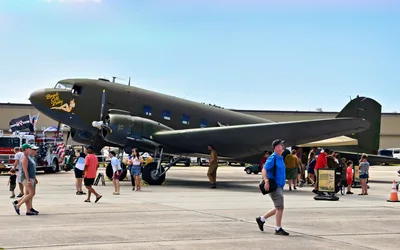
For four days each Labor Day weekend, the flat farm country around Cape May Airport fills with the rumbling of big radial engines and the chatter of a crowd that has come, in large part, to stand before the ghosts of history. That is the scene again in 2026, when the Naval Air Station Wildwood Aviation Museum stages AirFest from Thursday, September 3, through Sunday, September 6. The event is the museum's signature annual event and primary fundraiser, and this year brings together an extensive lineup of historic aircraft.
The setting alone is worth the trip. AirFest unfolds inside and around Historic Hangar #1, the former World War II dive-bomber training facility that now houses the museum. During the war the station prepared young naval aviators for combat flying; the training was dangerous, and by the time the station closed, 42 airmen had died in the line of instruction. The museum that now occupies the hangar is dedicated to those 42 aviators, a memorial that colors everything the institution does. Today Hangar #1 shelters a museum collection of 28 aircraft and helicopters.
AirFest is primarily a ground-viewing and static-display event rather than a scheduled air show, which means visitors get to see aircraft up close, meet pilots and crews, and learn their stories. The lineup spans World War II through the Cold War. Representing the Pacific war that shaped NAS Wildwood's original dive-bombing mission are the opposing sides of the air war: the TBM Avenger "Doris Mae," one of the U.S. Navy's most recognizable carrier aircraft of World War II, alongside a flying Japanese A6M Zero replica, converted from an American military trainer for the 1970 film "Tora! Tora! Tora!" A rare Stinson OY-1 Sentinel named "Gayle Ann," which flew artillery-spotting missions during the Battle of Saipan in June 1944 after being transported aboard the escort carrier USS White Plains, is also expected. So is "Miss Cherrie II," a Fairchild UC-61 Forwarder in U.S. Coast Guard markings recalling anti-submarine patrol history in Cape May County.
The jet age appears in the form of a flying Messerschmitt Me 262 reproduction from the Military Aviation Museum — a tribute to the aircraft that, as the world's first operational jet fighter, transformed air combat at the end of the war. The C-47 "Placid Lassie," a genuine 1943 combat veteran that crossed the English Channel twice on D-Day towing gliders for the 101st Airborne and later flew in Operation Market Garden, the Battle of the Bulge, and Operation Varsity, is among the headliners. There are trainers, too, and they carry an especially personal resonance: the SNJ, the Navy version of the legendary AT-6 Texan, was flown here at Wildwood to prepare naval aviators for combat, and two privately owned SNJs are scheduled to join the flight line. A side-by-side display of a Beechcraft T-34 Mentor and the Japanese Fuji LM-1 developed from it — only a handful of which are believed to still fly — offers a lesson in how one good design can ripple across the world. A rare Yak-52TD, a 1943 Fairchild PT-26 Cornell that once trained British and Canadian pilots, and a Douglas DC-3 round out the roster.
The FAA's William J. Hughes Technical Center also brings aviation STEM exhibits to the field.
Beyond the flying legends, the weekend is packed with what the museum calls aviation and public-safety flavor: military vehicles, fire trucks, living-history reenactors, historical wargaming, face painting and caricatures, a beer and wine garden, and a rotating cast of food vendors from Historic Cold Spring Village's Eatery Too to bacon-on-a-stick. Live music plays each day, from the John Walter Cape Community Band on Thursday to the band Animal House on Saturday and Sunday, while Ted Schwartz's 1940s-style live radio show sets the tone throughout. The Aero Club of Pennsylvania and the Experimental Aircraft Association plan a fly-in, sharing the field with AtlantiCare Medevac, Cape May County Mosquito Control, and the New Jersey Forest Fire Service.
Admission is $18 for adults and $14 for children ages 3 to 12, with free entry for museum members, active-duty military, and children under three. Parking is free, with shuttle service around the airport complex on Saturday and Sunday. Because this is a ground-viewing event rather than a choreographed air show, aircraft arrivals and departures cannot be guaranteed — part of the fun, organizers say, is that you never know quite when something will start up and take to the sky. But the real spectacle is the history itself: a World War II-era hangar that trained young men for war and a community that keeps showing up, year after year, to remind itself what the thunder overhead used to mean.