


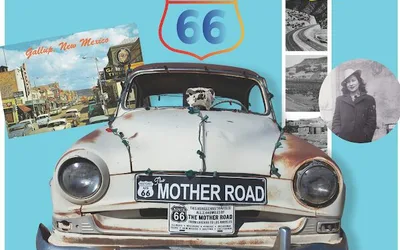
For a century, Route 66 has held a singular place in the American imagination. John Steinbeck called it "the mother road, the road of flight." Songwriters and screenwriters have romanticized it, and travelers from around the world still trace its remaining stretches in search of a lost era of roadside motels, neon signs, and open highway. As the road's centennial arrives in 2026, its history is being told with more depth and complexity than ever before—and one of the most meaningful stops on the celebration circuit is Santa Fe, New Mexico.
From August 28 through 30, the New Mexico History Museum in Santa Fe hosts the Route 66 Centennial Traveling Exhibit, a free, three-day event celebrating both the 100th anniversary of the Mother Road and the 250th birthday of the United States. The exhibit features 22 interpretive panels, oral histories, art, and artifacts tracing the road's century of history in New Mexico—a state that claims one of the longest stretches of the highway of any of the eight states it crossed. The exhibit is the creation of documentary filmmaker Katrina Parks of Assertion Films, who devoted 25 years to capturing the memories, struggles, and triumphs of women whose lives intersect with Route 66. That work became the three-part documentary series "Route 66: The Untold Story of Women on the Mother Road," broadcast through American Public Television. The traveling exhibit draws on Parks' research, pairing the documentary's rare footage and first-person accounts with historic artifacts, art, and interpretive panels that guide visitors through the road's evolution.
The exhibit has been touring New Mexico since early 2026, with stops in Grants, Albuquerque, and Gallup. For Santa Fe, it expands into a full weekend of programming. On Saturday, Aug. 29, a Route 66 Story Recording Station invites visitors to record their own memories connected to the road. Throughout Saturday and Sunday, the museum's auditorium will screen Parks' three-part documentary series. Artist Marla Allison leads hands-on art activities inspired by the iconic vehicles that have traveled the Mother Road—from Model Ts and classic Corvettes to lowriders and Ford Rancheros—allowing participants to customize their own designs.
The weekend culminates on Sunday afternoon with a special preview of a new documentary by Parks about atomic history on Route 66, followed by a panel discussion from 2:30 to 3:15 p.m. with members of the Red Water Pond community, filmmaker Katrina Parks, author and journalist Sharon Niederman, and Kaisa Barthuli, retired program director of the National Park Service's Route 66 Corridor Preservation Program. The conversation will address the lasting impacts of the nuclear age on the Southwest and the work of the preservation program.
The pairing of celebration and reckoning is deliberate. Parks and her collaborators see the centennial as an invitation not merely to nostalgia but to a fuller accounting of what the road carried—not just families on vacation, but also uranium ore, migrants, segregation, and the complex legacies of the communities the highway passed through. The presence of Red Water Pond community members at the Santa Fe event underscores the documentary's central argument: that Route 66's story cannot be told without including the people who bore the costs of the twentieth century's great transformations.
The event is free and open to the public, running daily from 10 a.m. to 5 p.m. at the New Mexico History Museum, 113 Lincoln Avenue in Santa Fe. A century after the road's creation, the Mother Road's stories return to the city, not as pavement, but as memory, art, and story, waiting for the next traveler to stop and listen.