


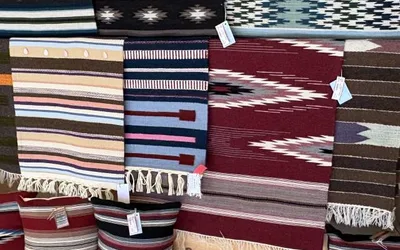
For eleven days every September, the New Mexico State Fair turns a corner of its livestock pavilion into a working wool mill, one that begins with a living, breathing sheep and ends, hours later, with a finished shawl draped across a loom. It is called Sheep to Shawl, and it is one of the most quietly mesmerizing spectacles on the fairgrounds — a full, unhurried demonstration of every step in the ancient chain that turns a fleece into a garment, performed in public by people who have spent decades perfecting each craft.
The exhibit lives inside the Jr. Livestock Pavilion at Expo New Mexico in Albuquerque, the fair's sprawling home on Central Avenue. From September 10 through September 20, 2026, visitors can wander in and watch the whole process unfold: a sheep being sheared, its wool washed and dyed, the fleece carded into soft, workable clouds, spun into yarn on spinning wheels, and finally woven into cloth on a loom. Demonstrations run from 9:30 in the morning until 5:30 in the evening, with shearing scheduled daily from 10:45 a.m. to 2:45 p.m. At every station, a volunteer is on hand to answer questions, explain the tools, and share the kind of hands-on knowledge that no museum display can capture.
The exhibit is a joint production of two organizations that together represent the full arc of New Mexico's wool story. On one side are the Sheep and Wool Producers of New Mexico, the growers who raise the animals and supply the fleece. On the other is the Las Aranas Spinners and Weavers Guild, the fiber artists who turn that raw material into something beautiful. The two groups, aided by friends and supporters from across the state, have made Sheep to Shawl a fixture of the fair for years, and a representative from each is always present to guide visitors through the process.
The guild's roots run deep in Albuquerque. Las Aranas was formed in 1971 with a simple mission: to provide education and learning experiences for its members and to increase awareness of and appreciation for fiber arts. More than half a century later, the guild still sponsors two major public events each year: the Spiders' Market, a fiber arts sale held the third weekend of March, and the Sheep to Shawl demonstrations at the State Fair each September. For the guild's members, the fair is both a showcase and a classroom, a chance to pass along skills that have been handed down for generations.
The pavilion also hosts the fair's annual Wool Show — the official wool show of the New Mexico Wool Growers, open to competitors from around the world — along with the Navajo Sheep Show, the Wool Lead Show, and milking demonstrations. It is a fitting companion to Sheep to Shawl, a reminder that the fair's wool exhibits are not just about history but about the living, evolving craft.
This year's fair, themed around Route 66, is notable for being the only state fair actually located along the historic highway, and it brings with it new attractions like Dino Encounters, a film showcase, and a slate of concerts at Tingley Coliseum. But amid the carnival rides, the green chile cheeseburger challenge, and the rodeos, the quiet, deliberate rhythm of Sheep to Shawl remains one of the fair's most enduring draws.
There is something almost hypnotic about watching the process unfold in real time. A shearer works a fleece off a sheep in one continuous, practiced motion; the wool is washed and dyed in vivid colors; carders turn the tangled mass into smooth, airy batts; spinners draw out thread on wheels that whir and creak; and finally a weaver, working a loom, builds the shawl row by row. By the end of the day, the raw fleece that began on a sheep's back has become a finished garment — a small miracle of transformation that humans have been performing for thousands of years, and that most modern visitors have never seen happen before their eyes.
For the volunteers who staff the exhibit, that moment of revelation is the whole point. The Las Aranas guild was founded to increase appreciation for fiber arts, and there is no better classroom than a fair, where a child can watch a sheep become a shawl in a single afternoon and walk away understanding exactly where their clothes come from. In an age of fast fashion and factory textiles, Sheep to Shawl is a deliberate act of preservation — a living demonstration that the craft is still practiced, still taught, and still capable of turning a humble fleece into something warm, beautiful, and entirely handmade.