


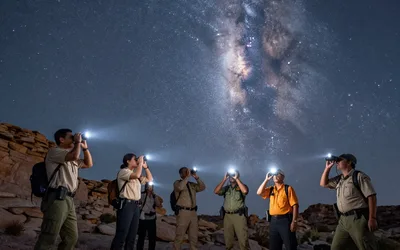
On the evening of September 11, 2026, as the sun sinks and the last daylight drains from the high desert of central New Mexico, a different kind of pilgrimage will begin at the Abó Unit of Salinas Pueblo Missions National Monument. Park rangers and volunteers will gather visitors at the visitor center and lead a sunset hike through the ruins of a seventeenth-century Spanish mission and the Ancestral Pueblo community that once surrounded it. When darkness finally settles, the telescopes will come out, cameras will be trained skyward, and the Milky Way — a river of stars that is visible in only a few places in the United States — will blaze overhead. This is "Dark Skies, Bright Stars!," the park's monthly dark-sky program, and it is free and open to anyone willing to trade a little sleep for a glimpse of the cosmos.
The event is part of a series the National Park Service runs from May through October at the monument's three units. The September 11 edition at Abó runs from 7:00 to 9:30 p.m., and it follows a familiar, beloved rhythm: a ranger-led walk that introduces the site's layered history, a telescope-viewing station where visitors can study the moon, planets, and star clusters, and a dark-sky photography workshop where guests learn to capture the night with everything from professional gear to a simple phone. Those who snap their best shot of the evening can have it printed on the spot by rangers and volunteers and take it home as a souvenir. The programs also frequently feature guest speakers from partner organizations across New Mexico, who share their expertise on a variety of astronomy topics.
What makes the evening so special is the setting itself. Salinas Pueblo Missions National Monument is one of only a handful of places in the United States where the Milky Way is plainly visible to the naked eye, and it earned that distinction the hard way. In 2016, the park received accreditation from DarkSky International as an International Dark Sky Park, achieving Silver-tier status.
The darkness is no accident. The park works hard to protect what nature provides. All of its structural lighting is dark-sky friendly, mounted on motion sensors, and confined to the few areas where it is truly necessary. The result is a landscape where the same stars that guided Ancestral Puebloans a thousand years ago still shine with undiminished brilliance.
That deep history is part of what makes the Abó Unit such a compelling place to stargaze. The site sits west of the town of Mountainair and covers roughly 370 acres. When Spanish explorers first arrived in 1581, they found a thriving Pueblo community, and the number and size of unexcavated pueblo mounds suggest it had been substantial for centuries. In 1622, Fray Francisco Fonte was assigned to the Abó Mission, and working with the Puebloans, he established a convento in rooms of one of the pueblos. Construction on a permanent church and convento began in 1623 and was completed by 1628. A second missionary, Fray Francisco Acevedo, arrived in 1629 and began renovating the church in 1640, enlarging it around the smaller original structure so that services could continue uninterrupted. The work was finished by 1658, producing the imposing mission known today as San Gregorio de Abó.
The mission's story, like its sister site at Gran Quivira, ended in tragedy. A combination of disease, drought, famine, and Apache raiding led to the abandonment of Abó in 1673. For more than a century the site lay quiet, until Spanish sheep herders attempted to return in 1815, only to be pushed out by Apaches in 1830. Settlers permanently returned in 1865, and the remains of those later reoccupation structures can still be seen south and east of the mission today.
The three units that make up the modern monument — Abó, Quarai, and Gran Quivira — sit in a region the colonial Spanish called the Salinas Province, named for the valuable salt deposits found there. Each unit preserves a distinctive seventeenth-century Spanish mission, an American Indian pueblo, and a wealth of other historic structures.
For visitors to the September 11 program, the evening offers a chance to connect those threads — the ancient pueblo, the Spanish mission, and the modern commitment to preserving the night sky. The ranger-led hike is designed to introduce the tapestry of cultures that shaped the Salinas Pueblo Missions and how their interconnectedness continues to shape New Mexico's central region. After the hike, guests can wander between the telescope station and the photography workshop, and those who want to simply lie back and take it all in will find the Milky Way best visible in the summer sky, along with the constellations Sagittarius, Scorpius, the Big and Little Dippers, Corona Borealis, and Cygnus, and the planets Jupiter and Saturn.
The park offers practical advice for anyone planning to attend: arrive at the visitor center to meet staff and volunteers, bring water and snacks, wear comfortable footwear, and carry any stargazing gear or cameras. Red-filtered flashlights are recommended to help navigate without impairing others' night vision, and visitors are asked to stay on marked trails at all times. Because sunset times and weather shift with the seasons, the park encourages checking its website and social media for any changes or cancellations.
The program also carries a quiet message about stewardship. DarkSky International notes that light pollution harms wildlife and ecosystems, human health, energy and climate, and the heritage of the night sky itself. By hosting these monthly gatherings, the park hopes to draw attention to what individuals can do at home — installing motion-activated, fully shielded outdoor lighting, using warm-colored LED bulbs, and switching off unnecessary lights — to conserve the darkness that makes places like Abó so extraordinary.
For those who make the trip to 69 Abo Ruins Road in Mountainair on September 11, the reward is a rare and humbling experience: standing among the ruins of a mission abandoned more than three centuries ago, watching the same stars rise that its builders watched, in a darkness that has survived against the odds. It is, as the park puts it, a chance to experience the awe and wonder of pristine night skies — and to remember that the sky above the Salinas Province is a resource worth protecting, one star at a time.