


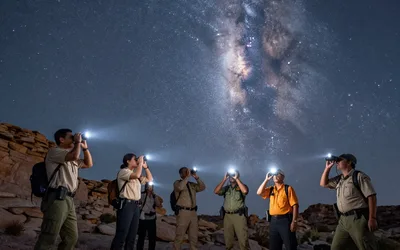
The grounds at Salinas Pueblo Missions National Monument close at 5 p.m. in the summer, but on the evening of October 9 the gates at the Abó Unit will stay open past dark. Park rangers and volunteers will lead a hike into the ruins at sunset, set up telescopes, and teach visitors how to photograph the Milky Way with whatever camera they happen to own — including the one in their pocket. The event runs from 6 to 8:30 p.m. and is free.
The setting is the point. Abó is one of three units of the national monument, along with Quarai and Gran Quivira, scattered across the high desert east of Mountainair in Torrance County. Together they preserve the remains of a cluster of Pueblo communities that Spanish colonists called the Salinas Province, named for the salt deposits that made the region worth trading in. The people who lived here were Tompiro speakers, relatives of the Piro to the south, who settled the valley around the end of the eleventh century and built a town on the edge of the Manzano Mountains where the eastern plains begin.
It was not an easy place to farm. Rainfall was scarce and groundwater scarcer; a small stream south of the pueblo ran only intermittently. The community survived by combining agriculture with foraging and trade, exporting piñon nuts and salt — a commodity the Spanish wanted both for mining and for preserving food. A wall encircled the pueblo, with a single entrance, because nomadic groups from the plains raided the village regularly. Historians have a grim nickname for Abó, Quarai, and Gran Quivira: the Cities That Died of Fear.
Franciscan missionaries arrived in the 1620s. Fray Francisco de Acevedo took up residence at Abó in 1629 and made it his headquarters, partly because of the town's size and partly because its trade gave it resources his other parishes lacked. Within a few years the community had funded an organ for the choir loft of its new church. The mission, San Gregorio de Abó, was built of red-brown sandstone using techniques similar to those at Chaco Canyon, and construction stretched across more than fifty years. By 1641 the pueblo held more than 1,600 people, and the smaller communities of Las Humanas and Quarai had been made visitas of Abó — satellite parishes the priest visited only occasionally.
The prosperity did not last. Drought, epidemic disease, and escalating conflict between the missionaries and the Tompiro hollowed out the community. By 1672 Abó and its mission counted roughly 500 residents; by 1678 the pueblo was abandoned, its people having migrated to Tajique and Islata. Later attempts to resettle the site in the early 1800s were driven off by Apache raids. The ruins sat largely alone until the area was protected, and in 1980 the three units were established as a national monument.
What the Tompiro saw overhead, though, has not changed much. The park received accreditation from DarkSky International in 2016, a designation announced on September 30 of that year by then-Superintendent Tom Betts. The celebration that October drew about 80 visitors to the Gran Quivira ruins, where Jim Greenhouse, space science director at the New Mexico Museum of Natural History and Science, led a night sky tour and astronomers from the Albuquerque Astronomical Society and the Lake County Astronomical Society shared their telescopes. The park had held seven evening events that summer for the National Park Service centennial; the designation committed it to at least four a year going forward. It now hosts monthly programs from May through October.
The park's skies are rated Silver tier, and its structural lighting is deliberately restrained — dark-sky friendly fixtures on motion sensors, limited to the areas where light is genuinely necessary. That restraint is what makes the Abó Unit's night sky legible. The National Park Service notes that in the United States there are limited places where the Milky Way is visible to the naked eye, and this is one of them.
The October program follows a format the park has refined over several seasons. The evening opens with a ranger-led walk through the Ancestral Pueblo and Spanish mission site, framed around the interwoven cultures of the Salinas pueblos and how that entanglement still shapes central New Mexico. After the hike, visitors can move between activity stations: one with telescopes, another on dark-sky photography. The photography station covers long exposures, low-light technique, and how to work without a flash — with instruction aimed at phone cameras as much as at DSLRs and mirrorless rigs. Visitors pick their best shot of the night, and rangers and volunteers print it on the spot as a souvenir. Programs often include guest speakers from partner organizations around the state.
A July event at the same unit showed how the format holds up when the weather does not cooperate. Overcast skies limited the astronomy, but the Moon and Venus still rose behind the ruins, and guest instructor Sarah McIntyre used the conditions to teach attendees how to shoot in low light — stopping down cameras, working from tripods, and making long exposures without a flash. When the clouds briefly broke, telescopes swung toward a triple star cluster. Ranger Adair Bock, seeing guests out at the end of the night, mentioned he had moved a rattlesnake out of the parking lot during the event — a reminder that a nighttime outing in Torrance County calls for a flashlight and a careful eye on the trail.
That is the practical advice the park gives for any of these evenings: arrive at the unit's visitor center to meet staff and volunteers, bring water and snacks, wear comfortable footwear, bring binoculars and a camera if you have them, and carry a red-filtered flashlight so you can navigate without wrecking anyone else's night vision. Stay on the marked trails. Check the park website and social media before heading out, since programs can be changed or cancelled.
What the evening offers, beyond the logistics, is a chance to stand in a place that was a thriving, contested, walled town of more than a thousand people and look up at the same sky its residents did — before the missionaries came, before the drought, before the abandonment. The park frames the dark sky programs as a way to experience "the same naturally dark sky that Ancestral Puebloans saw before the arrival of the Spanish." On a clear October night at Abó, that is not a marketing line. It is simply what is overhead.