


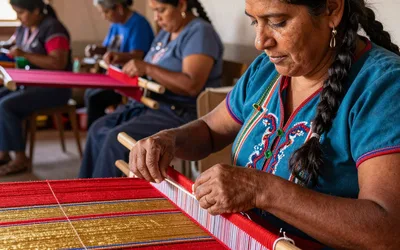
In the village of Chimayo, tucked into the foothills of the Sangre de Cristo Mountains north of Santa Fe, a family has been doing the same thing for a very long time. They raise sheep, they wash wool in the irrigation ditches, and they sit at Spanish floor looms and turn that wool into cloth. Emily Trujillo is the eighth generation to do it.
On the weekend of October 16 through 18, 2026, Trujillo will bring that inheritance down the Rio Grande to Los Ranchos, where she will teach a three-day workshop called Traditional Nuevo Mexico Chimayo Tapestry at Fiber Arts on 4th, the fiber-arts hub on 4th Street NW in Albuquerque's historic North Valley. Admission is $390. It is the second time this year the class has been offered; the first session filled in April.
The premise of the workshop is disarmingly practical. Trujillo teaches Chimayo techniques "on a loom you're familiar with," as the course description puts it, meaning students bring the skills they already have and learn to apply a regional tradition to them. Over three days, participants learn how Rio Grande and Chimayo weaving fit into New Mexico history, try one to three shuttle-work techniques that transfer to other tapestries, and explore one or more Chimayo tapestry techniques. By Sunday, each student finishes a small Chimayo weaving of their own design. Out-of-town visitors can arrange to rent a loom from the studio.
To understand what Trujillo is handing down, it helps to go back a few centuries. Chimayo weaving is not one style but a branch of a larger family of traditions -- Rio Grande weaving is the umbrella term, and it includes the Rio Grande, Saltillo, Vallero, and Chimayo styles, each a visual language developed by the Hispano settlers who arrived in the region in the early 1600s. The thread of it runs even further back: churro sheep supplied meat, milk, and wool, and by the 1700s churra sheep numbered in the hundreds of thousands across the ranches and villages of the upper Rio Grande Valley, and the Dine adopted the same animals into their own renowned weaving traditions.
By the 1840s, weaving was an industry. Records cited by Chimayo-area historians show tens of thousands of wool blankets shipped out of New Mexico on a biannual trade route, and the Rio Grande weft-faced striped blanket -- longer than it was wide -- became the product traders demanded most. Then the bottom fell out. Mill-woven blankets from industrial looms undercut the handweavers, and new sheep breeds such as the Rambouillet began displacing the churro. What saved the craft, in a strange way, was tourism. In the 1880s the railroad reached Santa Fe, and Chimayo families began making smaller, less utilitarian goods for visitors. That market gave rise to what is now recognized internationally as the Chimayo style: two stripes at the top and bottom framing a central geometric design that Chimayo weavers call a chevron. What began as a production response to a tourist trade became, over the twentieth century, a signature American art form.
The Trujillo family has been part of that story for all of it. Emily Trujillo was born in 1993 and raised on Centinela Ranch, the plot of land her family has lived on for six generations in Chimayo. She grew up rinsing yarn in the acequias, talking back to the family's flock of churro sheep, riding donkeys, irrigating orchards, and making enchiladas with Chimayo chile -- surrounded, as she puts it, by skilled weavers and the spectacular weavings they made. She is the only daughter of Irvin and Lisa Trujillo, both nationally known Rio Grande and Chimayo weavers, and the granddaughter of Jacobo "Jake" Trujillo, an accomplished weaver and teacher who helped preserve the Chimayo style through the twentieth century. Irvin began weaving in 1965 and founded Centinela Traditional Arts with Lisa in 1982; the gallery is one of only three weaving galleries left in Chimayo. Irvin received an NEA National Heritage Fellowship in 2007 and the Governor's Award for Excellence in the Arts in 2015.
Emily took a slightly sideways path into the family trade. She graduated from the University of New Mexico in 2017 with a double major in ethnology and psychology, and only became a full-time artist in 2021. By her own account, anxiety kept her from stepping fully into her parents' shoes until August 2022, when she finally felt brave enough to try. Since then she has made up for lost time. She is an award-winning weaver, a recurring juried exhibitor at Santa Fe's Traditional Spanish Market, a co-curator of a six-month exhibition at the Spanish Colonial Art Society's Nuevo Mexicano Heritage Arts Museum, and a manager at Centinela Traditional Arts. She teaches adults and children at the Espanola Valley Fiber Arts Center, the Los Maestros del Norte program, and McCurdy Ministries Community Center, and she leads the Chimayo Weavers Apprenticeship Program, which trains and creates jobs for emerging weavers.
That last piece is the crux of it. Trujillo has described her work as reviving a dying industry -- the Chimayo weaving trade that has existed since the 1880s but is now sustained by a small number of dedicated artists and families in northern New Mexico. The workshop at Fiber Arts on 4th is one expression of that effort, and so is the setting. Fiber Arts on 4th occupies a 7,500-square-foot campus on 1.5 acres near the Rio Grande, built as a hub to connect Albuquerque-area fiber artists with the state's broader weaving, spinning, dyeing, basketry, and felting communities. The studio even keeps a 15-passenger van for excursions to museum shows, fiber sales, and guild events around New Mexico. It is a fitting host for a class about a tradition that has always been carried by families and villages rather than institutions.
There is something worth noticing in the framing of the workshop itself. Trujillo does not ask students to abandon what they know. The class meets people on looms they already understand and layers a regional tradition on top -- history first, then shuttle technique, then Chimayo tapestry structure, then a finished piece of the student's own design. It is the same logic by which the tradition survived its hardest decades: adapt the old forms to the hands and markets that are actually present, and keep the knowledge moving. Eight generations in, that is still the method.
For anyone who has wanted to learn Chimayo weaving but assumed the door was closed, the October session is the second chance of the year. The April class has already come and gone. This one runs Friday, October 16 through Sunday, October 18, 2026, at Fiber Arts on 4th, 6463 4th St NW in Los Ranchos. Details and registration are at fiberartson4th.com.