


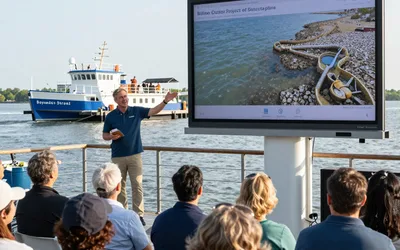
The city disappears the moment you step behind the hangar wall. That was the observation of Scott Koen, the port captain of the Baylander, when he showed a reporter around the ship's landing deck years ago: get behind the big structure and the traffic, the construction, the whole clamor of 125th Street simply falls away, leaving only the Hudson and the low skyline of New Jersey. It is an odd place to talk about oysters, and an oddly perfect one.
On the first Saturday of each month from June through October, the Baylander hosts a free presentation by the Billion Oyster Project, part of the Summer on the Hudson series run by the Riverside Park Conservancy in partnership with NYC Parks. The final session of the 2026 season falls on Saturday, October 3, from noon to 2 p.m., on the ship's so-called Jungle Deck. The event is free, open to all, and requires no registration. What visitors get is a two-hour window onto one of the more audacious ecological experiments underway in any American city.
The Billion Oyster Project was founded in 2014 by Murray Fisher and Pete Malinowski, two men who met at the Urban Assembly New York Harbor School, where Fisher served as director and Malinowski taught aquaculture. Malinowski grew up on Fishers Island in Long Island Sound, the son of aquaculturists who founded the Fishers Island Oyster Farm in 1981. He has said his parents moved there with a vision of starting a business that did not harm the environment. When he came to New York City, he brought that inheritance with him.
The pair shared a conviction that has shaped everything the organization does: restoration without education is temporary. Give students real responsibility for a degraded harbor, they found, and the students rise to it. That idea grew into a program that has drawn thousands of public school students from roughly a hundred city schools into the work of rebuilding reefs, alongside volunteers, community scientists, and restaurants.
The historical case for the work is startling. When Henry Hudson arrived in 1609, the harbor and its surrounding waters held roughly 350 square miles of oyster reefs. Some of those oysters, by contemporary accounts, grew nearly a foot long. Oysters were so central to the life of the city that New York was known, before it was the Big Apple, as the Big Oyster. Canal Street oyster cellars offered all-you-can-eat deals for six cents, a bargain with a built-in hazard: the story goes that management would slip a bad oyster into the pile of anyone who ate too many dozens. The city itself was in part built from the shells, which were burned for lime and used as fill and paving material.
By the mid-nineteenth century, untreated sewage and industrial pollution had begun killing the harbor's native oyster population. The waters stayed grim for generations. It was not until the early 1970s, with the passage of laws like the Clean Water Act, that life began creeping back. Today, Malinowski has said, the waters around New York are cleaner than they have been in more than a century, which is what makes the current effort conceivable at all.
The stakes are not merely sentimental. A single adult oyster can filter as much as fifty gallons of water a day. Oyster reefs function as natural breakwaters, reducing flooding and erosion, and they foster biodiversity by providing habitat for hundreds of species. Malinowski has compared a reef to a forest, with one crucial difference: oysters live underwater, where no one sees them. His stated aim is to make New York Harbor present for more New Yorkers, and a talk aboard a moored ship at a Harlem pier is one way of doing exactly that.
The mechanics of the project are as practical as they are ambitious. Its restoration team collects used shells from more than seventy-five restaurants around the city, keeping them out of landfills and returning them to the harbor. The shells are trucked to Governors Island, where they are cleaned and left to cure in the open air for months, a process that strips away bacteria and organic material until the shells are stable enough to go back into the water. Cured shells become the hard surface that free-swimming oyster larvae need in order to settle and grow. The organization reports collecting more than 300,000 pounds of shell a year and has recycled more than three million pounds to date.
Those shells form the foundation of new reefs, which the team designs, permits, builds, and then monitors, following the data to decide how and where to scale up. The results have been encouraging and also instructive. Oysters are spawning and recruitment is occurring harborwide, but the project has learned a harder lesson as well: small, isolated reefs do not sustain themselves. To create functional, self-sustaining oyster habitat, restoration has to happen at the scale of the whole harbor. That finding is what drives the organization's headline goal of restoring one billion oysters to New York Harbor by 2030. Earlier materials from the project and its partners cited a 2035 target, but the organization's current published goal is 2030, and recent coverage reflects the change. Since 2014, the project reports having restored roughly 200 million oysters and rebuilt about nineteen acres of reef across five regions of the harbor.
The venue for the talk carries its own history. The Baylander began its service life in 1968 as the harbor utility craft YFU-79, one of sixteen Skilak-class lighters the Navy used to move men and material around the delta regions during the Vietnam War. After the war it was laid up, then brought back in 1986 and converted into a helicopter landing trainer, renamed Baylander for its home port at Pensacola Bay. In that role it was billed as the world's smallest aircraft carrier, a 125-foot vessel with a helicopter deck and no hangar, used to give pilots from the Navy, Army, Air Force, Marine Corps, Coast Guard, and National Guard a place to practice landing at sea. It was struck from the Navy register in 2011.
Much of the military configuration survived, which is part of what makes the ship unusual. The Navy typically strips its vessels before they are repurposed, but the Baylander kept its captain's quarters, its antiquated radio room, and other fittings, turning it into something like a floating museum. It arrived at the West Harlem Piers at 125th Street in 2016, and in July 2020 it opened to the public as Baylander Steel Beach, a restaurant and bar from Michael Trenk and partners, the team behind Prohibition on the Upper West Side. The ship now serves as both a waterfront gathering spot and, on the first Saturday of the month, a classroom.
That dual identity is very much in the spirit of Summer on the Hudson, the season-long festival the Riverside Park Conservancy puts on with NYC Parks. Running from May to October and stretching from 59th Street to 181st Street, the series includes more than 300 events: concerts, movies under the stars, dance parties, fitness classes, and learning programs. All of it is free, and none of it requires registration unless specifically noted.
For anyone who has walked the Hudson shoreline and looked at the water without quite seeing it, the appeal of the October session is straightforward. The harbor is cleaner than it has been in living memory, a billion oysters are the stated goal, and the ship hosting the conversation is itself a survivor of a war and a half-century of changing purposes. The city, as Koen once put it, goes away behind the hangar wall. What is left is the water, and a case for what could live in it again.