


On the second weekend of October, Wave Hill sets out a pile of dried corn husks, some string, and a question that has been answered in this corner of the Bronx for thousands of years: what can you make from a plant that feeds you?
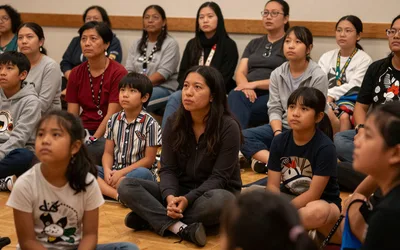
The Family Art Project: Corn Husk Dolls runs from 10 a.m. to 1 p.m. on Saturday, October 10 and Sunday, October 11, 2026, at the 28-acre garden and cultural center overlooking the Hudson River. It is free with admission to the grounds, and no registration is required. At 11:30 a.m. each day, families are invited into the Gund Theater for a storytime reading of "When the Shadbush Blooms," the picture book by Carla Messinger and Susan Katz, illustrated by David Kanietakeron Fadden.
The pairing is deliberate. Corn husk dolls are among the oldest and most widespread Indigenous crafts in North America, made from the dried outer leaves of the maize plant once the ears have been eaten. The husks are soaked until pliable, folded and tied into a figure, and left to dry. There is no face. A widely told story explains why: a corn husk doll who was praised for her beauty grew vain and cruel, and was given a plain face so that she would never again be admired for her looks alone. The lesson is about humility, but it is also about utility -- the doll is made from what would otherwise be thrown away.
That theme of a single plant doing many jobs runs through the whole weekend. Wave Hill's broader Indigenous Peoples' Weekend programming includes nature activities and a walking tour focused on female Lenape Saunksquas, or chieftains, and their role in the 15th-century Dutch-Indigenous alliance. The garden is open for the holiday on Monday, October 12, with free admission for all visitors.
Corn, or maize, was domesticated in Mexico roughly 9,000 years ago and reached the Eastern Seaboard long before Europeans did. For the Lenape -- the Indigenous people whose homeland, Lenapehoking, stretched from western Connecticut down through the lower Hudson and Delaware river valleys -- corn was one of the Three Sisters, planted alongside climbing beans and squash in a mutually supporting garden. The cornstalk gave the beans something to climb; the beans fixed nitrogen in the soil; the squash's broad leaves shaded out weeds and held in moisture. Old Lenape varieties had small ears with only eight or ten rows of kernels, and they came in colors that would surprise a modern supermarket shopper: a blue-black corn, a white flour corn, and one known simply as Grandmother corn.
"When the Shadbush Blooms" takes its title from another piece of that seasonal knowledge. The shadbush, also called serviceberry or Juneberry, is a small understory tree that blooms in early spring, just as the shad -- a migratory fish -- begin their run up the rivers. For the Lenape, the tree's white flowers were a signal that the fish had arrived, and that both fish and berries were ready to be gathered. The book tells its story in two voices, a "Traditional Sister" and a "Contemporary Sister," following a Lenape girl through the cycle of seasons and showing how the same acts -- fishing, picking berries, listening to stories in a warm house -- repeat across generations.
Carla J. S. Messinger, who wrote the book with Susan Katz, is Turtle Clan Lenape and a cultural educator. She directs Native American Heritage Programs with her husband Allan, a historian, and the pair have spent years giving presentations that, as one local newspaper account put it, offer "an accurate portrayal of early Native American life, devoid of stereotypes." Messinger lives in Allentown, Pennsylvania. Katz, her co-author, has written eight children's books. The illustrator, David Kanietakeron Fadden, is Wolf Clan Mohawk, grew up in Onchiota, New York, in a family of artists and storytellers, and works as museum coordinator at the Native North American Travelling College while helping run his grandfather's Six Nations Indian Museum in the summers. The book was named a CCBC Choices title and received a Skipping Stones Book Award honor.
The setting adds its own layer of history. Wave Hill House dates to 1843, and the estate passed through the hands of a long list of notable residents before the Perkins and Freeman families gave the two houses and 28 acres to the City of New York in 1960. The land itself, of course, was Lenape ground long before any of that -- the same ground the walking tour on Indigenous Peoples' Weekend asks visitors to reconsider.
For families, though, the appeal is simpler. A child sits down with a handful of dried husks, folds them, ties them off, and walks away with a doll that has no face and a story about why. Wave Hill House is wheelchair-accessible, with a ground-level entrance and a power-assist door, and ADA-compliant restrooms on the ground and lower levels. Admission to the grounds is $10 for adults, $6 for students and seniors, and $4 for children over six; the art project itself costs nothing extra. The event repeats both days of the weekend, so a rainy Saturday does not mean a missed Sunday.