


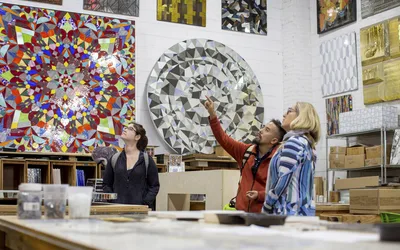
Every October, a peculiar kind of civic generosity descends on New York City. Doors that are normally locked, guarded, or simply invisible swing open. Subway tunnels, rooftop gardens, private art collections, the inner workings of the MTA, the terra cotta gargoyles atop a century-old skyscraper — for three days, they belong to anyone curious enough to show up.
That is the premise of Open House New York Weekend, which returns for its 24th annual edition from October 16 to 18, 2026, unlocking 300 destinations across all five boroughs for behind-the-scenes tours and special activities. Most sites are free and open to drop-in visitors, no reservation required — a deliberate design choice for an event whose whole point is access.
The festival's origins reach back to a moment when New York was doing the opposite of opening up. Open House New York was founded in 2001 by the architect Scott Lauer, in the wake of the September 11 attacks, when much of the city had closed itself off behind new security measures. Lauer, who grew up in the New Jersey suburbs and used to ride the train into the city as a teenager "clutching my camera and bag of subway tokens," built the organization as a countervailing force — one that argued for openness and access as essential components of civic life.
The inaugural Open House New York Weekend followed in 2003, staged as part of the city's first Architecture Week. It was a modest affair: 84 sites, marshaled by 300 volunteers. Lauer has recalled that a volunteer PR team "worked a miracle on a $0.00 budget" to draw media attention, and the response was promising enough to keep going.
Two decades later, the scale is almost unrecognizable. Recent editions have featured more than 340 sites, drawing tens of thousands of visitors. As OHNY's own website puts it, with a wink: "Forget the Mayor, Open House New York holds the keys to the city."
What those keys open is the appeal. Past lineups have included the last surviving Ellis Island ferry, the Sign Museum, the Brooklyn Seltzer Museum, the Alice Austen House on Staten Island — the home of one of America's earliest and most prolific female photographers — and the Brooklyn Banks at Gotham Park, a skate spot immortalized in Tony Hawk's video games of the late 1990s. There are artist studios at the Brooklyn Navy Yard and Brooklyn Army Terminal, the Wet Lab at Hudson River Park, a research aquarium and marine biology field station, and rowing lessons in a five-person Whitehall gig among the skyscrapers of Long Island City.
Kristin LaBuz, OHNY's executive director, has described the Weekend as "a buffet of opportunities for the city," one that specializes in "giving the public access to typically off-limits places or off the radar places." She has framed it in terms of the city's makers as much as its monuments: "New York is a place where people make things." And she has emphasized the breadth of the invitation — "There's a site for everyone, so take your child, your grandparent, or your best friend to check one out."
The mechanics matter if you plan to go. Sites split into two categories. Drop-in sites welcome walk-ins during official festival hours, with no advance registration. Ticketed sites require reservations, usually because of restricted capacity, security needs, or guided-tour formats; those tickets are released in early October through the OHNY website and can disappear quickly. The full lineup is published at ohny.org. The event runs Friday through Sunday, and the festival proper is preceded on the evening of October 15 by a Launch Party at the Woolworth Building.
There is something quietly radical in the premise. New York is a city of interiors — private apartments holding art collections, nondescript warehouses concealing critical infrastructure — and most of the time those interiors are simply not available to the people who live around them. OHNY Weekend inverts that for 72 hours. The theory of change the organization articulates is straightforward: an informed public fosters greater civic participation, and greater civic participation catalyzes an open city.
For a festival born in a season of closed doors, that is a fitting legacy. The 24th edition arrives October 16-18, 2026, across all five boroughs. Most of it costs nothing but the willingness to walk in.