


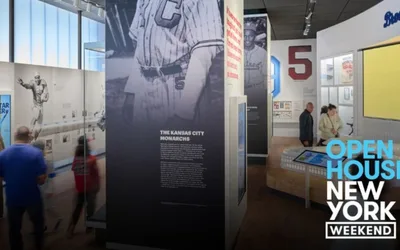
For one weekend each October, Open House New York throws open the doors of roughly 300 buildings, studios, infrastructure sites, and cultural institutions across the five boroughs, letting the public wander into places that are usually closed, ticketed, or simply overlooked. The 2026 edition, the festival's 24th, runs October 16 through 18, and among the sites on the list is one that has only been open to the public since 2022: the Jackie Robinson Museum at 75 Varick Street in Hudson Square.
The museum hosts a free Community Day, part of the OHNY Weekend program. The building stays open from 11 a.m. to 6 p.m., with the special activities running until 3 p.m. Visitors can join gallery tours that trace Robinson's deep-rooted imprint on New York City, from his playing days at Ebbets Field in Brooklyn to the decades he spent in Harlem as an athlete, an activist, and a businessman. There is a new signature Digital Scavenger Hunt and a round of "42" Trivia with prizes, a hands-on map activity called Jackie In My Neighborhood that invites visitors to mark the local sites where he lived, worked, and socialized alongside the places dedicated to his legacy today, and art-making stations for all ages. The museum is also offering a quiet zone for guests who need a sensory break, in addition to its regular KultureCity accessibility resources, and groups are welcome with advance notice.
That the museum exists at all is a story of patience. Rachel Robinson, Jackie's widow, announced the project on April 15, 2008, the 61st anniversary of her husband breaking baseball's color barrier with the Brooklyn Dodgers at Ebbets Field. Ground was not broken until April 27, 2017, by which point the Jackie Robinson Foundation had raised $23.5 million of a planned $42 million, and the opening was pushed to 2019. It slipped again. When the ribbon finally came down on July 26, 2022, Rachel Robinson, who had turned 100 just a week earlier, watched from a wheelchair in the summer heat and then cut it herself. Her daughter Sharon, 72, and son David, 70, were there too. The museum opened to the public on September 5, 2022, more than fourteen years after it was first announced.
David Robinson told the crowd that day that the issues his father challenged in 1947 had not gone away. "The signs of white only have been taken down," he said, "but the complexity of equal opportunity still exists." It was a fitting note for a museum that its own curators describe as being about a lot more than baseball. The family's original collection lived in a den at their Stamford, Connecticut, home, where one wall held photographs and plaques of Jackie's athletic achievements and a second wall, twice the size, was devoted to his social activism. The museum is, in effect, a modernized and vastly expanded version of that room, with a collection of more than four thousand artifacts, most of them from the Robinson family's own holdings.
Among the highlights is an interactive model of Ebbets Field, the demolished Brooklyn ballpark where Robinson played his home games, and Robinson's original National Baseball Hall of Fame plaque. The museum is operated by the Jackie Robinson Foundation, which Rachel Robinson founded in 1975, and it is described as New York City's first museum to focus primarily on the civil rights movement. The building that houses it, One Hudson Square, has its own history: an 18-story industrial structure designed by Ely Jacques Kahn in the modern-classical style and completed in 1929 and 1930, commissioned by Abe Adelson and built on land owned by Trinity Church. In its early years it was home to printing and publishing tenants, including the Macmillan Company and the Royal Typewriter Company, a reminder that Hudson Square was once the city's printing district. The museum occupies the ground floor, a 19,380-square-foot space.
The Harlem chapter of Robinson's life, which the Community Day tours emphasize, is easy to underrate. After his playing career, Robinson became the first Black television analyst in Major League Baseball and the first Black vice president of a major American corporation, Chock full o'Nuts. In the 1960s he helped establish Freedom National Bank, a Black-owned financial institution based in Harlem. He served as the first chairman of its board of directors, working to ensure the bank not only turned a profit but expanded access to loans and banking services for Black residents of Harlem and Bedford-Stuyvesant who had long been denied them. Freedom National stood at the center of 125th Street from 1964 until it closed in 1990. As the museum's own account of the bank puts it, the work caused Robinson considerable worry and many sleepless nights, but it was one of the clearest examples of his decades-long push for Black economic progress and independence.
That is the thread the Community Day is built around: not just the numbers on the back of a baseball card, but the neighborhood map of a man who lived and worked across the city. Visitors who come for the scavenger hunt and the trivia may leave with a sharper sense of where in New York those chapters actually happened. The event is free, and the museum asks that groups register in advance. Full details and ticket reservations are available through the Jackie Robinson Museum's website and the Open House New York Weekend listings.