


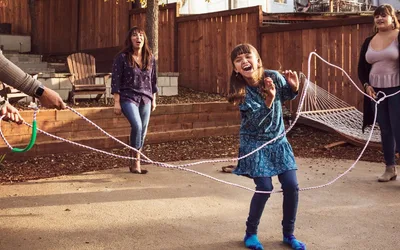
Late on a Thursday afternoon in October, the sound arrives before the sight does: the soft, insistent slap of two long ropes striking pavement in an eggbeater rhythm, one turning clockwise, the other counterclockwise, while somebody in the middle tries to find the gap between them. That sound has been a fixture in Washington Square Park since early May, and it will keep going through the end of October. Every Thursday between 5:30 and 7 p.m., the Double Dutch Aunties set up in the park and teach whoever walks up the fundamentals of street-style and competitive jump rope. The sessions are free, open to all ages, and require nothing but a pair of sneakers and a willingness to look foolish for a minute or two.
On Thursdays the park belongs to the ropes. The format is deliberately unglamorous: no registration, no equipment to buy, no performance standard to meet. Beginners learn to turn before they learn to jump, because turning is the part that makes the whole thing work, and the timing of two ropes is a skill in itself. More experienced jumpers get pushed toward the competitive side of the sport, where speed, tricks, and choreography come in.
The group behind the sessions describes itself as running weekly Double Dutch programs at parks and recreation centers in New York City and Charlotte, with junior coaches gaining hands-on experience running a recreation program alongside the adults. That detail matters more than it might first appear. Double Dutch in New York has always been a hand-me-down skill, taught by older kids to younger ones on schoolyards and sidewalks, and a session where teenagers coach beginners is closer to the tradition than a formal class would be.
The Aunties also come with a literary side. Their website lays out a trilogy of books following four girls, Fatimaah, Tracey, Daysia, and Kendra, whose friendship is built between two turning ropes. The first, Bronx Born, Rope Raised, is set in the Bronx during the golden era of hip-hop, where Double Dutch becomes the rhythm connecting schoolyards, neighborhood blocks, and the girls' ambitions. The second book, Beyond The Ropes, follows them out of New York into college life and HBCU culture; the third, Bronx Streets, Executive Seats, brings them back around to careers, families, and the question of what they owe the generation coming behind them. The series is fiction, but the arc it describes, from playground to profession to giving back, is the same arc the free park sessions are trying to make real.
The sport itself has a deeper New York history than most people jumping on a Thursday afternoon probably realize. The competitive circuit now extends well beyond New York, with the annual Double Dutch Holiday Classic at the Apollo Theater in Harlem billing itself as the Super Bowl of the sport.
That history is worth holding in mind while watching a first-timer get tangled in the ropes. The eggbeater turn, the rhymes, the schoolyard pedagogy, the idea that a game could be organized into a sport and then handed back to the neighborhood as a free program, all of it runs through a Thursday evening in a public plaza. The Aunties' sessions run through October 29, which makes the October 22 date one of the last two chances this season to learn from them in the park. Anyone who has ever watched a Double Dutch crew from a respectful distance and wondered how the timing works can simply show up, step in, and find out.