


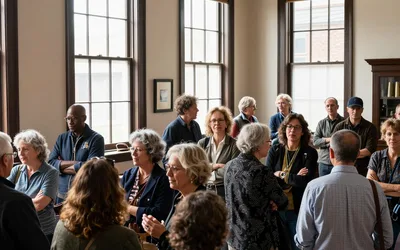
The last farmhouse standing in Manhattan sits on a rise above Broadway at 204th Street, a Dutch Colonial house of fieldstone and clapboard that William Dyckman built around 1784, when the surrounding acres were farmland and the nearest city was a long carriage ride south. On the evening of October 29, 2026, from six to eight, that house will host the opening reception for an exhibition that turns its gaze from the Dyckmans to a different Dutch colonial figure entirely: Peter Stuyvesant.
The show is called Spot P! and it is the work of three people. Kasper Klop is a Dutch artist who came to this history from the outside, asking what his own responsibility is, as a Dutch person, for a man whose name is still all over New York. Morwenna Spagnol is his long-time artistic partner; the two of them describe their practice as mixing theater, puppetry, video, social action and site-specific work, and they have shown at Rattlestick Theater for the Global Forms Theater Festival, Collab NYC, The Tank, Summerhall in Edinburgh, the Voila Europe Theatre Festival in London, and on the streets of Paris. Deron Gopie is the videographer on the project. The reception is free and open to the public.
The premise is a survey. Klop and his collaborators wanted to know how much New Yorkers actually know about Stuyvesant, and then, once they have been told the facts, what they make of them. They did not conduct this inquiry in a gallery. According to the museum, the team set up at three places that celebrate the old colonial officer: Stuyvesant Square in Manhattan, where his statue stands; Stuyvesant Avenue in Bedford-Stuyvesant, Brooklyn; and outside a smoke shop, because Stuyvesant is also the name on a brand of cigarettes. The exhibition displays the replies they collected, in all their variety, from confident knowledge to blank incomprehension to astonishment, powerlessness, indifference, outrage, and answers that managed to hold several contradictions at once.
Alongside the survey responses, the show includes extracts from primary source material, which is to say what Stuyvesant wrote in his own hand about the things he did. It also documents the method: how the team intercepted busy pedestrians, how many of them said no, and the video consent forms signed by everyone who appears in the final footage.
The history the survey is testing is not obscure, but it is unevenly remembered. Stuyvesant was born around 1610 and served as director-general of New Netherland until the English took the colony in 1664. He is routinely credited with laying the foundations of what became New York City, and his name is attached to a square, a statue, a high school, a Brooklyn neighborhood, and a cigarette brand. He was also a trader who owned enslaved Africans, sold enslaved people at public auction, and used his fortune and influence to advance that trade. He held and expressed deeply antisemitic views, and when the Dutch West India Company ordered him to let Jews settle in New Amsterdam, he complied only under protest, having described them in terms the New York Post quoted in 2017 as "deceitful," "very repugnant" and "blasphemous." He suppressed religious minorities generally, and he waged a violent campaign against the Lenape.
That record has made him a recurring target in the long argument over New York's monuments. In August 2017, as Mayor Bill de Blasio weighed the removal of the Columbus statue, the Shurat HaDin-Israel Law Center demanded that the city scrub Stuyvesant's name from public property, including Stuyvesant High School, and replace it with that of Asher Levy, one of the first Jewish settlers in New Amsterdam. The New Netherlands Institute pushed back at the time, arguing that seventeenth-century religious customs were not the same as Confederate memory. The dispute never fully resolved; it simply recurs, in cycles, whenever the city audits its own commemorative landscape.
What Klop's project adds to that argument is not another proposal for removal. It is a question about partial history. Monuments, the exhibition's framing suggests, are symbols of an acknowledged history, of a collective thinking, and the trouble is what gets left out of the acknowledgment. If the laws abolished slavery long ago and the monuments still reflect the men who profited from it, what world are we living in? Why does the law not apply to legacy, in our society and in our community? The show asks what would happen if the full story got told rather than the partial one, as so often happens in the commemorative landscape.
That question lands with particular weight at the Dyckman Farmhouse, which has spent the past several years asking a version of it about itself. The house was built by a wealthy white family whose history was always well known, while the people they enslaved were not. In 2018 the museum launched DyckmanDISCOVERED, an initiative to research and tell the stories of the enslaved and free Black people who lived and worked on the farm and the neighboring Dutch farms of what is now Inwood. Funded initially by the New York Community Trust and later by the Institute of Museum and Library Services, the project hired researchers, produced new educational materials, and commissioned site-specific installations by local artists. It has surfaced names and biographies, including a woman named Hannah, born between 1784 and 1794, who according to census records may have been living in the farmhouse in 1820. The farmhouse passed out of the family, was bought back and restored by descendants, sold to the city in 1915, and opened as a public museum a year later.
Spot P! runs at the Dyckman Farmhouse Museum from October 29, 2026 through January 30, 2027. It is supported by The Holland Society of New York and DutchCultureUSA, a program of the Kingdom of the Netherlands in the United States. The opening reception is free, but space is limited and registration is required. The museum is at 4881 Broadway, at the corner of 204th Street, in Inwood; there is no parking at the farmhouse, and it is easily reached by public transportation.