


The John E. Pechmann Fishing Education Center sits on a hill above a string of ponds off Raeford Road, across from Lake Rim, and from the outside it looks like exactly what it once was: a fish hatchery. That is, in a sense, the whole point. The buildings and the water are the same; only the mission has changed. Instead of raising fish to stock North Carolina's rivers and reservoirs, the place now raises anglers.
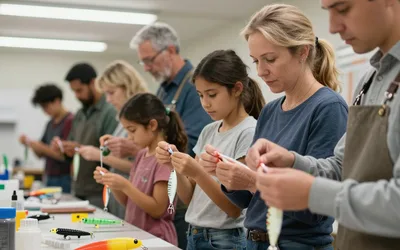
One of its more unusual offerings is the DIY Fishing: Soft Plastics Lure Making Workshop. Participants — the center has historically welcomed kids as young as 8 alongside a parent or guardian — spend the session learning how molten plastic becomes a fishing lure. They work with molds and raw materials, pour their own baits, and go home with a handful of custom soft plastics ready for the water. The workshop covers the fundamentals of turning out artificial worms, lizards, crayfish and other soft baits, the kinds of imitations that dominate tackle boxes for both freshwater and saltwater fishing.
The supply list is short but non-negotiable: closed-toed shoes, long sleeves, and long pants. That is not bureaucratic fussiness. Melting plastic is hot, it can spatter, and the center treats the workshop as a genuine shop class rather than a craft table. The dress code is the first lesson in respecting the material.
What makes the event more than a novelty is the setting. The Pechmann Center is, according to the N.C. Wildlife Resources Commission, the only fishing education center of its kind in North Carolina. Its director, Tom Carpenter, has described a property with a long and shifting history. It began in the 1920s as a private game farm and fish hatchery. The Wildlife Resources Commission came into possession of it sometime before the 1960s, and through the 1960s and into the 1980s it operated as a hatchery for striped bass and channel catfish. When the Commission bought the hatchery in Watha — which had much better water quality — the Fayetteville property was demoted to little more than an equipment depot. The stocking ponds stayed full of water and nothing else.
What rescued it was duck hunting. Lee Warren, then president of the Cumberland County chapter of Ducks Unlimited, was trying to build up a Green Wing event for young members, and the chapter had been running it at a Boy Scout camp in White Oak. That search for a home base led to the idle hatchery grounds, and the ponds that had once grown catfish were repurposed for teaching. The center that grew out of that request now runs classes year-round — introductory fishing for adults and for women, fly-tying at basic and intermediate levels, family fishing workshops, kayak fishing, topwater bass basics, catfishing, crankbait instruction, even a rod-building class where participants leave with the rod they built. The lure-making workshop is part of that same philosophy: give people a skill they can use, and they will keep fishing.
The center's namesake never saw most of it. John E. Pechmann was a prominent criminal defense attorney from Fayetteville who was appointed to the Wildlife Resources Commission in 1993, elected chairman in 1999, and re-elected to a fourth term as chairman. He died in July 2004 at 57, of an apparent heart attack. In a statement released by the Commission, executive director Richard B. Hamilton remembered him as a man with "a great rapport with young people" who "set a positive example for them." Pechmann sponsored youth fishing programs and handed out lifetime licenses to youngsters in connection with National Fishing and Boating Week, and he was instrumental in the approval, funding and construction of the Commission's headquarters at Centennial Campus. He also pushed hard for a "recruitment and retention" program aimed at keeping existing hunters and anglers involved and bringing new ones in. Hamilton called his conservation ethic "exemplary and came straight from the heart."
That emphasis on recruitment and retention is the thread running from the man to the building to a Thursday-evening class about melting plastic. The Commission has been candid that its angling community skews older and that the future of the sport depends on getting new people onto the water. A workshop where a child pours a chartreuse worm and then, presumably, fishes it, is recruitment in its most literal form. The center's programs are free or low-cost, and donations are what keep them that way. Pre-registration is required for events, and a North Carolina fishing license is not needed to take part.
There is also something quietly subversive about the workshop's premise. Soft plastic baits are among the cheapest and most disposable items in a tackle box — the kind of thing anglers buy by the bag and lose to snags without a second thought. Making them by hand inverts that. A poured worm carries the maker's fingerprints, or at least the maker's color choices, and the pride of a fish caught on it belongs to the person holding the rod. The center's own pitch leans into this: don't just fish, fish with something you made.
For families looking for a fall evening that does not involve a screen, the logistics are simple. The workshop runs at the Pechmann Center at 7489 Raeford Road in Fayetteville. Participants should arrive dressed for a workshop, not a picnic — closed-toed shoes, long sleeves, long pants — and should expect to leave with more than they came with. The center is open weekdays from 9 a.m. to 4 p.m., with weekend hours by event only, and its exhibits, fishing platform and restrooms are universally accessible. Anyone needing accommodations can contact center director Tom Carpenter in advance.
The ponds below the building are still there, still holding water that once grew striped bass and channel catfish. On a good evening, someone will walk out of the classroom with a bag of homemade baits and a reason to come back and use them. That, more than any single fish, is what the place was built to produce.