


Every October, the University of North Carolina at Chapel Hill sets aside a day to celebrate the amendment that lets it argue with itself. First Amendment Day, now in its seventeenth year, is a campuswide, daylong series of events built around a simple premise: that a public university is, or ought to be, a marketplace of ideas, and that keeping that marketplace open requires both conviction and tolerance.
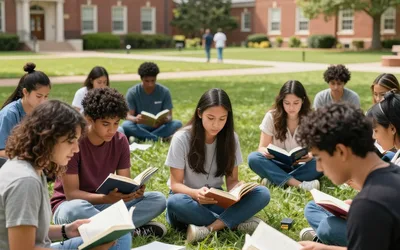
The 2026 edition falls on Wednesday, October 7, timed as always to National Banned Books Week. That pairing is not incidental. Among the day's traditions is a public reading from banned and challenged books, in which students and other members of the university community take turns reading aloud from works that someone, somewhere, has tried to remove from a shelf. The act is deliberately plain — people standing up and reading — and that is the point. It dramatizes what the First Amendment protects by doing the thing that censorship forbids.
The day is organized by the UNC Center for Media Law and Policy, a collaboration between the university's School of Journalism and Media Studies and its School of Law. The center's involvement explains the event's particular flavor: this is not a generic free-speech rally but a program with a media-law spine, concerned with how expression actually works in schools, newsrooms, and public institutions.
The 2026 schedule reflects that mix of the practical and the celebratory. The morning opens with "Speak Freely for Free Coffee" in the Campus Y Courtyard from 9 to 11 a.m., hosted by Freedom Forum First Amendment student ambassadors and sponsored by the Freedom Forum. Participants add their thoughts to a free-expression wall and receive a ticket for a free coffee, redeemable that day at The Meantime Coffee Co., along with First Amendment guides and other giveaways. A half-hour later, from 9:30 to 10:45 a.m. in Carroll Hall Room 33, the Freedom Forum's Alex Morey leads a workshop for student leaders on the difference between exercising your own right to expression and making decisions that affect other students' rights. The workshop is free and open to the public, and students can earn Campus Life Experience credit.
The event's origins reach back to 2009, when the center was approached by the Liberty Tree Initiative, a coalition of media professionals and academics working to raise awareness of free speech. The name came from the colonial-era Liberty Tree, the Boston elm where colonists gathered to speak and organize before the Revolution. UNC's first First Amendment Day was held on October 1, 2009, and it was conceived as a way to address what organizers saw as a declining understanding of America's First Amendment traditions, especially among young people.
The second annual observance, in 2010, established some of the day's enduring rituals. It began — after a morning of rain that one account described as the weather exercising its own freedom of expression — with the planting of a symbolic Liberty Tree next to Carroll Hall. The day went on to include a cappella performances, documentary screenings, and panels featuring visitors from organizations such as the Foundation for Individual Rights in Education. Frank LoMonte, then executive director of the Student Press Law Center, delivered the keynote. Cathy Packer, a journalism professor who led the Center for Media Law and Policy, is credited as the founder of the university's First Amendment Day.
The idea did not stay in Chapel Hill. By 2017, High Point University was planting its own Liberty Tree — a disease-resistant Jefferson elm — as part of its second annual First Amendment Day, and organizers there noted that the observance had spread to dozens of campuses nationwide. Iowa State University held its own First Amendment Day in 2011, complete with a Liberty Tree planting and a speaker from FIRE. What began as one journalism school's response to civic ignorance became a small national tradition.
At Carolina, the format has stayed remarkably consistent across seventeen years: a full day, multiple venues, no admission charge, and an explicit invitation to the general public. The day's stated aims include discussing the public university's special role as a marketplace of ideas and "the need to be tolerant when others exercise their rights" — a formulation that acknowledges the uncomfortable part of free expression, the speech you would rather not hear. That the university pairs its celebration with readings from books others have tried to suppress gives the whole day its quiet argument: the right to read and the right to disagree are the same right, and a campus that honors one has to make room for the other.
First Amendment Day is free and open to the public. A full schedule of events is available at FirstAmendmentDay.unc.edu, and UNC students can register for CLE credit through Heel Life.