


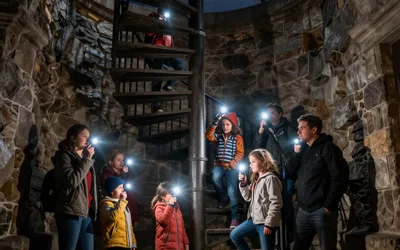
For most of the year, the way to see Old Baldy is to walk up to the keeper's cottage on a weekday morning, buy a ticket, and climb 108 stairs and five landings in broad daylight, with the Cape Fear River estuary spread out below. Twice this fall, the routine changes. On the evenings of October 30 and 31, 2026, the Old Baldy Foundation keeps the grounds open past dark for Old Baldy After Dark, a family-friendly Halloween program built around a nighttime ascent of North Carolina's oldest standing lighthouse.
The event runs from 6:30 to 8:30 p.m. each night. Admission is $13 per person, and the ticket covers everything on the grounds: the scavenger hunt, the Island Ledger graveyard mystery, and Lighthouse Legends Storytime, along with the climb itself. New this year, the climb is timed. Guests choose a specific slot when they buy, a change the foundation says is meant to keep the tower from getting crowded and to give everyone a better experience inside. The timed portion applies only to the lighthouse; ticket holders can arrive whenever they like during the evening, wander the lawn, work through the hunts and stories at their own pace, and head to the tower when their slot comes up. Because the timed slots are limited, the foundation recommends buying in advance through its website rather than waiting until the night of the event.
What makes the evening more than a seasonal photo opportunity is the building it happens in. Old Baldy is the second of three lighthouses built on Bald Head Island since the eighteenth century, all of them meant to guide ships past the shoals at the mouth of the Cape Fear River. The island itself is part of Smith Island, a cluster of islands cut by creeks and inlets, and it took its name from the bare dunes on its south beach that early observers thought resembled a bald head. Offshore, Frying Pan Shoals reach nearly thirty miles into the Atlantic, shifting sandbars under a thin skin of water. Sailors are said to have given the cape its name for the feeling that navigating near them produced.
The first tower, sometimes called "Older Baldy," went up in the 1790s after years of argument over whether the river needed a navigational aid at all. North Carolina's late-eighteenth-century growth, fed by exports of tar, pitch and lumber, had turned Wilmington into a busy trade port, and mariners were struggling with the inlet's hazardous water. The North Carolina Assembly imposed a shipping duty to pay for a lighthouse, and Benjamin Smith, who owned Bald Head Island at the time, donated the land. Construction was slow, with money and materials in short supply, and Alexander Hamilton, overseeing the project, worried openly about the quality of the work; an engineer sent to assess it, William Allibone, reported that the walls looked weak next to other lighthouses along the East Coast. The U.S. Lighthouse Service took over in 1791, Henry Long became the first keeper in 1794, and the light was first activated on December 23 of that year. The tower was built of Philadelphia brick shipped to the island, eight stories tall with a fifteen-foot iron lantern room, glass windows and a copper dome.
That lighthouse did not last. Its position close to the Cape Fear River became a problem as the channel shifted, and the structure deteriorated. The tower standing today was built in 1817, and it has held its original form and location ever since, which is what makes it the oldest lighthouse still standing in North Carolina. It was raised with soft red bricks and finished in stucco, which keepers whitewashed every two years to protect it. When the whitewashing stopped, patches of stucco began to fall away, and from time to time someone passing by would stop and patch a missing piece with new stucco. The result is the mottled, patchwork surface visitors see now, a record of two centuries of small repairs rather than a single original coat.
The light itself has changed as often as the coastline. The original fixed light burned in fifteen lamps. A new apparatus installed in 1834 flashed red on a thirty-second cycle. The light went dark during the Civil War and was not relit until 1879; it was changed to white in 1893 with new lamps. When the Cape Fear Lighthouse Station came into service, Old Baldy was reduced to a fourth-order fixed light in 1903, and the government let it operate as an active station until 1935. During World War II it served as a radio beacon. It is no longer an official navigational aid, but the historic light was relit in 1988, and the tower has been in the care of the Old Baldy Foundation, the nonprofit responsible for its preservation and operation, ever since.
The island's wartime history is part of the setting too. Wilmington was one of the last Confederate ports open to blockade runners, and the Cape Fear region became the Confederacy's final stand in defending the supply line that fed Robert E. Lee's army. After Fort Fisher fell in January 1865, Confederate soldiers at Fort Holmes on Bald Head Island were exposed and the position was abandoned, captured by Union forces on February 16, 1865. The fall of Fort Fisher sealed Wilmington's fate and, with it, the last link in the Confederate supply chain.
All of that is the backdrop for an evening that is, by design, not solemn. The foundation bills After Dark as a family-friendly adventure rather than a haunted house, and the programming reflects it: a scavenger hunt, a mystery staged around the island's graveyard, and a storytime devoted to lighthouse legends, all of it spread across grounds that include picnic tables, a lawn, the lighthouse's Oil House and interpretive signs. The keeper's cottage, a recreation of an 1850s house, holds the Smith Island Museum of History, where artifacts from the foundation's collections rotate on exhibit and where visitors can learn about the keepers, pirates and surf men who shaped the island. On an ordinary day, admission to the lighthouse and museum is $10 for adults and $5 for children ages 3 to 12; the After Dark ticket, at $13, folds the evening's activities in with the climb.
Practical details matter here, because Bald Head Island is not a place you drive to on a whim. The lighthouse sits at 101 Lighthouse Wynd, and reaching the island means a ferry crossing and, for most visitors, leaving the car behind. The event runs two nights only, and the timed climb slots are the piece most likely to sell out first. Tickets for October 30 and 31 are sold in advance through the Old Baldy Foundation's website. The foundation's own pitch for the evening leans on the atmosphere rather than the frights: the ghosts of the past seem to come alive under the glow of the full moon, it asks, so do you dare to climb?