


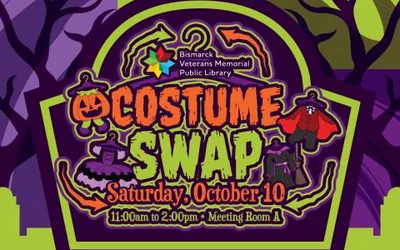
For three days in early October, the Bismarck Veterans Memorial Public Library will do something libraries rarely advertise: it will ask people to bring in things and take nothing back. Between September 28 and October 7, patrons are invited to drop off gently used Halloween costumes for all ages and sizes. Then, on Saturday, October 10, from 11 a.m. to 2 p.m., the library opens Meeting Room A and lets anyone walk in and "shop" the swap for free.
The rules are simple and, in their way, telling. Costumes should be new or gently used, free of tears and stains, and complete — no missing masks, capes, or essential pieces. Accessory donations are welcome, but open containers of makeup, fake blood, or anything messy or unsanitary cannot be accepted. Donations are encouraged but not required; anyone may come to the swap whether or not they contributed. And the library is firm on one point: it will not take costume donations during the swap itself. The drop-off window closes on October 7 so that staff and volunteers have time to sort and arrange what arrives.
It is a small, practical idea — a clothing swap for the one night of the year when what you wear matters more than usual — and it fits a library that has spent more than a century positioning itself as a shared resource rather than a quiet room of shelves. The event is free, open to all ages, and requires no registration. The library's public information specialist, Kevin R. Tengesdal, sent out the media advisory, and the contact for the event is Katie Dinneen-Wirtz, an adult services associate.
To understand why a costume swap makes sense here, it helps to know how this particular library came to exist. Bismarck's first free public library opened in 1917, built with a $25,000 grant from the Carnegie Foundation. The road to that building was long. The city's pioneer women had established a reading room in a schoolhouse with 200 donated books soon after Bismarck was founded in 1873, making the books available after school hours. An early push for a Carnegie library began in 1893, led by Marshall Jewell and C.M. Dahl, and was initially well received by both residents and the foundation — until the Panic of 1893 wrecked the economy and the idea was shelved. More campaigns followed in 1901, led by former Governor Hanna and others, and they too failed. By the 1910s, Bismarck was the only city in the country with a population over 3,000 that had no public library, a distinction its residents did not enjoy. In 1908 the Civic Improvement League formed a library committee, as did the city Federation of Women's Clubs and the Bismarck Commercial Club. By 1915 community members were laying out plans for a reading room and donating materials and labor for shelves and bookcases. The Carnegie letter finally arrived in 1916, and construction was finished at the end of 1917.
That first building was eventually demolished in 1980 and later replaced by a parking garage at 6th Street and Thayer, a structure whose architecture pays respect to the original Carnegie library — each level is named for a famous author, and a plaque inside the first floor recalls what stood there. The library itself had already moved on. In 1963 it relocated, into a building financed through a veterans' bond levy, and was renamed in honor of local veterans. That is the origin of the "Veterans Memorial" in its name, a detail easy to pass without noticing. A major expansion concluded in 1987, producing a 70,000-square-foot building that occupies an entire city block and moved the entrance to its current address at 515 North Fifth Street.
Today the library holds more than 185,000 items and draws over 237,000 visitors a year to its main branch, plus more than 20,000 visits to its outreach locations. Its cardholders — more than 50,000 residents of Burleigh County — borrowed over 632,000 items last year. It is a full-service municipal library serving Bismarck and the surrounding county, and a member of the Central Dakota Library Network, which connects it to resources from 20 libraries across Burleigh, Morton, McLean, Mercer, and Oliver Counties.
What circulates there is broader than most people expect. Alongside books, audiobooks, and DVDs, the library lends board games, video games, art prints, fishing poles, movie binge boxes, and activity passes. That willingness to lend unusual things is part of the same instinct behind the costume swap: a library as a place where the community's stuff gets shared rather than bought, used once, and forgotten in a closet.
The Halloween timing is not incidental to this library's personality. In 2025, the Bismarck Veterans Memorial Public Library was honored at the American Library Association's PR Xchange Awards for a commercial called "Phantom Finds," which promoted its ghost hunting kits. Library director Christine Kujawa accepted the award at a ceremony in Philadelphia on June 28, 2025. A library that lends ghost hunting equipment and makes an award-winning commercial about it is a library that has already decided Halloween is its season.
The costume swap extends that spirit in a distinctly unglamorous direction. There is no admission, no ticket, no registration, and no requirement to give in order to receive. The mechanics are the point: costumes are among the most wasteful purchases a family makes, worn for a single evening and then outgrown or abandoned. A swap converts one household's discarded pirate or princess into another household's Halloween, at no cost, and keeps the whole transaction inside the community. The library's only real constraints are practical — no tears, no stains, no missing pieces, and nothing that could leak or spoil in a bin.
For anyone in Bismarck planning to take part, the sequence matters. Costumes can be dropped off at the library at 515 North Fifth Street between September 28 and October 7. The swap itself runs Saturday, October 10, from 11 a.m. to 2 p.m. in Meeting Room A. Donations will not be accepted that day. Everything else — browsing, trying things on, taking a costume home — is free and open to all ages, whether or not you brought anything to share.