


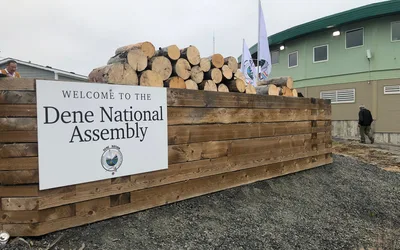
The 56th Dene National Assembly was supposed to happen in Fort Simpson in August. It ended up happening somewhere else entirely, rescheduled more than once, in a different community, in a different season — a gathering defined less by its agenda than by the fires that kept pushing it around the map.
The Dene Nation first announced the assembly for August 11 to 13 in Fort Simpson, the community also known as Łı́ı́dlı̨ı̨ Kų́ę́ First Nation, on the Mackenzie River in the Dehcho region. Then the wildfires came. By mid-July, Fort Simpson was entering its third week under an evacuation order, with a fire burning near the community and rain offering only partial relief. The Dene Nation postponed the assembly, saying it appreciated "the patience and understanding as we support our relatives affected by this natural disaster." Residents would be kept out of the community for roughly three weeks.
At that point the plan was still to hold the assembly in Fort Simpson, just later — rescheduled from August to September 22 to 24. That plan did not hold either. By late August the Dene Nation had moved the gathering to Kátł'odeeche First Nation and set new dates of September 29 to October 1, a decision made in consultation with the Chief and Council of Kátł'odeeche "to ensure the fullest possible participation of Dene leadership," according to Dene National Chief George Mackenzie. "The Dene Nation acknowledges this is the third adjustment to the Assembly schedule and thanks members and communities for their patience and understanding," Mackenzie said at the time.
Then came another adjustment. The Dene Nation announced that the assembly would instead run from October 6 to 8 at Kátł'odeeche First Nation, near Hay River on the southern shore of Great Slave Lake. "This decision has been made in response to the ongoing wildfire situation and out of concern for the safety and wellbeing of delegates, Elders, youth, community members, and all participants who will gather for the assembly," the Dene Nation said in its release. "The Dene Nation remains committed to ensuring that this important national gathering proceeds in a safe, respectful, and meaningful manner."
The backdrop was relentless. At the time of the announcement, 44 fires were burning in the Dehcho region, including an out-of-control blaze adjacent to Fort Simpson. NWT Fire said the community was not at threat, crediting work done to contain the area closest to the community and key travel routes, and crews were making progress on remaining hotspots within Fort Simpson. But smoke from blazes further afield still hung over the region, and the Dene Nation chose not to gamble on the safety of the hundreds of delegates, Elders, and youth who travel in from across Denendeh.
It was the second consecutive year that fire had reshaped the assembly. The 55th Dene National Assembly had originally been set for September 2025 but was postponed to allow the Dene Nation to support NWT communities affected by wildfires — Fort Providence and Whatì were among those evacuated that year. That gathering eventually convened in Radįlį Kóe, or Fort Good Hope, from January 20 to 22, 2026, where delegates passed a resolution to launch a revised constitutional development plan and unveiled a First Nations Data Governance Strategy aimed at building economic independence through Dene-controlled data systems. Mackenzie called it "a very productive meeting, reflecting our resilience and commitment to addressing the pressing issues facing Denendeh."
There is a certain irony in an assembly being chased by fire, given what the Dene Nation was built to do. The organization traces its origins to 1969, when the federal government's White Paper — proposed by Pierre Trudeau and Jean Chrétien — suggested abolishing existing treaties and assimilating Indigenous peoples into the rest of Canadian society. The Indian Brotherhood of the Northwest Territories formed in response, and in 1976 it published the Dene Declaration, which identified the Dene as a nation for the first time. "We, the Dene of the Northwest Territories, insist on the right to be regarded by ourselves and the world as a nation," the declaration read. The name "National Indian Brotherhood of the NWT" was formally changed to "Dene Nation" at a Dene National Assembly, and the constitution was amended to open full membership to all those who had formally declared themselves under the Dene registry. The annual assembly has been the organization's central gathering ever since — the place where the five regional governments of the Gwich'in, Sahtu, Dehcho, Tłı̨chǫ, and Akaitcho, along with Dene from outside the territory, come together to set direction.
Kátł'odeeche First Nation, the eventual host, is a community of Dene people of South Slavey ancestry living in and around the Hay River area. It is a signatory to Treaty 8 and one of only two reserves in the Northwest Territories. The community itself knows wildfire intimately; in 2023, Kátł'odeeche and the Town of Hay River were both ordered evacuated as a fire bore down, sending residents to a crowded evacuation centre in Yellowknife. Hosting the assembly meant welcoming delegates into a community that had recently lived through exactly the kind of disruption the assembly was being moved to avoid.
When the gathering finally opened on Tuesday, October 6, it ran for three days and covered a broad range of ground: health care, Dene youth, climate change, and caribou among the topics on the agenda. The middle day fell on the National Day for Truth and Reconciliation, and the Dene Nation planned a special commemoration, though details were not released in advance. Federal cabinet ministers were scheduled to attend. Rebecca Alty, the territory's MP and Minister of Crown–Indigenous Relations, was set to speak about major projects in the North, and Eleanor Olszewski, the federal minister responsible for emergency management, was also slated to address the assembly — a fitting presence given that some NWT communities had spent the previous summer under evacuation orders.
The assembly convened just days after a difficult moment for its host. Elaine Auger had announced her resignation as chief of Kátł'odeeche First Nation, saying in a statement shared on the First Nation's Facebook page that a council member faced allegations of harassment and sexual harassment. She said the allegations were affecting women in the community and "must be addressed through a fair process." The assembly went ahead regardless, in a community navigating its own internal challenges even as it opened its doors to the wider Dene Nation.
What the 56th Assembly will be remembered for may not be any single resolution but the sheer persistence of the thing. An event planned for August in one community, rescheduled to September, then to a different community, then moved again by a week, finally landed in October on the shores of Great Slave Lake. The Dene Nation thanked Łı́ı́dlı̨ı̨ Kų́ę́ First Nation for its preparation and Kátł'odeeche First Nation for stepping in as host. In a territory where summer after summer now brings evacuation orders and out-of-control fires, the annual gathering of the Dene has become something its organizers must plan around the weather — and, increasingly, around the climate itself. That the assembly still convened, three days of health care and caribou and reconciliation, is perhaps the point.