


The address in the municipal listing is wrong in a way that's almost funny. The Municipality of the District of Chester's events calendar gives the location as 148 Bristol Avenue, Wallasey, CH44 0AY, United Kingdom — a postcode in the Wirral, across the Mersey from Liverpool, England. The event is not in England. It is in Liverpool, Nova Scotia, a town on Nova Scotia's South Shore. The Mawio'mi takes place on the grounds of the Hank Snow Home Town Museum, and the museum's own address is 148 Bristol Avenue. Somewhere in the calendar's data entry, a Canadian town and an English one got stitched together. The date, at least, is right: Wednesday, September 30, starting at 11 a.m.
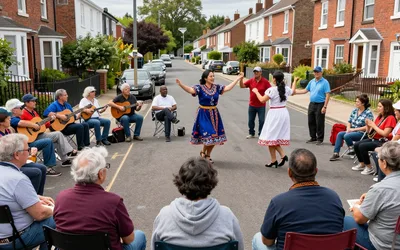
What is happening there is a Mawio'mi — the Mi'kmaq word for a gathering, the same kind of event that English speakers usually call a powwow. In Mi'kmaq culture a Mawio'mi is one of the most important social and governance institutions the people have: a time for singing, dancing, drumming, feasting, teaching, and the renewal of relationships. The listing promises stories, music, and dancing, and asks attendees to bring their own chair, which is the tell that this is a real, grassroots, outdoor gathering rather than a ticketed production. There is no admission, no capacity limit, no seating provided. You carry your own chair across the grass and you sit.
The choice of September 30 is not incidental. That is the National Day for Truth and Reconciliation, declared a federal statutory holiday in 2021 to honour the children who never returned home from Canada's residential schools, the survivors, and their families and communities. It is also Orange Shirt Day, a movement that began in 2013 in Williams Lake, British Columbia, after Phyllis Webstad recounted having the new orange shirt her grandmother bought her taken away on her first day at a residential school. In Nova Scotia the observance runs straight into Treaty Day on October 1, which marks the Peace and Friendship Treaty between the Mi'kmaq and the Crown and opens Mi'kmaq History Month. So the gathering at the museum sits at the hinge of two days: a day of mourning and a day of treaty renewal.
That the event is held on the grounds of a country music museum is less incongruous than it first appears. The Hank Snow Home Town Museum occupies the former Liverpool railway station, a building with its own long history. Construction of the Liverpool train station began, and by the new year a tri-weekly train service ran between Liverpool and Halifax; just before Christmas in 1906, the first passenger and freight train went westward to Yarmouth. The station closed in 1981 and found a second life as the museum.
The museum exists because of the Friends of Hank Snow Society, and the museum is run by volunteers and staff under the society's direction. Visitors pay admission at the original ticket counter. Inside are Hank Snow memorabilia and the Nova Scotia Country Music Hall of Fame. The building is not a random venue for a Mi'kmaq gathering, though the connection is more human than thematic. Hank Snow — born Clarence Eugene Snow in Brooklyn, Queens County, on May 9, 1914 — had a personal tie to this station. His mother worked there, and as a boy he would run to it when he was being beaten at home. It was, in a sense, a place of refuge for a child in trouble. That a building with that history now hosts a gathering devoted to remembering children harmed by institutions carries its own quiet weight, whether or not anyone planned it that way.
Snow himself became one of the most successful country artists Canada ever produced: 140 albums, more than 85 charting singles on the Billboard country charts between 1950 and 1980, a long reign at the Grand Ole Opry, and songs like "I'm Moving On," "I've Been Everywhere," and "Hello Love" that were covered by the likes of Elvis Presley and Johnny Cash. He died in 1999. The museum that bears his name is run by volunteers and staff under the Friends society, and it shares its grounds each year with events that have nothing to do with country music.
The Mawio'mi is a third-party event; the Chester municipal calendar notes plainly that it "has not been verified by the Municipality," which is standard language for community submissions. The Eastern Synod's Circle for Reconciliation and Justice has promoted a Treaty Day Mawio'mi at the same address at noon on October 1. The Second Story Women's Centre in Lunenburg, which closes its doors each September 30 to observe the day, has pointed people toward the Liverpool gathering as one of the region's ways to mark it, describing speakers, survivors, and Elders sharing lived experience alongside Mi'kmaq dancing, drumming, and singing.
That is what the hour at 11 a.m. on the museum grounds amounts to: not a spectacle but a coming-together. Elders and survivors speak. Drums sound. Dancers move on the grass. There is music, and there are stories, and there is the simple fact of people from the town and from the surrounding Mi'kmaq communities sitting in the same place on a day set aside for hard remembering. The instruction to bring your own chair is the whole ethos in miniature — nothing is provided for you, you bring what you have, and you sit down together. Anyone can come. No ticket, no registration, no gate.
For anyone trying to find it, ignore the United Kingdom postcode in the listing and look for the old railway station on Bristol Avenue in Liverpool, Nova Scotia, where the trains stopped running in 1981 and where, on the last day of September, the drums start at eleven.